

On the political chessboard of the Middle East, the struggle between power, ideology, and interest rarely remains confined to diplomatic rhetoric; rather, it directly shapes the nerves of global powers, the fragility of financial systems, and the subtle fabric of international relations. In recent years, the intellectual and strategic gulf that has emerged between two influential Islamic states of the region has highlighted this reality in a new and deeply complex manner.
On one side stands a state that has sought to cool regional tensions, manage conflicts, and align its domestic and foreign policy with economic stability and the expansion of investment. On the other side is a country propelled by ideological motivations, expansive geopolitical outreach, and the operational politics of proxy networks a role which many analysts describe as reflecting imperial-style ambitions. These contrasting trajectories are not only fragmenting the new strategic order of the region but also raising serious questions about the balance of the global system.
Regional Conflicts and Global Reverberations
According to international media and renowned research institutions, the conflicts emerging around Yemen, Sudan, and the Red Sea are no longer localized crises. Their reverberations now extend to foreign investment, global trade routes, energy supply chains, and highly sensitive diplomatic negotiations. Economic experts caution that when two states whose influence stretches from the Gulf to Africa and from the Middle East into the broader international economy stand opposed in their policy orientations, the outcome is heightened uncertainty in global markets, anxiety within regional alliances, and growing complexity in international diplomacy.
On the one hand, a conciliatory and pragmatic approach to defusing conflicts appears to be taking root; on the other, a model of ideological assertiveness and power projection through proxy structures is emerging a model capable of reshaping the balance of power across the region.
Clash of Strategic Worldviews
Political and military analysts argue that the most delicate dimension of this situation lies in the fact that it cannot be reduced to a mere diplomatic coldness between two states. It has evolved into a clash of far broader strategic worldviews. One country, over recent years, has invested in reducing tensions, prioritizing diplomatic engagement, enhancing investment-based partnerships, and safeguarding its economic vision.
In contrast, the other has been weaving a web of influence through non-state militias, parallel security networks, and ideologically aligned groups a network that now extends beyond national borders into Africa, the Eastern Mediterranean, and the Red Sea corridor. This proxy-driven model not only disrupts military equilibrium but also complicates questions of state sovereignty and regional order.
Western Concerns and Global Implications
Within American and European policy circles, this scenario has assumed the form of a serious strategic challenge for Washington and global powers alike. Numerous international reports emphasize that if these bilateral divergences continue to deepen, they may disrupt global investment flows, inject uncertainty into financial initiatives, and stall sensitive negotiations at the international level whether related to energy corridors or security cooperation. For this reason, Western decision-makers increasingly view the situation not as a routine regional disagreement, but as a potential threat to the broader balance of global power.
Historical Lessons and Proxy Confrontations
History demonstrates that when ideological self-assertion collides with pragmatic statecraft in any region, its consequences rarely remain confined to diplomatic statements. Smaller states, fragile political systems, and economically vulnerable societies are often the first to fall within the blast radius of such confrontations. The same reality is visible today in the conflicts of Yemen and Sudan, where proxy actors, competing loyalties, and external influences appear to be eroding the authority of state institutions. In this context, many experts regard the situation not merely as regional politics, but as an expression of a new global engineering of power one in which narrative warfare unfolds alongside military and diplomatic strategy with equal intensity.
Also Read: Global Outcry After Caracas Operation
Two Diverging Pathways
It is also important to recognize that this emerging tension is not moving along a single trajectory; rather, it is opening two distinct pathways simultaneously. One path emphasizes economic cooperation, investment-driven integration, regional reconciliation, and state stability; the other is defined by ideological expansion, proxy-based influence, strategic outreach, and symbolic displays of power. These parallel paths have produced what some global observers describe as the rise of a “new Islamic axis” an axis that appears to be tilting more toward rivalry than partnership, with effects now extending well beyond the region itself.
Future of Regional Stability
In this light, the real question is not which state is right or wrong; rather, it is where this new contest for power will ultimately lead the future of the region. Should diplomatic engagement recede and proxy confrontation advance to the forefront, the likely outcome would be a state of prolonged instability an imbalance capable of affecting the global economy, energy supplies, maritime security routes, and even the foundational structures of international diplomacy.
A Crossroads for the Middle East
This moment calls for sober reflection by the international community, regional leaderships, and the two powerful Islamic states at the center of this unfolding equation. History bears witness that when ideological gravitation and expansionist impulses overshadow diplomatic balance and responsible state strategy, the circle of disruption widens dramatically. Today, the Middle East stands at precisely such a crossroads where one road leads toward reconciliation, economic realism, and responsible strategic conduct, while the other points toward proxy confrontation, ideological rivalry, and the tense psychology of power politics.
The decision now rests with the region’s leaderships whether they steer history toward stability or toward confrontation for every move on this strategic chessboard extends far beyond two countries, reaching into the very nerves of the global order.




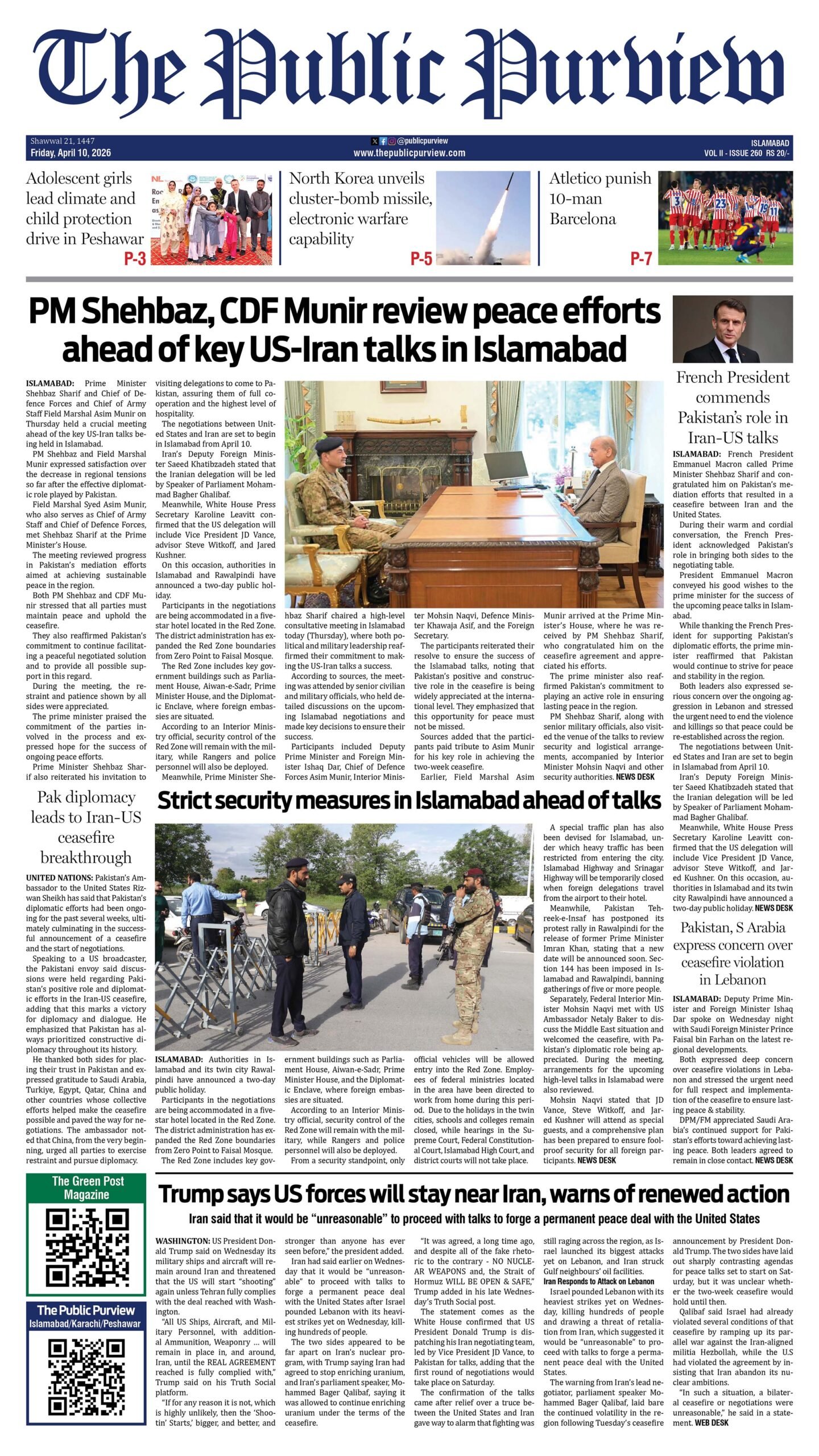 Today's E-Paper