
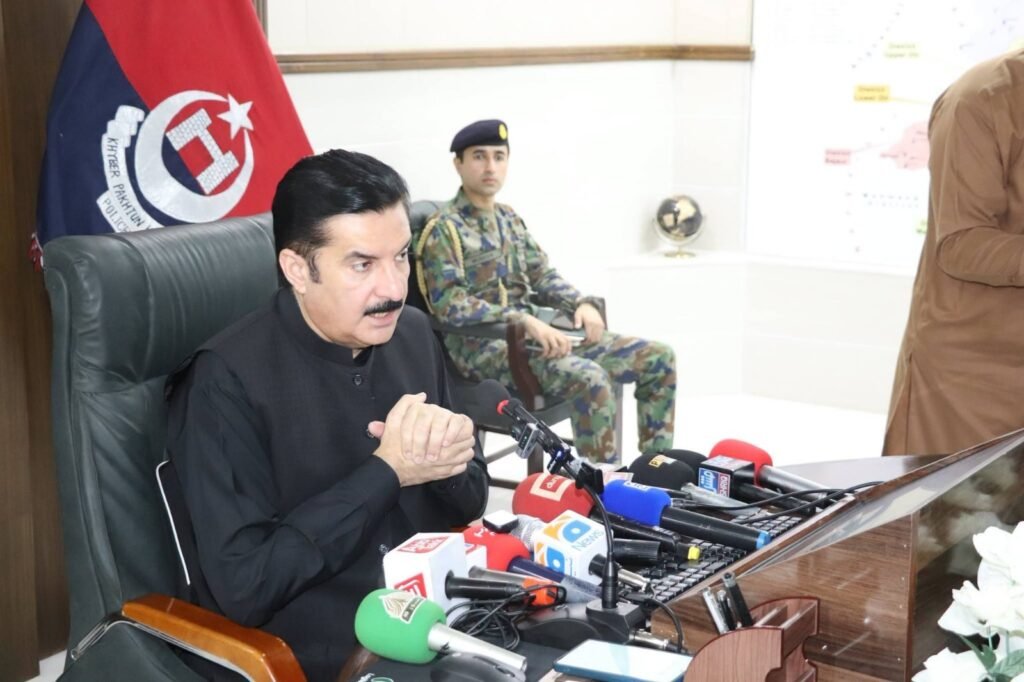
PESHAWAR, November 8, 2026: Khyber Pakhtunkhwa Governor Faisal Karim Kundi has said the provincial government sought Rs160 billion to address security challenges, a demand endorsed by the federal government, as officials outlined plans to strengthen policing, counterterrorism operations and security infrastructure across the province.
Speaking at a special security briefing at Governor House Peshawar, Kundi said restoring peace and law and order remained the province’s foremost priorities. He reaffirmed the commitment to support security forces and police in combating terrorism.
The briefing was attended by provincial advisers, senior civil officials and media representatives. Adviser on Home and Tribal Affairs Kifayatullah Khan and Home Secretary Amjad Ali Khan presented details of existing security challenges and proposed reforms.
Governor Kundi said a major Apex Committee meeting had been held in Peshawar in the presence of the prime minister and senior civil and military officials, followed by coordination meetings with the federal government in Islamabad.
He stressed that political ownership of security operations was essential and said intelligence-based operations would remain central to efforts to restore peace.
The governor also ruled out negotiations with armed groups unwilling to recognise the state, Constitution and law, reiterating a zero-tolerance policy against terrorism.
Referring to regional security concerns, Kundi alleged that Afghan territory was being used by India to support terrorism in Pakistan. He also criticised what he described as the previous government’s silence over statements by Afghan officials concerning Peshawar and alleged drone incursions.
He said decisions concerning Khyber Pakhtunkhwa’s security and governance must be made within Pakistan rather than influenced by developments in Afghanistan.
Security briefing highlights police shortages
According to figures presented during the briefing, Khyber Pakhtunkhwa Police faces a shortage of 10,587 personnel, while the Counter Terrorism Department (CTD) requires another 638 personnel.
Officials reported a 36 percent shortage of operational police vehicles, while only 12 percent of the force currently has access to anti-drone systems.
The briefing also highlighted gaps in security infrastructure in the merged districts, where the governor said no police lines had yet been established.
Officials stated that the previous provincial government allocated only 3.2 percent of the total security budget to the merged districts.
Of the Rs6.4 billion approved for rehabilitation of counterterrorism infrastructure, only Rs1 billion had been released, according to the briefing.
The participants were also informed that 15,186 former Khassadars had been integrated into the police force, with significant training and educational challenges remaining.
Security casualties and counterterrorism operations
The briefing presented figures showing that 1,003 armed forces personnel, 627 police personnel and 808 civilians lost their lives in security-related violence between 2024 and September 2026.
Of these, 255 military personnel, 302 police personnel and 304 civilians were reported killed during the first nine months of 2026.
Officials also reported that security forces had killed 3,788 militants during counterterrorism operations over the preceding three years.
The figures were presented by provincial officials during the briefing.
Rs70 billion security plan and police modernisation
Under the proposed Strong Khyber Pakhtunkhwa initiative, officials outlined a Rs70 billion security programme, including Rs59.8 billion for police and Rs10.3 billion for the CTD.
The briefing compared the proposed allocation with reported security expenditure of Rs98 billion over the previous decade.
The reform programme aims to increase police fortification to 75 percent, surveillance capacity from 15 to 60 percent and night-fighting capability from 18 to 50 percent.
Plans also include expanding anti-drone capabilities from 1 to 50 percent, increasing armoured CTD vehicles from 16 to 70 percent and improving jammer availability from 3 to 50 percent.
Officials proposed extending the CTD’s operational jurisdiction to all 34 districts and establishing District Nerve Centres and a Safe Cities Authority in 10 districts.
The government also aims to reduce the police personnel shortage from 15 percent to 5 percent.
Judicial reforms and community policing
The proposed reforms include establishing specialised counterterrorism courts with arrangements to protect witnesses and facilitate timely proceedings.
Artificial intelligence tools are also planned to identify and counter false or fabricated narratives circulating on social media.
Smart front desks are proposed for 406 police stations, while Dispute Resolution Councils and Tribal Liaison Committees would be established across districts.
Monthly open courts and regular jirgas are also planned to strengthen public engagement and improve coordination between communities and law enforcement agencies.
Governor Kundi emphasised that restoring public confidence in the police was essential for lasting peace.
He also called for improvements in police salaries, security allowances and compensation packages for families of personnel killed in the line of duty.
The governor said development projects, roads and bridges could deliver meaningful benefits only when citizens felt secure.
He stressed the importance of engaging young people in constructive activities and adopting successful security and governance initiatives from Punjab, Sindh and Balochistan.
The briefing concluded with a question-and-answer session involving the governor, Adviser Kifayatullah Khan, Home Secretary Amjad Ali Khan and Inspector General of Police Abbas Ahsan.