
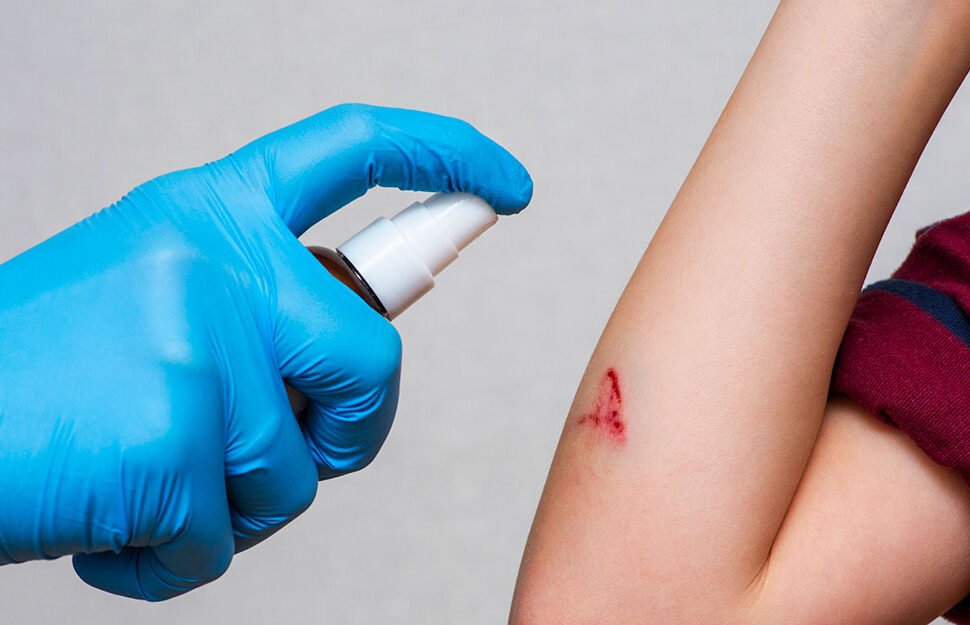
Scientists at the Korea Advanced Institute of Science and Technology (KAIST) have developed a spray that can rapidly seal severe wounds and stop heavy bleeding in less than a second, a breakthrough that could transform emergency medical care in battlefield and trauma situations.
According to the research team, the spray reacts instantly with blood, turning it into a soft, rubber-like gel that seals the wound while accelerating the body’s natural clotting process. The technology is designed for situations where rapid blood loss poses an immediate threat to life.
Also Read:
Unlike conventional field treatments that rely on bandages, gauze, or applied pressure, the spray works without compression, making it particularly effective for gunshot wounds, shrapnel injuries, deep cuts, and irregular wounds where tourniquets are difficult to use.
How the spray works
KAIST researchers said the spray is based on a powdered compound known as AGCL, made from three naturally derived components.
The first ingredient is alginate, extracted from seaweed, which quickly forms a gel when it comes into contact with liquid. Alginate is already widely used in medical dressings.
The second component, gellan gum, is produced through bacterial fermentation and helps reinforce the gel’s structure. According to the researchers, it allows the seal to withstand pressure of up to 40 kilopascals, similar to the force of a strong hand press.
The third ingredient, chitosan, derived from the shells of crustaceans and insects, carries a positive electrical charge. This property enables it to attract red blood cells and platelets, significantly speeding up the clotting process.
When combined, these materials can absorb up to seven times their own weight in blood, sealing wounds almost instantly while supporting natural healing mechanisms.
Potential military and medical use
Due to its rapid action, the spray is initially being developed for military and emergency medical use, where seconds can mean the difference between life and death. Researchers believe it could eventually be used in hospitals, ambulances, and even standard first-aid kits.
However, the technology is still in the research and development phase. Before it can be deployed in real-world settings, it must undergo clinical trials and receive regulatory approval.
Research motivation
Kyusoon Park, a member of the research team, said the project was driven by the goal of saving lives.
“The core of modern welfare is minimizing the loss of human life,” he said. “I started this research with a sense of mission to save even one more soldier. I hope this technology will serve as a life-saving solution in both national defense and civilian medical fields.”
If approved, the spray could represent a major advancement in trauma care, offering a fast, portable, and effective solution to uncontrolled bleeding.




 Today's E-Paper