
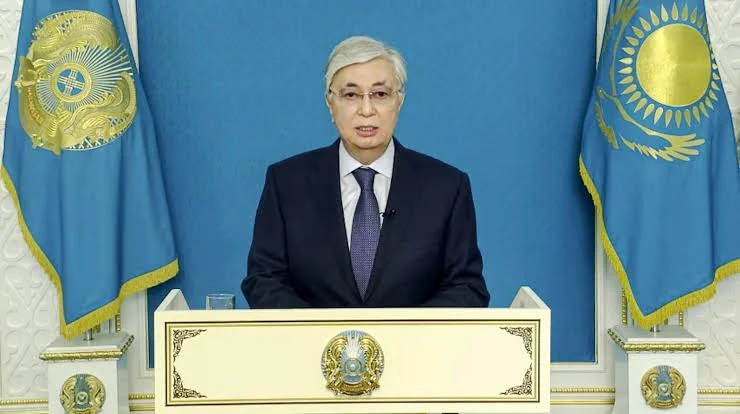
Kazakhstan President Kassym-Jomart Tokayev has announced an ambitious programme of infrastructure development, economic modernisation, energy expansion and digital transformation, pledging to strengthen national sovereignty, raise living standards and position Kazakhstan among the world’s technologically advanced economies.
Delivering his State of the Nation Address on October 28, 2026, titled “Kazakhstan’s Current Priorities in a New Historical Cycle,” President Tokayev outlined sweeping reforms covering transportation, healthcare, education, agriculture, taxation, investment and public administration.
The President announced that approximately 6.5 trillion tenge from the National Fund would be allocated through 2029 to finance infrastructure modernisation, including 1.5 trillion tenge earmarked for social projects in 2026 and the first two months of 2027.
He described the initiative, named “People’s Construction,” as the largest infrastructure development programme in Kazakhstan’s history, designed to create employment, strengthen regional economies and improve public services.
Kazakhstan Targets Major Infrastructure Expansion
President Tokayev said the government would undertake extensive construction and modernisation projects across the country, covering roads, hospitals, schools, airports, railway stations, energy facilities and public utilities.
Under the first phase, approximately 70 healthcare facilities and 50 educational, sporting and cultural institutions will be constructed.
The healthcare projects will include perinatal centres, hospitals, ambulance stations, rehabilitation facilities for children and sports centres for children with special needs.
The President emphasised that infrastructure investment must deliver measurable economic and social benefits while creating opportunities for domestic businesses.
He also proposed declaring 2027 the Year of Nationwide Large-Scale Construction, with development activities extending to every region, district and village.
Economy Expected to Approach $400 Billion
Highlighting Kazakhstan’s economic performance, President Tokayev cited International Monetary Fund forecasts indicating that the country’s gross domestic product could approach $400 billion in 2026, with GDP per capita exceeding $19,000.
According to the figures presented in his address, Kazakhstan is expected to rank 47th globally by economic size.
He said manufacturing now accounts for more than 14 percent of GDP, reflecting progress in diversifying the economy beyond traditional raw-material industries.
The combined value of Kazakhstan’s gold and foreign exchange reserves and National Fund assets has exceeded $130 billion.
President Tokayev stressed that these financial resources must support long-term national development rather than short-term spending.
Minimum Wage to Rise to 110,000 Tenge
In a major announcement for workers, the President instructed the government to increase the national minimum wage from 85,000 to 110,000 tenge, effective January 1, 2027.
The measure is expected to benefit approximately 1.8 million people, including more than 370,000 public sector employees.
He also announced salary increases of up to 40 percent for district-level primary healthcare specialists, depending on their length of continuous service.
More than 77,000 healthcare professionals are expected to benefit from the measure.
The President said improving citizens’ incomes and tackling inflation would remain central priorities of the government’s economic policy.
Kazakhstan Aims to Become Eurasian Logistics Hub
President Tokayev identified transport and logistics as major drivers of future economic growth, saying Kazakhstan must capitalise on its strategic geographical position between China and Europe.
He announced that the Bakhty–Ayagoz railway line would become operational in 2027, increasing freight capacity on routes towards China by 20 million tonnes.
The Aral–Caspian transport corridor, whose construction began in August, is expected to shorten the Trans-Caspian route by approximately 1,000 kilometres and reduce freight delivery times to three days.
The President also directed authorities to modernise border crossings, improve road infrastructure and accelerate the digitalisation of freight transportation.
He announced plans to begin constructing a modern airport in Astana in 2027, alongside the development of regional aviation facilities.
Tokayev said Kazakhstan must become a major organiser of international freight flows rather than simply serve as a transit territory.
Energy Security and Nuclear Power Development
Addressing Kazakhstan’s growing electricity requirements, President Tokayev set a strategic target of achieving a sustained electricity surplus by 2029.
He said existing generation capacity was insufficient to support the country’s industrial expansion, artificial intelligence ambitions and growing demand for data centres.
The government has been instructed to construct new power plants, modernise electricity transmission networks and expand renewable energy generation.
The President also highlighted nuclear energy as a central component of Kazakhstan’s long-term energy strategy.
He suggested that construction of the Balkhash Nuclear Power Plant could begin as early as 2027, while negotiations should advance for the proposed Moyynkum Nuclear Power Plant.
He further proposed considering a strategic uranium reserve to secure fuel supplies for future nuclear power stations.
Artificial Intelligence and Digital Economy Prioritised
President Tokayev called for accelerating the implementation of the Digital Qazaqstan strategy, with artificial intelligence playing a central role in economic modernisation.
He said two supercomputers had already been launched, while a third was expected to become operational before the end of 2026.
The President also highlighted the completion of a fibre-optic connection across the Caspian seabed and the ongoing construction of data centres.
He instructed the government to establish a simplified legal framework for digital employment and develop programmes enabling citizens, particularly rural residents, to earn income through digital platforms.
The proposed reforms also include expanding online marketplaces, supporting technology-based entrepreneurship and introducing asset tokenisation to facilitate investment.
Tokayev emphasised that digitalisation should generate practical economic benefits rather than merely automate existing administrative procedures.
Investment Reforms and Business Development
The President announced plans to strengthen Kazakhstan’s investment climate by improving coordination among government institutions and ensuring greater legal protection for investors.
He proposed establishing an Investment Court in Alatau City based on the English common law model to handle commercial disputes.
The government has been instructed to submit relevant legislative amendments by January 2027.
Tokayev also called for a comprehensive programme to support medium-sized enterprises, improve access to long-term financing and strengthen cooperation between smaller businesses and major industrial companies.
He proposed considering a three-year moratorium on inspections of micro and small businesses beginning January 1, 2027.
The President further instructed authorities to review tax legislation, reduce unnecessary administrative burdens and consider higher taxation for individuals possessing substantial wealth.
Agriculture, Water Security and Industrial Growth
Agricultural modernisation also featured prominently in the address.
President Tokayev said the agricultural sector recorded growth of nearly six percent last year, with agro-industrial output reaching 15 trillion tenge.
He called for greater investment in agricultural machinery, food processing, irrigation systems and modern farming technologies.
The President also referred to proposals for introducing artificial intelligence into agriculture to improve productivity and resource management.
Water conservation was identified as a critical national priority, with the government directed to accelerate the development of a National Water Resources Information System.
He stressed that expanding agricultural production must be accompanied by modern water-saving technologies.
In the industrial sector, Tokayev called for stronger investment in critical minerals, rare-earth metals and advanced geological exploration to strengthen Kazakhstan’s participation in global manufacturing supply chains.
Healthcare, Education and Social Protection
President Tokayev announced plans to establish eight modern perinatal centres and seven multidisciplinary children’s hospitals as part of the nationwide infrastructure programme.
He also called for improved healthcare access, stronger primary healthcare services and additional facilities for children with special educational needs.
In education, the President emphasised reducing administrative burdens on teachers and strengthening their professional protection.
He said social assistance should increasingly target citizens who genuinely require government support, while reforms must be introduced carefully to avoid hardship for vulnerable communities.
Inflation Control and Financial Sector Reforms
The President described inflation as a major threat to household incomes and called for closer coordination between the government and the National Bank.
He said Kazakhstan’s banking assets had exceeded 75 trillion tenge, while deposits had reached 52 trillion tenge.
Tokayev urged financial institutions to direct more resources towards productive investment and long-term business financing.
He also called for closer cooperation between the Kazakhstan Stock Exchange, Astana International Financial Centre and Alatau City to strengthen the national financial market.
Public Administration Reforms and National Unity
President Tokayev directed the Presidential Administration to prepare a comprehensive public administration reform plan by June 1, 2027.
The proposed changes aim to reduce bureaucracy, eliminate overlapping responsibilities and introduce artificial intelligence into government operations.
Referring to Kazakhstan’s 35th anniversary of independence, he emphasised the importance of national unity, constitutional governance and political stability.
The President warned that growing international uncertainty, geopolitical tensions and weakening trust among major powers required Kazakhstan to strengthen its economic resilience and national institutions.
He said the country’s long-term development must be guided by justice, accountability, technological advancement and respect for the rule of law.
Concluding his address, President Tokayev reaffirmed his commitment to building a “Just, Strong, Clean and Progressive Kazakhstan,” stressing that the success of national reforms would ultimately be measured by improvements in citizens’ living standards.
The address outlined a development strategy centred on infrastructure investment, industrial diversification, energy security, digital transformation and institutional modernisation, with major implementation targets extending through 2029 and beyond.