
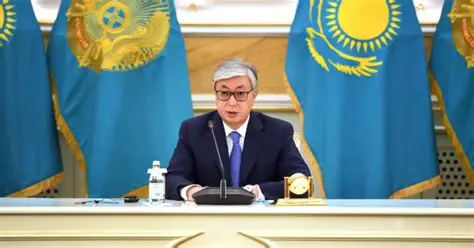
President Kassym-Jomart Tokayev has called a national referendum for March 15, 2026, asking voters to approve a draft new Constitution of the Republic of Kazakhstan that would reshape the country’s political system and institutional framework. If adopted, the new Constitution would take effect on July 1 and trigger early parliamentary changes, marking the most comprehensive constitutional overhaul since independence.
What is being proposed?
The draft Constitution is a complete replacement of Kazakhstan’s current basic law. It contains 96 articles across 11 sections and reflects what officials describe as a transition from a “super-presidential” system to a presidential republic with a stronger and more influential Parliament.
The reform goes beyond targeted amendments. A Constitutional Commission reviewed proposed changes to 77 articles—about 84% of the existing Constitution—before deciding to prepare an entirely new text.
The final draft was presented to the president in February and published for public review. If approved in the referendum, the day of adoption would become a state holiday.
Why is the referendum happening now?
The constitutional reform was first proposed by President Tokayev in his annual Address to the Nation on September 8, 2025. He outlined plans to reset the political system, including replacing the current parliamentary structure with a unicameral legislature.
In January 2026, a 130-member Constitutional Commission was formed, representing all regions and including legal experts, lawmakers, civil society representatives and members of the National Kurultai. Over 12 meetings, the commission reviewed thousands of public submissions sent through government digital platforms.
The draft was first published on January 31, 2026, by the Constitutional Court and finalized on February 12 for nationwide discussion ahead of the March vote.
How would the political system change?
A unicameral Parliament
The draft would establish a single-chamber Parliament called the Kurultai, composed of 145 deputies elected under a proportional party-list system for five-year terms.
Under the proposal, the Kurultai would gain expanded powers. It could:
-
Issue a vote of no confidence in the government by majority vote.
-
Summon ministers for reports at the request of one-third of deputies.
-
Request the president to dismiss a minister with a two-thirds majority, if the minister fails to implement laws.
-
Approve appointments of the vice president, prime minister, and certain key officials, including judges of the Constitutional Court and members of the Central Election Commission.
The proportional electoral system is intended to strengthen political parties and increase accountability through party-based representation.
A new People’s Council
The draft creates a new consultative body known as the People’s Council of Kazakhstan. It would serve as a nationwide advisory institution representing public interests.
The council would be able to propose draft laws to the Kurultai, initiate referendums, and make recommendations on domestic policy. Its detailed powers would be defined in constitutional law.
Changes to the presidency and executive branch
The Constitution would formally introduce the post of vice president. The vice president would be appointed by the president with parliamentary consent and would be barred from party membership, elected office, business activity, or other paid positions.
The president would nominate a prime minister after consultations with party factions in Parliament. The prime minister would require parliamentary approval. Government ministers would be appointed by the president upon nomination by the prime minister, following consultations with the Kurultai. The president would retain direct authority over the ministers of foreign affairs, defense and internal affairs.
A constitutional line of succession would be established: vice president, chair of the Kurultai, then prime minister.
What legal and rights protections are included?
The draft Constitution strengthens several procedural and human rights guarantees.
It explicitly constitutionalizes fair-trial principles, including the presumption of innocence, the burden of proof on the prosecution, the exclusion of illegally obtained evidence, and a prohibition on convictions based solely on confession. It also enshrines protections similar to “Miranda rights,” requiring authorities to inform individuals of the reasons for detention and their rights at the moment their liberty is restricted.
Other provisions include:
-
A ban on double jeopardy.
-
A prohibition on retroactive laws that increase liability.
-
A constitutional right to compensation for damage caused by unlawful actions of state bodies.
-
Recognition of the independence of the Human Rights Commissioner (Ombudsperson).
-
Constitutional recognition of the legal profession’s role in ensuring access to justice.
Certain rights would be designated as non-derogable, meaning they could not be restricted under any circumstances.
What does it say about digital rights?
The draft introduces explicit guarantees for personal data protection. It prohibits unlawful collection, processing, storage and use of personal data, including through digital technologies.
It also protects the confidentiality of communications and financial information, allowing restrictions only as provided by law.
What values and principles are emphasized?
For the first time, the preamble would declare human rights and freedoms as the state’s highest priority.
The Constitution reaffirms sovereignty, territorial integrity and the unitary nature of the state as immutable values. It emphasizes unity, interethnic and interfaith harmony, justice, environmental responsibility and the recognition of the people as the sole source of state power.
It defines marriage as a voluntary and equal union between a man and a woman. It also reinforces the secular character of the state and education system.
Education, science, culture and innovation are identified as strategic priorities, reflecting a shift toward human capital development.
What happens if voters approve it?
If the referendum passes on March 15, the new Constitution would enter into force on July 1, 2026.
The current Parliament would continue operating until that date. Within one month of the Constitution taking effect, the president would be required to call elections for the new Kurultai. Those elections would need to be held within two months of the announcement.
The reform would formally conclude a multi-stage constitutional review process and mark the transition to a new institutional model for Kazakhstan’s governance.



 Today's E-Paper