

Kashmir Solidarity Day is not merely a date on the calendar or a ceremonial observance; it is a living symbol of national consciousness, sustained struggle, and a collective moral commitment. It is the day when informed and conscientious people across Pakistan and around the world reiterate a fundamental truth: the Kashmir issue is not simply a geographical dispute, but a prolonged struggle of a living nation for the right to self-determination, human dignity, and basic freedoms. This day reminds us that silence is the most powerful weapon of oppression, while the voice of truth remains its most effective resistance.
History bears witness to the fact that Kashmir has long possessed a distinct civilizational, cultural, and spiritual identity. The manner in which the Kashmir dispute reached the halls of the United Nations after the partition of the subcontinent itself proves that this conflict was international in nature from the very beginning. The resolutions of the United Nations Security Council still exist, affirming the Kashmiri people’s right to decide their future through a free and fair plebiscite. Yet, tragically, the imbalance of power, global interests, and persistent diplomatic apathy have reduced these resolutions to mere words on paper.
Over the past several decades, the situation in occupied Kashmir has steadily deteriorated. Reports by human rights organizations, investigations by international media, and testimonies of eyewitnesses confirm a grim reality: extrajudicial killings, enforced disappearances, mass graves, restrictions on freedom of expression, and systematic efforts to alter the demographic structure have become routine. Particularly since August 5, 2019, the harrowing conditions imposed on the Kashmiri people have posed a piercing question to the global conscience: are human rights truly universal, or are they reserved only for the interests of powerful nations?
Kashmir Solidarity Day stands as an ethical response to this very question. It reinforces the belief that no matter how prolonged oppression may be, it has never proven permanent in the course of history. The resistance of the Kashmiri people is not the product of fleeting emotions but the manifestation of a collective consciousness transmitted from one generation to the next. Children growing up under curfews, amid gunfire and fear, still carry in their eyes the same dream of freedom once cherished by their elders. It is precisely this continuity that forms the greatest strength of any liberation movement.
For Pakistan, Kashmir is not merely a point on the agenda of foreign policy; it is a matter of ideological, moral, and humanitarian responsibility. Quaid-e-Azam Muhammad Ali Jinnah’s declaration of Kashmir as Pakistan’s jugular vein underscored the reality that this issue is not only about borders, but about regional peace, stability, and justice. Kashmir Solidarity Day renews Pakistan’s resolve that it will never abandon its political, diplomatic, and moral support for the Kashmiri people, regardless of how complex global circumstances may become.
The role of the international community in this context deserves serious scrutiny. The modern world presents itself as a champion of human rights, democracy, and the rule of law, yet in the case of Kashmir, these very principles often appear compromised by double standards. Economic interests, arms markets, and geostrategic alliances are frequently prioritized over human lives. Kashmir Solidarity Day thus serves as a silent yet powerful indictment of this global hypocrisy, reminding the world that justice loses its meaning when it becomes selective.
The media and the digital sphere have added a new dimension to this struggle. Today, Kashmiri youth are not confined to stones and slogans alone; they are using social media, documented evidence, and international platforms to make their voices heard. Despite internet shutdowns, information blockades, and systematic censorship, the inherent nature of truth is such that it ultimately finds its way through. Kashmir Solidarity Day symbolizes the continuity and resilience of that truth.
This day also compels us to reflect upon our own responsibilities. Mere slogans, banners, or one-day observances are not sufficient to fulfill the true spirit of solidarity. Genuine solidarity demands sustained awareness, continuous engagement, and practical diplomatic and intellectual efforts. Educational institutions, intellectual circles, the media, and civil society must play an active role in keeping this issue alive, so that Kashmir does not fade into a passing headline but remains a permanent question for the global conscience.
Kashmir Solidarity Day further teaches us that the struggle for freedom is not confined to physical borders alone; it is also fought on the fronts of thought, the pen, and moral conduct. It instills the courage to stand with the oppressed, to speak the truth, and to raise a voice against injustice. History testifies that when nations remain steadfast in their ethical stance, even the fortresses of power eventually begin to tremble.
Ultimately, Kashmir Solidarity Day is a day of hope hope that the sacrifices of the Kashmiri people will not be in vain; hope that the darker the night of oppression, the closer the dawn of justice; and hope rooted in the conviction that the collective voice of humanity will one day open those closed doors behind which an entire nation awaits its freedom.




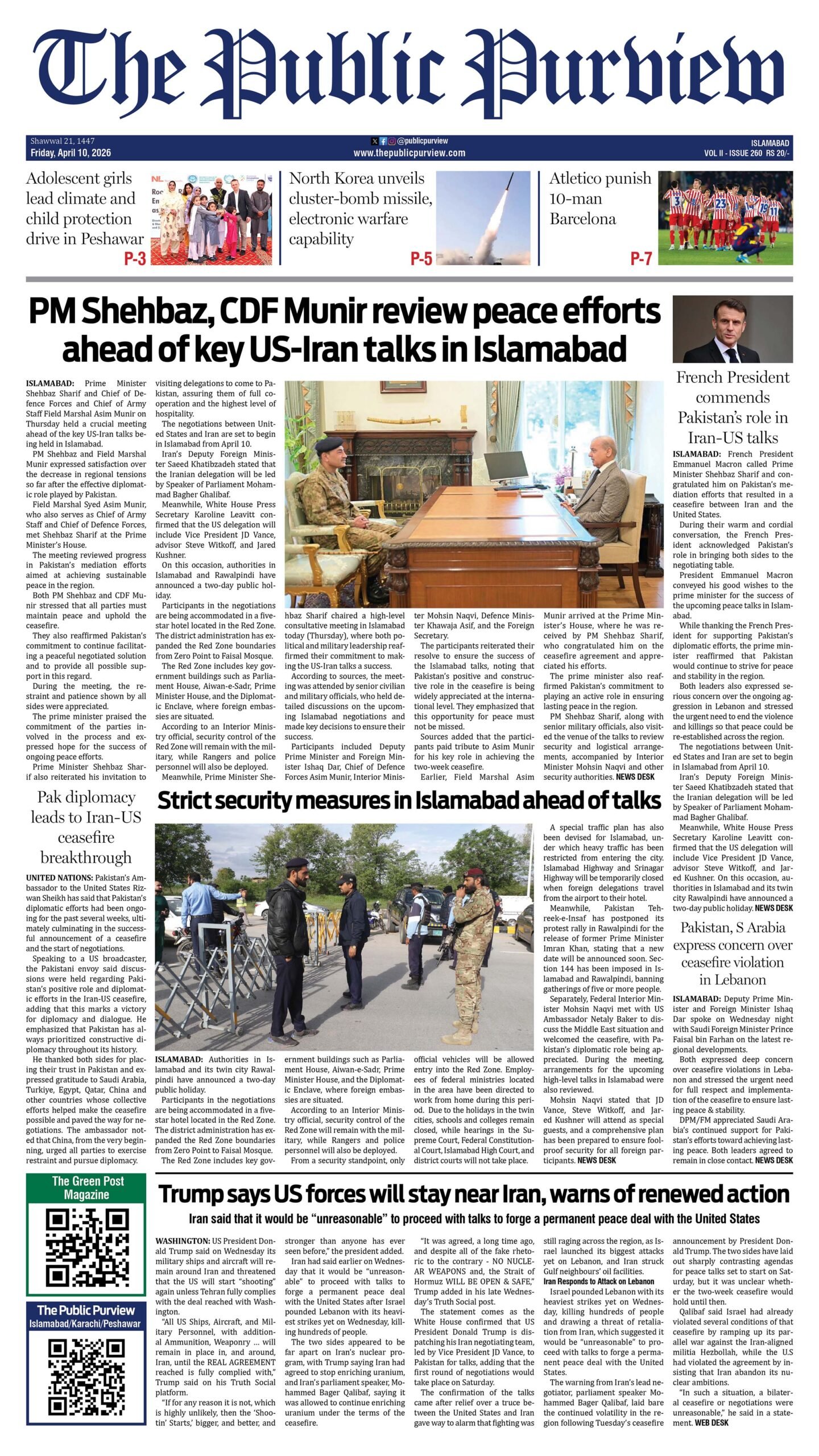 Today's E-Paper