

Once, the streets of Kabul echoed with the thunder of American helicopters and the roar of artillery. Today, the same alleys witness Chinese engineers, businessmen, and diplomats mapping out roads, mines, and economic corridors. History has delivered an ironic twist: a land that endured decades of war is now being courted not by tanks and drones, but by commerce, strategy, and cautious diplomacy.
The recent escalation along the Pakistan–Afghanistan border reminded the region that volatility is never far. Military exchanges, cross-border strikes, and retaliatory rhetoric had once again brought the specter of conflict to the forefront. In such moments, nations often act on impulse, letting emotions dictate policy. But impulses, however fiery, rarely secure lasting peace. Strength, in its truest form, is not just the ability to strike—it is the discipline to stop.
Pakistan, an atomic power and a nation with a long history of counter-terror operations, understands this truth profoundly. Thousands of lives lost, economic disruption, and social trauma have shown that the cost of unbridled military action is immeasurable. More importantly, it has taught the nation that power is not measured solely in gunfire, but in the judicious restraint that follows achieving a targeted objective.
If an operation succeeds in neutralizing a specific threat, continuing the barrage serves no strategic purpose. The mission’s goal is precise; perpetuating conflict only breeds cycles of revenge and instability. History is replete with examples of states that faltered not due to weakness, but due to the failure to curb force at the right moment.
At this delicate juncture, Pakistan must act as a mature state. Once objectives are met, guns must fall silent, and diplomatic doors must swing open. Millions live along the border, ordinary people whose lives are upended by every skirmish. For them, war is not a debate—it is destruction.
Afghanistan itself has endured decades of relentless conflict. Soviet invasions, civil wars, U.S. intervention, and a sudden withdrawal have left its society fragile, its infrastructure shattered, and its people weary. Entire generations have known only instability. The departure of American forces created a vacuum that was immediately felt across the region. That void is now the space where diplomacy and commerce can make a decisive mark.
It is in this vacuum that China has quietly extended its influence. Beijing’s strategy has historically favored economic engagement over military confrontation. In Kabul, Chinese presence signals not aggression but opportunity. Mines, roads, infrastructure, and trade—these are the instruments through which influence is now exerted. Afghanistan’s wealth of minerals, from lithium to copper, represents not only economic potential but a chance for stability.
Here lies Pakistan’s critical diplomatic opportunity. The China–Pakistan relationship is not mere formality; it is decades-old trust and partnership in economic and strategic ventures, exemplified by the China–Pakistan Economic Corridor. Simultaneously, Afghanistan welcomes China’s engagement for its development needs. By leveraging this trust, Pakistan can encourage Beijing to act as a calming, stabilizing bridge, replacing hostility with confidence, and confrontation with cooperation.
The region, at this moment, needs commerce more than gunpowder. Roads, ports, energy, and mining projects can transform deserts of conflict into landscapes of progress. Pakistan must recognize that Afghanistan’s stability is intrinsically linked to its own. A thriving, peaceful neighbor is a strategic asset; a faltering one is a perpetual source of tension.
Yet, in all of this, national pride cannot be compromised. Pakistan must not appear weak, nor should Afghanistan feel humiliated. The art of diplomacy lies in ending confrontation while preserving dignity on both sides. When nations negotiate with honor, the doors to sustainable solutions open wider.
In such moments, the voice of BabaTall resonates quietly in my mind. He always says:
Bachha! Bravery is not in keeping your sword drawn at all times.
Bravery is in sheathing it at the right moment and turning an enemy into a neighbor.
BabaTall’s simple wisdom contains profound truth: the true test of power is not in the battlefield but in the restraint that follows. Many wars are won; few achieve lasting peace.
This is precisely the challenge before Pakistan and Afghanistan today. If both nations act with prudence, they can transform this crisis into a historic opportunity. Border tensions can be replaced by cooperative mechanisms, economic collaboration, and regional engagement. China’s presence can be a vital conduit, helping Kabul channel its energies into construction rather than confrontation.
In the words of the Qur’an:
“And if they incline to peace, then incline to it [also] and rely upon Allah. Indeed, it is He who is the Hearing, the Knowing.” (Surah Al-Anfal 8:61)
This verse reminds leaders that when the path of peace presents itself, it must be embraced with faith, strategy, and decisiveness.
The Prophet Muhammad ﷺ said:
“The strong person is not the one who overpowers others in wrestling; rather, the strong person is the one who controls himself in anger.” (Sahih al-Bukhari, Hadith 6114)
These words echo the very principle Pakistan must follow: the might to strike is not as valuable as the wisdom to restrain.
A poetic couplet, echoing the ethos of our region, lingers in my thoughts:
“The sword may cleave the night, but the pen builds dawn;
True victory lies where silence sings, not where cannons roar.”
The streets of Kabul still carry memories of past battles—ruined buildings, wounded generations, and weary eyes that have seen too much. Yet, the historical moment now offers a new trajectory. If America’s guns departed, China’s roads and workshops have arrived. This is a chance for a new chapter, where commerce and collaboration replace artillery.
Pakistan must seize this opportunity. Once military objectives are achieved, guns must fall silent. Diplomacy must lead, and China, as a trusted partner, can help spread the fragrance of brotherhood through the corridors of Kabul. Only through such calibrated restraint can this conflict’s cycle be broken.
BabaTall’s voice returns, gentle yet firm:
Bachha! Wars burn cities,
but markets and roads build them anew.
Perhaps now it is time to let Kabul’s corridors smell not of gunpowder but of cooperation, trust, and the quiet dignity of nations choosing wisdom over vengeance.


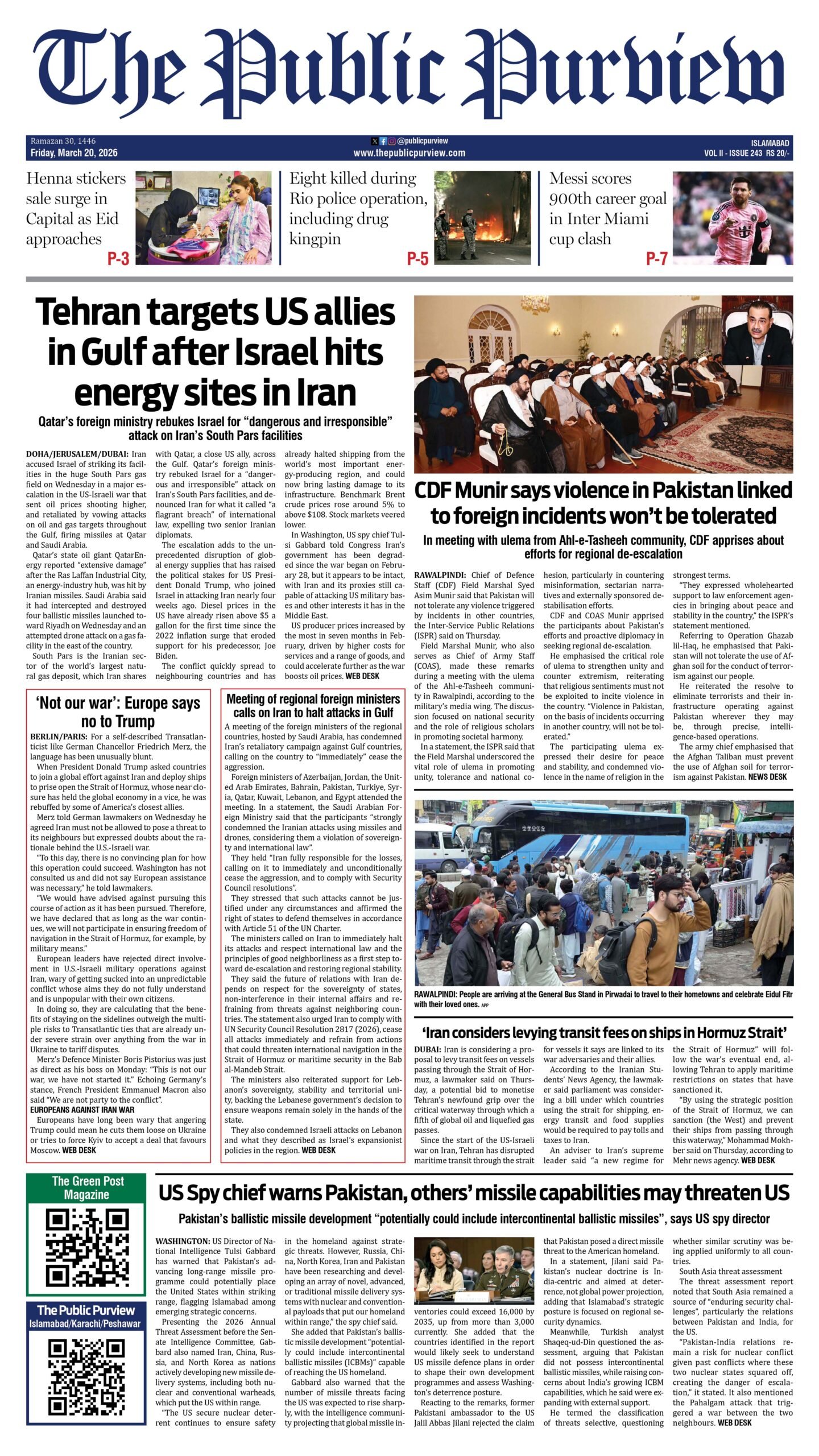 Today's E-Paper