

By Dr. Faheem
“The inception of the new year witnesses that history repeats itself. However, the interests, trends, and tools transform with the passage of time. Currently, territory, ideology, power, and resources are the main factors that induce states into wars. Israel-Palestine, Pakistan-India, and US-Middle East rivalries clarify the above statement. It is proven that international institutions of peace, treaties, and justice cannot make states devoid of wars.
Currently, the America-USA nexus and their attack on Iran and the martyrdom of Iranian supreme leader Ali Khamenei have propagated a wave of fear and ignited curiosity about future dynamics.
Iran confirms death of Ayatollah Ali Khamenei in US-Israel strike
Although no one can deny the fact that America has taken part as an ally of Israel just to ensure its dominance over Iran’s natural resources, regime change is only a means to an end. But Trump’s approach to changing his dream into reality is totally erroneous and evil.
As the deceased Khamenei appears to be more powerful in death than in life, the funeral prayers, large protests across the world, and condolences from heads of state to Iran prove that regime change at this moment is out of the question. For regime change, the fulfillment of a few factors is essential: firstly, a large number of citizens protesting against the leader; secondly, a strong party with an opposing ideology; and thirdly, a huge number of supporters of that party leading to regime change in any state. The French Revolution, Iranian Revolution in 1979, fall of Bashar al-Assad’s regime, and the exile of Sheikh Hasina justify the criteria for regime change.
Now that America has realized regime change in Iran is not a piece of cake, they have changed their stance, stating in last night’s conference that regime change was not an objective of war. Still, the future cannot be predicted based on current circumstances. The reaction and response of these countries and their allies will shape future dynamics.
However, the analysis of this war clarifies a few assumptions. Firstly, it can be said that the world is reverting to nationalism, making allies, friends, and foes based on interests rather than emotions. The UK Prime Minister Keir Starmer stated that the UK will not join offensive strikes, although Trump showed grief over the UK’s non-intervention in the war. Russia and China, Iran’s closer allies, did not intervene directly against America, justifying that states limit their relations to intact their interests.
Secondly, technology plays a crucial role in power politics; the more technology, the more powerful. Based on technological dominance, America and Israel claim Iran is an easy victory, though it may take time. Thirdly, America’s unipolar world order may continue for years through hard power. This war may stop very quickly in the near future but will leave certain implications. Religious-based extremism, terrorism, inflation, and political instability are inevitable.
So, it’s high time for Pakistan, specifically as a neighboring country of Iran, to prepare itself to face new post-war emerging challenges.”



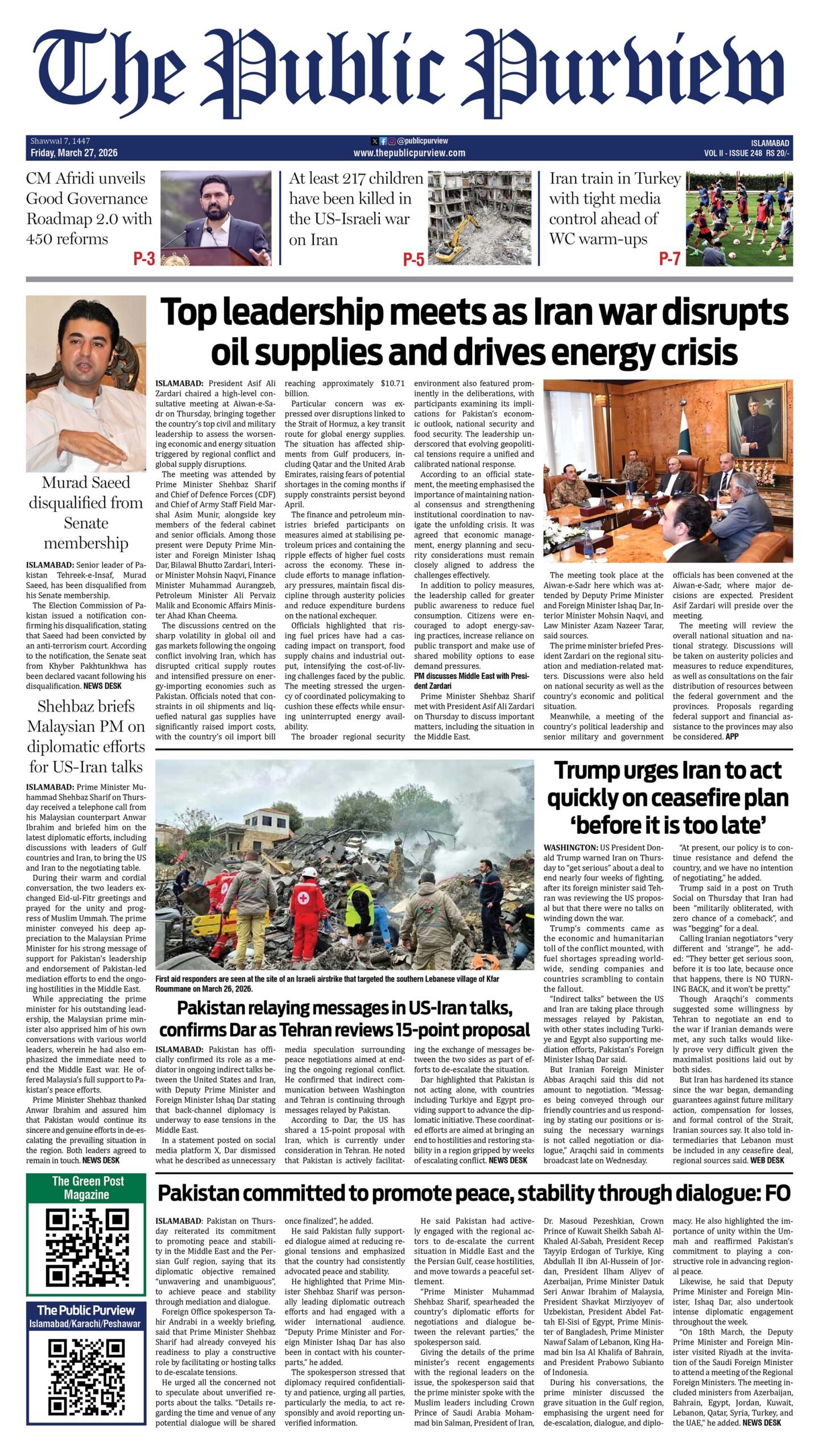 Today's E-Paper