
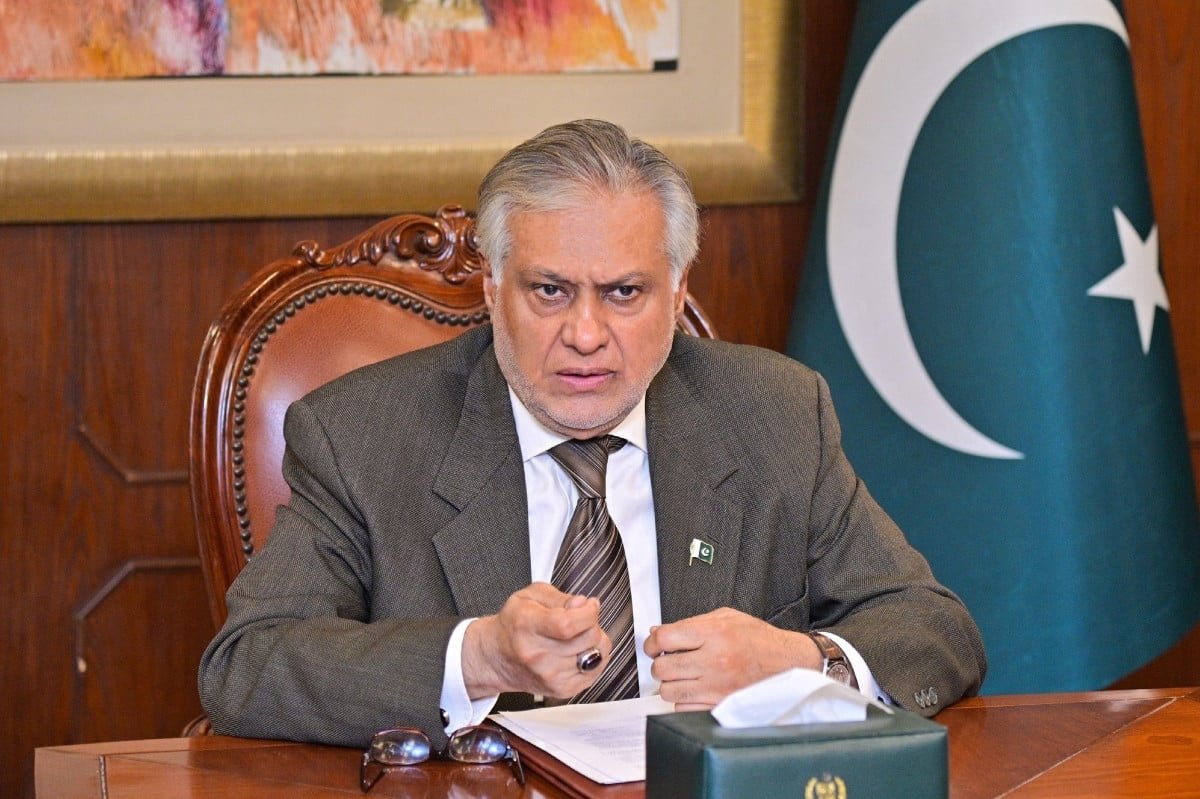
ISLAMABAD, August 9, 2026: Deputy Prime Minister and Foreign Minister Senator Ishaq Dar has said the Makkah Joint Defence Agreement signed by Pakistan, Saudi Arabia and Türkiye is a purely defensive arrangement aimed at strengthening collective security rather than targeting any country.
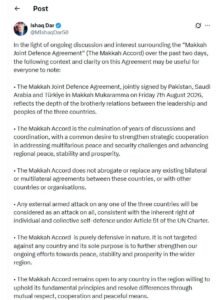
In a detailed statement posted on X amid growing regional and international interest in the accord, Dar said any external armed attack on one of the three signatory states would be treated as an attack on all three, in line with the right to individual and collective self-defence under Article 51 of the United Nations Charter.
The agreement was signed by Prime Minister Shehbaz Sharif, Saudi Crown Prince and Prime Minister Mohammed bin Salman, and Turkish President Recep Tayyip Erdoğan at Al-Safa Palace in Makkah on Friday, August 7.
According to the official joint statement, the accord seeks to strengthen collective deterrence against aggression and expand defence cooperation among the three countries.
https://x.com/i/status/2086390289036611929
Accord Not Directed Against Any Country
Dar rejected suggestions that the agreement was aimed at a particular state or designed to create an aggressive military bloc.
“The Makkah Accord is purely defensive in nature,” he said, adding that its sole purpose was to reinforce efforts for peace, stability and prosperity across the wider region.
He said the agreement reflected the depth of longstanding ties between the leadership and people of Pakistan, Saudi Arabia and Türkiye and was the result of years of discussions, coordination and shared strategic planning.
The foreign minister said the three countries had a common desire to address complex peace and security challenges while promoting regional stability and economic prosperity.
Turkish officials have also stressed that the agreement does not target Iran or any other country. Turkish Foreign Minister Hakan Fidan said assistance under the pact would be determined through consultations among the member states if an attack occurred.
Existing Agreements to Remain in Place
Dar clarified that the new trilateral agreement would neither cancel nor replace existing bilateral or multilateral arrangements involving Pakistan, Saudi Arabia or Türkiye.
He said the pact would operate alongside the three countries’ current defence relationships and international commitments.
This provision is significant because Türkiye remains a member of NATO, while Pakistan and Saudi Arabia maintain separate defence and strategic partnerships with several regional and global powers.
Dar’s clarification appeared intended to address speculation that the new accord could disrupt the signatories’ existing alliances or compel them to abandon established security frameworks.
Membership Open to Other Regional Countries
The deputy prime minister said the Makkah Accord would remain open to countries in the region that support its principles and are willing to resolve disputes through cooperation, mutual respect and peaceful means.
The provision could allow the agreement to expand beyond its three founding members, although no additional country has formally joined so far.
Türkiye has publicly supported the possible expansion of the arrangement. Fidan said Egypt was among the countries that could potentially become a member, subject to the resolution of technical matters.
However, Dar’s statement indicated that participation would be conditional on adherence to the accord’s defensive purpose and commitment to peaceful dispute resolution.
‘Attack on One Is Attack on All’
The agreement’s most consequential provision is its collective-defence clause, under which an armed attack against Pakistan, Saudi Arabia or Türkiye would be considered an attack against all three countries.
The official joint statement described the agreement as an effort to strengthen collective deterrence and enhance all areas of defence cooperation among the three states.
While the provision has drawn comparisons with NATO’s Article 5, the operational details of the pact, including the nature and scale of any joint response, are expected to be determined through consultation among the member countries.
Fidan said the alliance would initially take “humble but concrete steps,” with a ministerial committee and a general secretariat expected to be established as part of its institutional structure.
Pakistan Reaffirms Commitment to Regional Peace
Dar said the agreement was consistent with the central principles of Pakistan’s foreign policy and reflected Islamabad’s commitment to peaceful conflict resolution.
He said Pakistan would continue working with brotherly regional countries to build a more secure, stable and prosperous future for their people.
The foreign minister added that Islamabad remained committed to diplomacy, cooperation and the peaceful settlement of disputes.
The agreement was formally announced following the Makkah Al-Mukarramah Summit for Joint Defence, where the three leaders reviewed bilateral and trilateral relations and discussed issues of mutual interest. The joint statement said the pact was intended to promote peace, security and stability within the region and beyond.
The latest clarification comes as the agreement attracts close attention across the Middle East, South Asia and Western capitals over its potential implications for regional security and future defence cooperation.
Also Read: Erdoğan Says Makkah Defence Pact Is Not Against Any Country, Open to Friendly States