
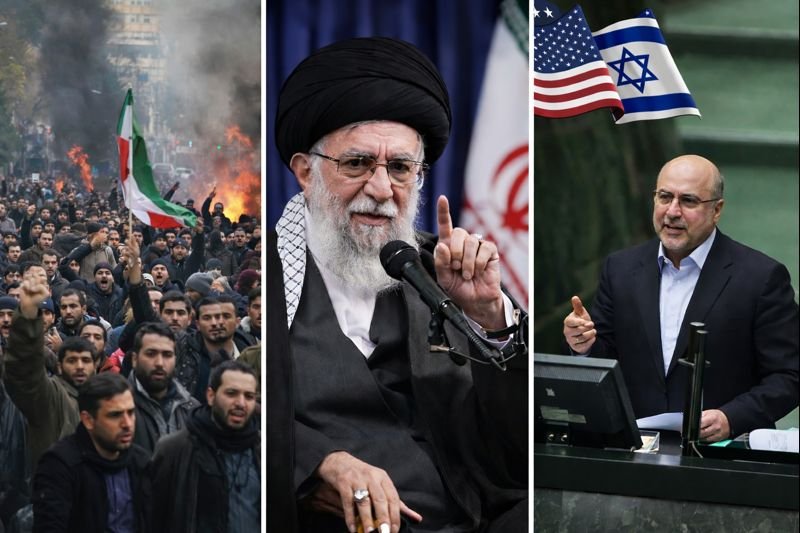
TEHRAN: Iran has warned the United States that any military action against the country would trigger retaliation against Israel and US military bases across the region, as tensions escalate amid nationwide protests and a sharp exchange of rhetoric between Tehran and Washington.
The warning was issued by Iran’s parliament speaker Mohammad Baqer Qalibaf, who told lawmakers that US bases and Israel would be considered “legitimate targets” in the event of an attack, according to Reuters. The statement comes as Israel remains on heightened alert over the possibility of US involvement linked to unrest inside Iran.
The escalation follows strong remarks by Iran’s Supreme Leader Ayatollah Ali Khamenei, who accused the United States and President Donald Trump of fueling protests to destabilize the country. Khamenei condemned Trump’s public support for Iranian demonstrators, describing protesters as acting to “please Washington” and alleging that US actions were responsible for Iranian casualties in recent conflicts.
Protests and official response
The protests began over inflation, rising living costs, and economic hardship, but quickly evolved into political demands for leadership change. Iranian authorities say the unrest is being exploited by foreign powers, while acknowledging that sanctions and economic pressure have deepened public frustration.
International media reports say Khamenei has vowed that Iran will not back down, warning that security forces would respond firmly to what he described as sabotage and vandalism. He has repeatedly framed the demonstrations as part of a broader external plot against the Islamic Republic.
Rising regional tensions
The sharp rhetoric has heightened concerns across the Middle East, where US forces and allies are already on alert. Israeli officials have warned of possible spillover effects if the crisis escalates, while Iranian leaders have linked domestic unrest to wider regional confrontations involving Israel and the United States.
Analysts note that the situation is volatile because it combines internal dissent with long-standing geopolitical rivalries, increasing the risk of miscalculation.
Decades of strained relations
The current standoff is rooted in decades of strained relations between Iran and the United States. Ties were irreparably damaged in 1953 when the CIA helped overthrow Iran’s elected prime minister Mohammad Mossadegh, restoring the US-backed monarchy.
Also Read: Khamenei rebukes Trump as Iran protests intensify
After the 1979 Islamic Revolution, led by Ayatollah Ruhollah Khomeini, Iran cut diplomatic ties with Washington following the US embassy hostage crisis. Relations have since been shaped by sanctions, proxy conflicts, and disputes over Iran’s nuclear programme.
Although the 2015 nuclear agreement briefly eased tensions, relations deteriorated again after the US withdrew from the deal in 2018 and reimposed sweeping sanctions. Subsequent years saw rising military tensions, stalled diplomacy, and renewed economic pressure on Iran.
Why it matters
The latest confrontation highlights the fragility of Iran’s internal stability and the high geopolitical stakes surrounding the protests. For the wider region, including Pakistan, prolonged unrest or military escalation could affect border security, energy markets, and regional trade routes.
As protests continue and warnings harden, the crisis underscores how quickly domestic unrest in Iran can intersect with broader regional and international tensions.



 Today's E-Paper