
HARBIN: China’s leading grain-producing province, Heilongjiang, is expanding contract farming to raise agricultural returns, using traceability, customized production, and scaled partnerships to link farmers more closely with high-end buyers.
Officials and companies say the approach—often referred to as customized or contract farming—allows producers to tailor crops and livestock to client specifications while improving quality control and price realization. The model is gaining traction across Heilongjiang’s major agricultural zones, including rice, beef, and other value-added products, at a time when the province is seeking to sustain yields and lift farm incomes.
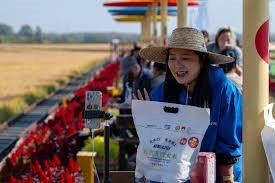
In Wuchang, a city administered by Harbin and known for premium rice, firms such as Qiaofu Dayuan Agricultural Co., Ltd. are dedicating large tracts of land to contract orders. Each rice bag carries a QR code that enables buyers to trace production from seed selection and planting to processing and delivery, a system designed to verify standards agreed with clients.
Company managers said more than two-thirds of their rice acreage in Wuchang’s core growing area is assigned to custom orders, largely for restaurant chains in southern and eastern China. To maintain quality, the company combines ecological duck–rice farming with smart agriculture tools, while marking individual plots with client names to ensure compliance.
The contract model is also spreading to livestock. In Sunwu County, Heilongjiang Hei Zun Niu Industrial Management Group Co., Ltd. supplies customized beef cuts to restaurants and premium retailers through a fully tracked cold-chain system. Company representatives said preferences for cuts and marbling are agreed in advance, with low-temperature processing used to preserve quality.
Provincial data show the expansion is occurring against a backdrop of record output. Heilongjiang produced about 82 million tonnes of grain in 2025, marking its 22nd bumper harvest and its 16th consecutive year as China’s top grain-producing region. To secure returns alongside high yields, the province has encouraged new production and marketing models.
According to the provincial agriculture department, 310 businesses were engaged in custom farming in 2025, covering more than 92,000 hectares and generating sales of about 5.05 billion yuan ($725 million). Officials said the model delivered roughly 1.35 billion yuan in additional income and is being extended beyond rice to corn, soybeans, fruits, vegetables, livestock, and fisheries.
Authorities said the aim is to move contract farming from pilot projects to a more organized, scalable system that improves traceability, stabilizes demand, and supports long-term income growth for producers.





 Today's E-Paper