
The politics of the Middle East stand at a critical crossroads. In recent years, wars, proxy conflicts, and rapidly shifting global power dynamics have compelled Gulf states to recognize that long-term security cannot rely solely on external powers. In this context, the proposal put forward by former Prime Minister of Qatar, Hamad bin Jassim bin Jaber Al Thani, has sparked an important debate. He has suggested that Gulf states consider establishing a collective defense alliance through the Gulf Cooperation Council, functioning in a manner somewhat similar to the North Atlantic Treaty Organization.
This proposal is not merely a theoretical idea but rather a logical response to evolving regional realities. Over the past decade, the Middle East has experienced a series of wars and political crises that have exposed the fragmentation and ineffectiveness of the current Arab defense framework. Gulf states possess immense financial resources, yet in terms of military technology, defense industry development, and strategic autonomy, they remain heavily dependent on Western powers. This gap could potentially be addressed through a new regional alliance.
Naturally, Saudi Arabia would likely serve as the central pillar of such an alliance, given its political and military weight within the Gulf. If it were joined by Qatar, United Arab Emirates, Kuwait, Bahrain, and Oman, a cohesive regional security structure could begin to emerge. However, the true strength of such an alliance would become evident with the participation of two major military powers of the Muslim world: Pakistan and Turkey. The inclusion of Egypt would further reinforce its political legitimacy across the Arab world.
In the present global environment, Israel’s military superiority—combined with unwavering Western support—has significantly altered the balance of power in the region. Although organizations such as the Arab League were established to foster cooperation, they have never evolved into an effective collective defense mechanism. Internal rivalries, geopolitical competition, and proxy conflicts have historically prevented meaningful military integration among Arab states. As a result, the region has remained strategically fragmented, allowing external powers to exert significant influence over its security dynamics.
Under these circumstances, the need for a structured and coordinated defense alliance has become increasingly evident. Such an alliance should not be designed to provoke new conflicts, but rather to establish a credible deterrence framework capable of maintaining regional stability. If Gulf capital, Turkish military technology, and Pakistani defense expertise were integrated into a unified strategic platform, the resulting alliance could become a powerful force not only in the Middle East but across the broader Muslim world.
In this context, Pakistan could play a pivotal role. Pakistan’s armed forces are widely recognized for their professionalism, and the country possesses significant capabilities in missile technology, drone development, and defense production. In recent years, Pakistan has strengthened military cooperation with Gulf states and Turkey through training programs, joint exercises, and strategic consultations. Should a comprehensive defense alliance emerge, Pakistan could serve as a key contributor in the fields of intelligence coordination, military training, and defense manufacturing.
Similarly, Turkey has made remarkable progress in developing its defense industry over the past decade. Turkish advancements in drone warfare, naval systems, and electronic warfare technologies have established it as a rising military power. When combined with Gulf financial resources and Pakistani operational experience, Turkish technological capabilities could form the backbone of a self-reliant defense ecosystem within the Muslim world.
However, one critical question surrounding this proposal concerns the role of Iran. The current concept does not include Iran as part of the potential alliance, largely due to longstanding political differences and geopolitical sensitivities. Nevertheless, it is equally clear that sustainable peace in the Middle East cannot be achieved by completely isolating Iran. Despite years of severe economic sanctions, Iran has made considerable progress in defense technology and military capability development. Therefore, any emerging regional security architecture must seek to maintain a balance—prioritizing diplomatic engagement and strategic stability rather than confrontation.
History also demonstrates that one of the greatest weaknesses of the Arab world has been internal division. At various points, regional rivalries have escalated into proxy wars, placing different blocs of the Muslim world in direct or indirect confrontation with each other. In many cases, external powers exploited these divisions for their own strategic advantage. It is precisely this historical experience that now compels the region to reconsider its security architecture.
If Gulf states genuinely wish to establish an effective defense alliance, their cooperation must extend beyond traditional military coordination. It should also encompass defense industrial collaboration, cyber security, intelligence sharing, and joint training structures. Furthermore, an institutional platform must be created to guide policy formulation and oversee the practical implementation of collective security initiatives.
It is also important to recognize that the current international system is gradually evolving toward a multipolar order. In such an environment, states and alliances capable of ensuring their own security and strategic autonomy will wield greater influence. The Muslim world does not lack resources; rather, it has historically lacked strategic coordination and sustained political will. If these elements can be brought together, a strong regional defense alliance is not only possible but potentially transformative.
Ultimately, the real question is not whether such an alliance can be created, but whether the Muslim world is prepared to learn from the divisions and weaknesses of its past. If the Gulf states, together with Pakistan, Turkey, and Egypt, move forward with a shared strategic vision, the coming years could witness the emergence of a defense bloc capable of providing stability, deterrence, and strategic balance across the Middle East and the broader Muslim world.
The Strategic Reset of the Gulf: The Need for a Collective Defense Alliance in the Muslim World





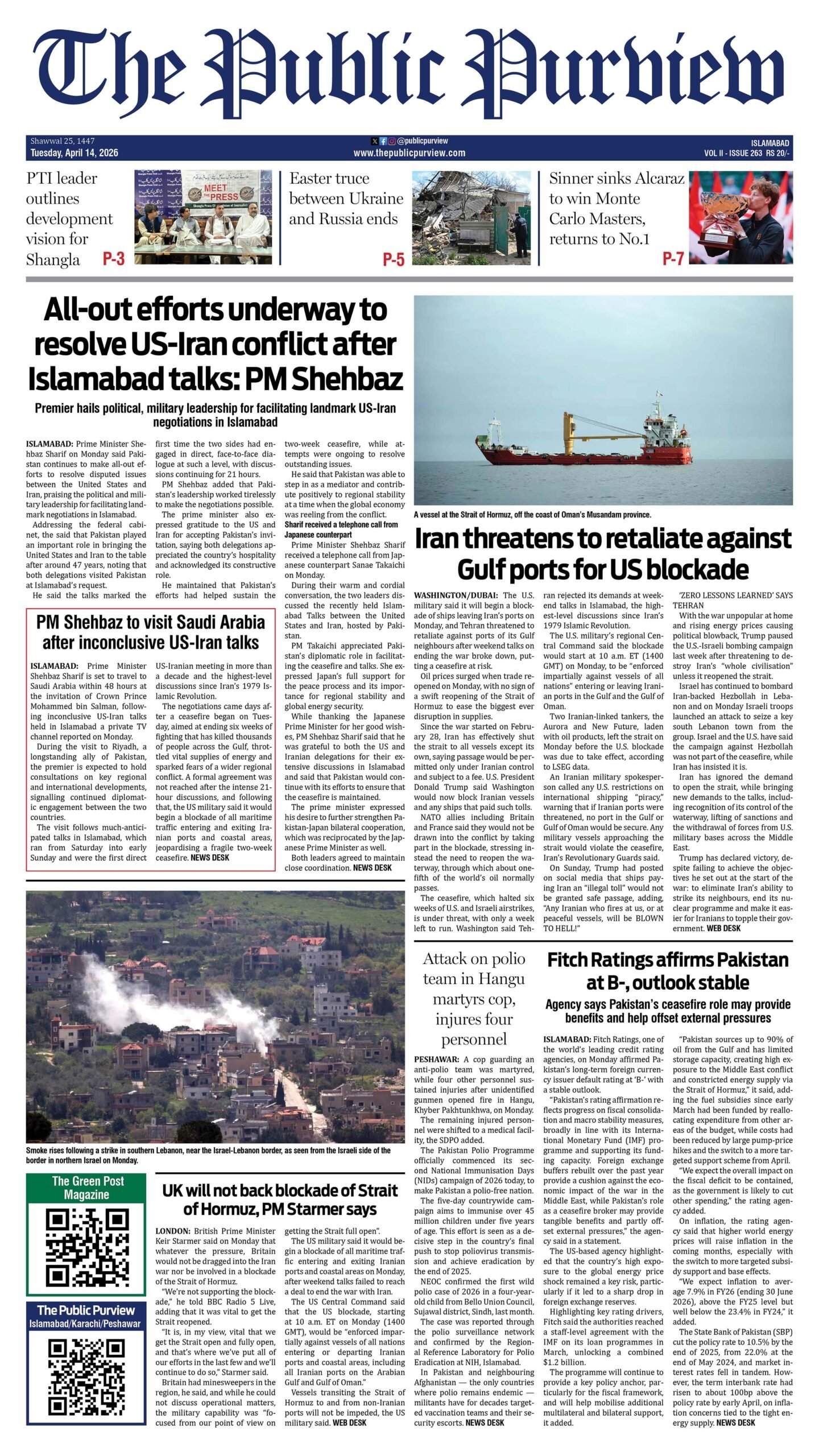 Today's E-Paper