
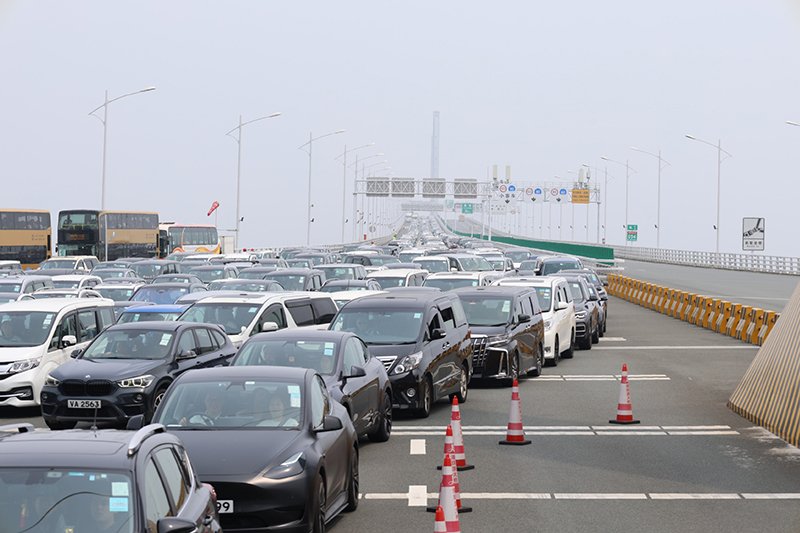
GUANGZHOU: Major cross-boundary transport links in the Guangdong–Hong Kong–Macao Greater Bay Area (GBA) have surpassed key passenger milestones, underscoring the region’s growing connectivity and integration of infrastructure, rules, and people-to-people exchanges.
The Zhuhai land port of the Hong Kong-Zhuhai-Macao Bridge has handled more than 100 million inbound and outbound passenger trips since opening to traffic in 2018, authorities said. The milestone follows the Hong Kong section of the Guangzhou-Shenzhen-Hong Kong Express Rail Link reaching its 100-millionth passenger trip.
Faster travel reshapes daily movement
The expanding transport network has significantly reduced travel times across the GBA. A high-speed train from Guangzhou South Station to Hong Kong’s West Kowloon Station now takes under 50 minutes at its fastest, while the journey from Shenzhen’s Futian Station to West Kowloon is about 15 minutes.
According to MTR Corporation Chief Executive Officer Jeny Yeung Mei-chun, sustained record passenger numbers on the Hong Kong rail section reflect growing cross-boundary movement driven by deeper integration between the mainland and Hong Kong.
Also Read: Chinese automaker empowering consumer choice and innovation
The Hong Kong-Zhuhai-Macao Bridge has cut travel time between Hong Kong and Zhuhai or Macao from about three hours to roughly 45 minutes. Officials at the bridge’s border checkpoint said it took more than five years to reach the first 50 million passenger trips, but only one year and eight months to add the next 50 million.
Infrastructure and policies working together
Six major river or sea-crossing passages are now operational across the GBA, forming a network that supports integrated regional development. Officials say these projects, combined with policy measures, are helping turn the region’s “one-hour living circle” into reality.
Erik Yim Kong, a member of the Legislative Council of the Hong Kong Special Administrative Region, said the two landmark cross-boundary projects have facilitated the flow of talent, capital, and innovation, accelerating the integration of urban functions and industrial chains across the region.
Policy measures have also streamlined border procedures. Smart clearance systems using facial recognition and fingerprint verification have been introduced at major ports, including Gongbei Port between Zhuhai and Macao and Shenzhen Bay Port between Shenzhen and Hong Kong, reducing clearance times to seconds.
Growing exchanges across the region
Residents say improved infrastructure and simplified procedures have made cross-boundary travel part of daily life, supporting work, shopping, and family visits. Officials in Hong Kong have also highlighted ongoing rail projects aimed at further integrating metro networks between Hong Kong and Shenzhen.
Authorities and observers say the combination of modern infrastructure and facilitative policies is strengthening economic links and social ties across Guangdong, Hong Kong, and Macao, reinforcing the Greater Bay Area’s integrated development.





 Today's E-Paper