
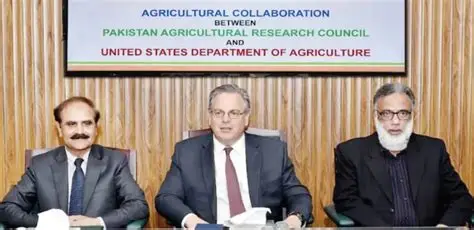
The Government of Sindh and the United States Department of Agriculture (USDA) have announced an $80 million investment to expand school feeding in the province, launching the Sindh School Meals Program to provide daily meals to more than 200,000 primary school students. The initiative is funded under the McGovern-Dole International Food for Education and Child Nutrition Program and will be rolled out across nearly 1,300 schools.
The program was formally launched on February 17 in Karachi.
What is the Sindh School Meals Program?
The Sindh School Meals Program is a six-year initiative designed to improve child nutrition and support school attendance and learning outcomes.
It will provide daily cooked meals at school and take-home rations using U.S.-supplied commodities, including fortified wheat, pulses and vegetable oil. Fresh produce will also be sourced locally within Sindh.
The $80 million funding comes from the USDA through the McGovern-Dole program, which supports school feeding and child nutrition projects in low-income, food-deficit countries.
Who is implementing the program?
The initiative will be implemented by Save the Children and the World Food Programme (WFP), in coordination with several Sindh government departments.
These include the Planning and Development Department, the School Education and Literacy Department, and the provincial Food and Health departments.
Oversight will be provided by a Joint Steering Committee comprising representatives from the Government of Sindh, WFP, Save the Children and other national partners.
Who will benefit?
More than 200,000 students enrolled in approximately 1,300 primary schools across Sindh are expected to receive meals under the program.
Officials say the initiative aims to improve enrolment, attendance and foundational learning by addressing hunger and nutritional deficiencies that can affect concentration and academic performance.
Pakistan currently has an estimated 25 million children out of school, according to WFP officials, and school meal programs are widely viewed as one tool to encourage attendance, particularly in low-income communities.
What additional support is included?
Beyond food distribution, the program includes capacity-building measures at school and district levels.
Thousands of teachers, headteachers, School Management Committee members and district officials will receive training in food safety, nutrition education and monitoring.
The initiative also includes the rehabilitation of water, sanitation and hygiene (WASH) facilities in participating schools to ensure safe food preparation and consumption environments.
How does the McGovern-Dole program work?
The McGovern-Dole International Food for Education and Child Nutrition Program is a U.S. government initiative that purchases agricultural commodities from American farmers and provides them to support school feeding and maternal and child nutrition projects abroad.
Its statutory objectives include reducing hunger and improving literacy and primary education, particularly for girls. In addition to food assistance, projects may include teacher training and education support.
What happens next?
The Sindh School Meals Program will be phased in across targeted schools, with coordination between provincial authorities and implementing partners.
Officials say the program is intended to strengthen institutional capacity within Sindh’s education system while addressing short-term nutritional needs.
If fully implemented as planned, the initiative will operate over six years, combining imported fortified staples with locally sourced produce to support both student nutrition and local agricultural livelihoods.



 Today's E-Paper