
The United States has long been regarded as one of the most influential nations in modern history. Its global reputation has been built not only on economic strength and technological advancement but also on democratic values, academic excellence, and a tradition of intellectual openness. For many individuals around the world, including scholars who have studied within its universities, the United States has represented a model of opportunity, innovation, and institutional strength. My own academic experience there reinforced this perception, revealing a society capable of remarkable openness in scholarship and public debate.
Because of this historic stature, the actions and policies of American leadership inevitably attract global attention. Decisions taken in Washington often extend far beyond national borders, shaping international relations, security arrangements, and economic stability. Consequently, the responsibility carried by American leadership is greater than that of most nations. With power comes the expectation of prudence, foresight, and an awareness that global stability is deeply affected by the tone and direction of American policy.
In principle, the President of the United States is elected by American citizens to serve their national interests. Yet the geopolitical reality of the modern world means that the policies of the United States often influence many other countries. When leadership decisions appear to disregard humanitarian considerations or the sensitivities of other nations, questions naturally arise regarding the balance between national interest and global responsibility. Effective leadership in such circumstances requires careful judgment and respect for international norms.
History offers numerous lessons about the consequences of geopolitical interventions. The experiences of Vietnam, Afghanistan, Iraq, Libya, Syria, Lebanon, and Gaza illustrate how complex international conflicts can become when military power is used without sustainable political solutions. In many of these cases, the immediate objectives of intervention were accompanied by long-term instability, humanitarian suffering, and geopolitical tensions that continue to shape global politics today. These historical episodes demonstrate that military superiority alone rarely guarantees durable peace.
The renowned American statesman John F. Kennedy once warned, “Mankind must put an end to war before war puts an end to mankind.” His words remain deeply relevant in the contemporary era, where geopolitical conflicts possess the potential to destabilize entire regions. Similarly, the former Soviet leader Mikhail Gorbachev emphasized that lasting peace emerges not from domination but from cooperation and dialogue among nations. Such reflections from prominent leaders underscore an enduring principle of international relations: genuine security is achieved through diplomacy and mutual respect rather than through unilateral action.
Equally significant is the role of democratic societies in shaping the direction of political leadership. Citizens in democratic systems hold the responsibility of ensuring that their elected representatives act in accordance with ethical principles and long-term global stability. Democratic legitimacy derives not only from elections but also from informed civic engagement, critical debate, and the collective commitment of citizens to responsible governance.
Political philosophers have long argued that power must be accompanied by restraint. Montesquieu, one of the foundational thinkers of modern political theory, observed that “constant experience shows us that every man invested with power is apt to abuse it unless he is restrained.” This insight remains central to the functioning of democratic institutions. Strong systems of accountability, transparency, and public debate are essential to ensuring that political authority is exercised wisely.
In today’s interconnected world, the consequences of political decisions travel faster and farther than ever before. A policy decision in one country can affect economic markets, diplomatic relations, and security arrangements across continents. In such a context, leadership that prioritizes confrontation over dialogue risks amplifying tensions rather than resolving them. Conversely, leadership that values diplomacy, international cooperation, and humanitarian responsibility can contribute to a more stable global order.
The United States possesses immense intellectual resources, powerful institutions, and a long-standing tradition of academic and political debate. These strengths provide the country with the capacity to lead in ways that promote international peace and cooperation. Many people across the world continue to admire the American commitment to scientific advancement, educational excellence, and democratic governance. It is precisely because of these strengths that expectations remain high regarding the role the United States can play in promoting stability and constructive engagement in global affairs.
Ultimately, history judges nations and leaders not merely by their power but by the wisdom with which they exercise it. Military strength and political authority may command immediate influence, but lasting respect is earned through responsibility, fairness, and a commitment to the welfare of humanity as a whole. Leadership that embraces diplomacy over domination and cooperation over confrontation contributes far more effectively to the preservation of global peace.
In a world confronted by numerous challenges, economic uncertainty, climate change, humanitarian crises, and geopolitical tensions, the need for thoughtful and responsible leadership has never been greater. Nations with significant global influence carry a special obligation to ensure that their policies contribute to stability rather than conflict.
The path toward a peaceful and cooperative international order therefore lies not in unilateral assertions of power but in dialogue, understanding, and respect among nations. When leadership recognizes that global peace is a shared responsibility, the prospects for a more stable and harmonious world become significantly stronger.
Leadership, Responsibility, and the Global Consequences of Power




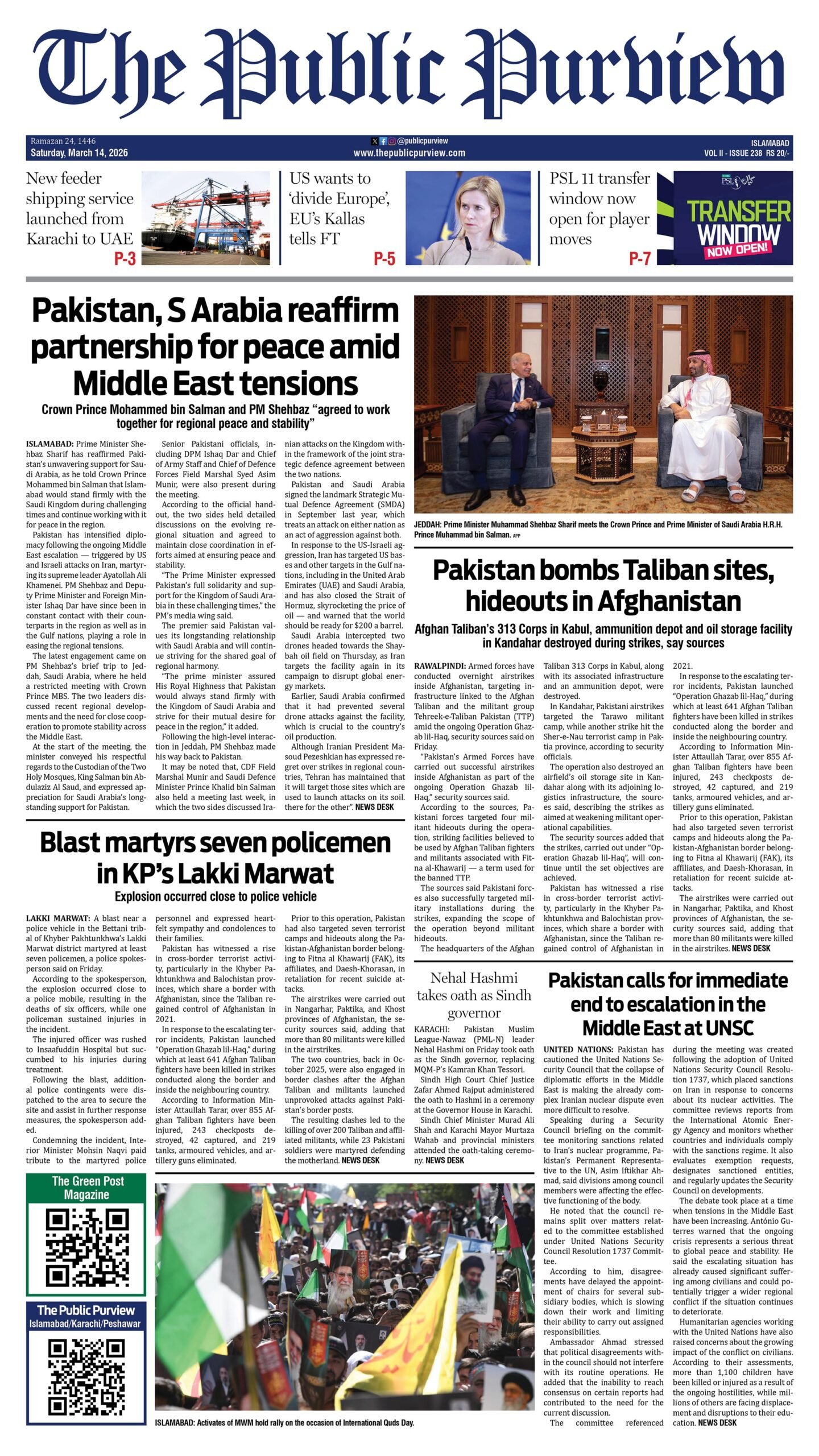 Today's E-Paper