
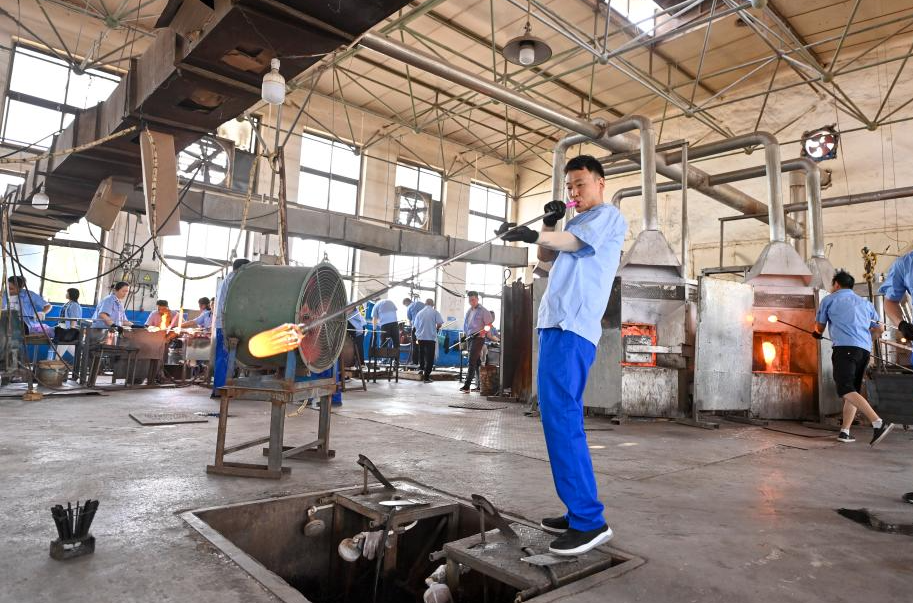
TAIYUAN: The centuries-old art of glass-blowing, introduced to China from the Middle East, has flourished in Qixian County, Shanxi Province, where it has evolved into a vibrant specialty industry with global reach.
Local historians trace the county’s connection to glass-blowing back to the Ming and Qing dynasties, when Shanxi merchants brought glass products and techniques from Syria and other regions along the “tea road.” Over time, Qixian developed into China’s core production hub for hand-blown glassware, now accounting for more than 60 percent of domestic output. Officials say over 70 percent of its products are exported to more than 80 countries and regions worldwide.
Beyond manufacturing, Qixian has embraced cultural preservation. Enterprises have established intangible cultural heritage centers that host study tours for students, offering immersive experiences in glass-blowing. At Honghai Glass Cultural Industrial Park, visitors watch artisans transform molten glass into delicate vessels, while exhibitions and DIY sessions make the craft accessible to younger generations.
Honghai Glass Co., Ltd. has combined tradition with innovation, developing patented techniques such as stacked-color blending to cater to international markets, particularly in the Middle East. Chairman Li Jiansheng said the company integrates production, exhibitions, and tourism, drawing around 100,000 visitors annually.
Nearby, Xizun Glass employs more than 500 artisans and has positioned its products as high-end luxury items. General Manager Zhang Wenlei said the company’s hand-blown goblets, priced between 2,000 and 3,000 yuan, are sold in Europe and the United States, challenging perceptions of glassware as low-cost goods.
Qixian’s glass industry is also embracing smart manufacturing. Xifulai Glassware Co., Ltd. has introduced intelligent production lines for borosilicate glassware, significantly increasing efficiency while reducing costs. Company representative Wang Naiwei said the new lines produce 70,000 pieces daily, doubling traditional capacity.
Today, Qixian’s glass sector includes 62 manufacturers and more than 230 supporting enterprises, employing around 30,000 of the county’s 249,000 residents. Since 2024, 11 new companies have begun self-operated exports, while many others have expanded facilities. The county has also promoted 5G-enabled smart manufacturing and established a national-level glassware quality inspection center, alongside a dedicated academy to train craftsmen and digital talent.
Officials say these efforts have positioned Qixian as both a guardian of cultural heritage and a modern hub for global glassware production.





 Today's E-Paper