
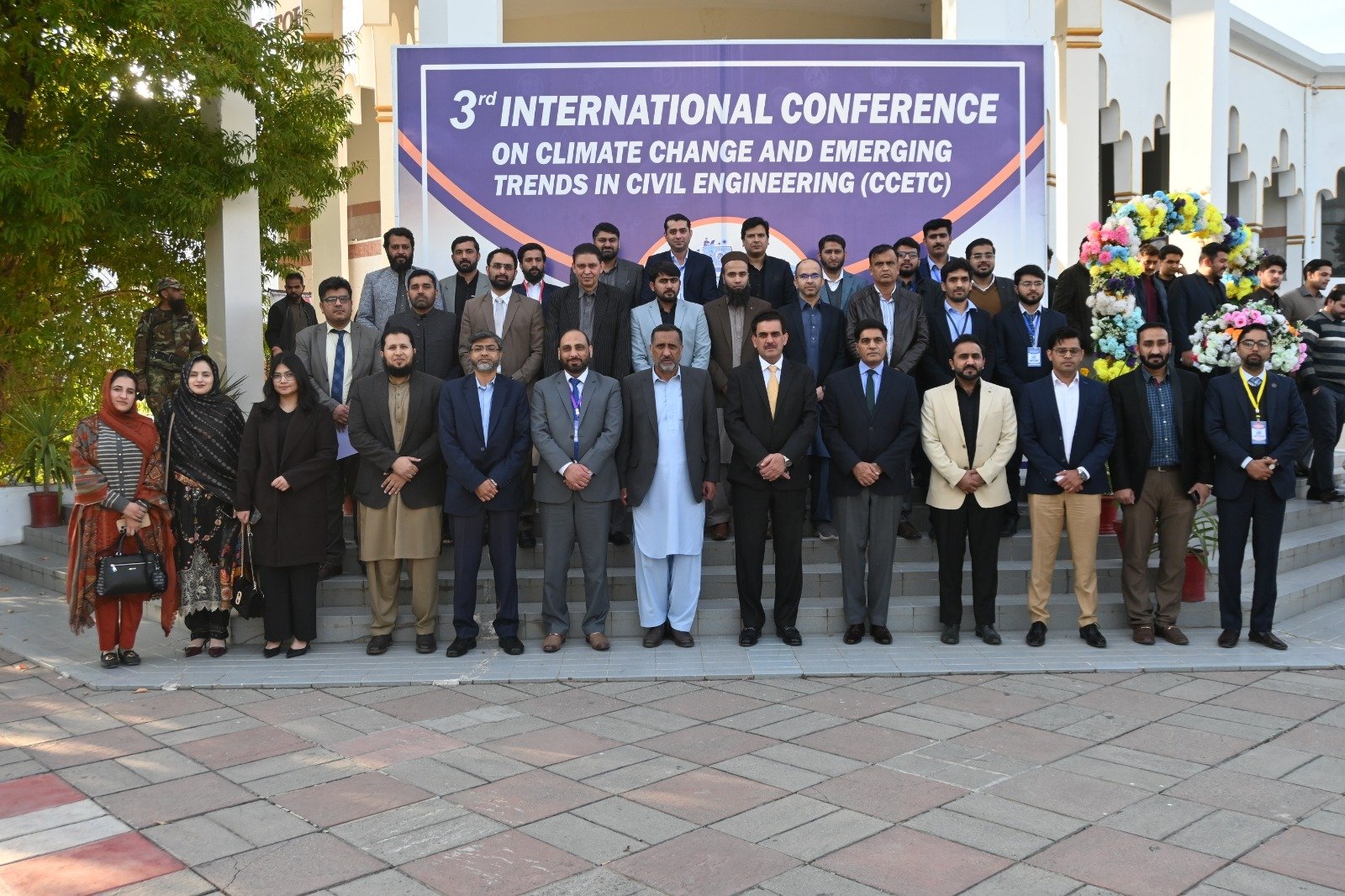
TOPI, PAKISTAN – The Ghulam Ishaq Khan Institute of Engineering Sciences and Technology (GIKI) successfully concluded the 3rd International Conference on Climate Change and Emerging Trends in Civil Engineering (CCETC 2026). Organized by the Faculty of Civil Engineering with support from national and global partners, the two-day forum brought together senior government officials, global climate experts, industry leaders, development organizations, and academic researchers to advance Pakistan’s response to climate change through engineering innovation and policy-driven research.
The conference opened with a landmark announcement by Ms. Aisha Humera Moriani, Federal Secretary for the Ministry of Climate Change (MoCC), who formally declared a strategic collaboration between the Ministry, its research arm—the Global Climate Change Impact Studies Centre (GCISC)—and GIKI to establish a Centre for Environmental and Water Research at the Institute. This new facility is designed to serve as a national hub of excellence, focusing on translating advanced research into practical, policy-relevant solutions for climate resilience and environmental protection.
In his inaugural address, Prof. Dr. Fazal Ahmad Khalid (SI), Rector GIKI and Patron-in-Chief of the conference, emphasized that sustainability has become an essential pillar of modern civil engineering practice. He highlighted the responsibility of academic institutions to lead the development of research-based solutions that strengthen national climate resilience. Conference Chair Prof. Dr. M. Ashraf Tanoli further underscored the event’s significance as a strategic platform bridging academia, industry, and government to enable critical knowledge exchange on adaptation strategies, sustainable construction, and resilient infrastructure.
Significant contributions regarding Pakistan’s environmental challenges were made during the opening session. Mr. Shakil Durrani, Executive Director SOPREST, drew attention to the country’s alarming environmental conditions, specifically accelerated glacier melt and increased flood events, while stressing the need for improved implementation of environmental regulations. Highlighting regional cooperation, Prof. Dr. Atta Ullah Shah, Vice Chancellor of Karakoram International University (KIU), pointed to the GIKI–KIU partnership as a vital mechanism for integrated research to protect the fragile ecosystems of northern Pakistan.
The nexus of water resources and climate adaptation was addressed in a keynote by Engr. Muhammad Azam Joya, Advisor to the Chairman WAPDA. He detailed the monitoring and resilience features of national hydropower projects, such as the Diamer-Bhasha Dam, and assured WAPDA’s full support for collaborative research initiatives. Ms. Aisha Humera Moriani also delivered a keynote address describing climate change as a profound socio-economic challenge. She encouraged the adoption of low-carbon materials and indigenous innovation to support Pakistan’s Nationally Determined Contributions (NDCs), alongside governmental efforts in emission reduction and e-waste management.
The second day of the conference featured insights from national and international experts. Ms. Sameeta Faiq from WWF Pakistan advocated for environmental stewardship and community participation to mitigate climate risks. Prof. Dr. Arinaitwe Julius, Vice Chancellor of Metropolitan International University, Uganda, emphasized the critical role of global academic cooperation in developing scalable solutions. Additionally, Dr. M. Azmat, Regional Director of FAO Pakistan, highlighted the interdependence of climate change, agriculture, and water resources, calling for sustainable management to support vulnerable populations and ensure food security.
The conference garnered an exceptional academic response, receiving 110 abstracts. Following a rigorous peer-review process, 62 papers were accepted and presented across multiple technical sessions. These contributions covered a wide spectrum of focus areas within climate-resilient civil engineering, including sustainable infrastructure, water resource management, transportation systems, geotechnical resilience, and emerging technologies.
The closing ceremony was graced by Engr. M. Danish Siddique, Director of SINACO Engineers Pvt. Ltd., who appreciated the high quality of research and emphasized the importance of strong industry–academia linkages to translate innovative ideas into practical solutions. The Guest of Honor, Dr. Muhammad Israr, Secretary of the Higher Education Department (HED) for the Government of Khyber Pakhtunkhwa, highlighted the central role of higher education institutions in generating research-driven policy input and preparing future engineers to design sustainable infrastructure.
Concluding the event, Prof. Dr. Fazal Ahmed Khalid commended the organizing committee and participants for making CCETC 2026 a meaningful international forum. He reaffirmed GIKI’s commitment to leading interdisciplinary research and contributing to national policy development to address the multifaceted challenges of climate change.




 Today's E-Paper