

Pakistan’s strategic realignment has been shaped largely outside formal political channels, with Asim Munir emerging as the central figure directing both national security and foreign policy. His rise from Chief of Army Staff to a statesman of influence reflects consistent management of internal instability and external pressures. Under his leadership, Pakistan shifted its approach toward India following the 2019 revocation of Article 370 and Article 35A, moving from reactive condemnation to proactive deterrence. This involved calibrated military posturing, engagement in international forums like the Shanghai Cooperation Organization, and the strengthening of internal security to prevent hybrid warfare, replacing perceived weakness with “strategic clarity” by clearly defining Pakistan’s red lines and countering destabilization attempts in regions such as Balochistan and Khyber Pakhtunkhwa. Simultaneously, Munir restructured Pakistan’s approach to Afghanistan, ending the distinction between “good” and “bad” Taliban, targeting all militant factions, completing border fencing, and asserting that no group would be tolerated as a strategic asset, thereby restoring sovereignty and signaling the end of non-state actors’ influence on policy.
Domestically, Munir launched an unprecedented crackdown on sectarian militancy, dismantling networks, seizing assets, prosecuting leaders, and enforcing the state’s monopoly on violence across all sectarian lines to reaffirm national unity. These initiatives paved the way for a prominent international role, with Pakistan mediating escalating tensions between the United States and Iran. Islamabad is preparing to host senior officials from both nations, leveraging Pakistan’s strategic border with Iran and longstanding partnership with the US to act as a credible bridge. Munir’s credibility in both capitals, combined with synchronized engagement by Pakistan’s military and civilian leadership, enabled high-level communications, including direct dialogue with the US President and outreach to Iran’s leadership, aligning timelines and parameters for de-escalation. This coordinated effort helped avert potential military confrontation, safeguarded global trade routes like the Strait of Hormuz, and offered both nations a pathway to resolve tensions without humiliation, positioning Munir and Pakistan as critical facilitators of regional stability and global economic security.
In the midst of these high-wire diplomatic acts, the domestic perception of Field Marshal Asim Munir has undergone a profound transformation, crystallizing into a bond of trust between the military leadership and the wider populace. It is a relationship that stands in stark contrast to the environment he stepped into at the outset of his tenure. In the beginning, he faced outright hatred from a specific, albeit vocal, segment of society—the “few usual idiots” as they have come to be known in the national discourse. This faction, consisting of a ragtag alliance of polarized politicians, opportunistic media personalities, and their foreign-funded proxies, attempted to delegitimize his appointment from day one. They engaged in a sustained campaign of vilification, spreading misinformation, attacking the institution he represents, and hoping to replicate the cycles of division that had plagued Pakistan’s civil-military relations for years. They underestimated the man they were dealing with. Unlike his predecessors who might have sought to placate critics or engage in the messy back-and-forth of political point-scoring, Munir adopted a policy of dignified silence. He did not respond to the chatter; he simply worked. He focused on the mandate of his office—security—and delivered results so tangible that the noise of his detractors was drowned out by the applause of a grateful nation.
Today, the narrative has completely inverted. The same urban elites who once sneered at his appointment now quietly acknowledge his strategic genius. The political factions who sought to use him as a punching bag have found themselves irrelevant, their manufactured controversies unable to compete with the reality of a leader who is ending terrorism, stabilizing the economy through improved security perceptions, and elevating Pakistan’s diplomatic standing to heights not seen in decades. Field Marshal Munir is now undeniably loved by the whole nation, a unifying figure in a country often defined by its divisions. This love is not born of charisma alone, but of competence. The people of Pakistan, from the bustling bazaars of Karachi to the valleys of Hunza, feel a sense of pride that has been long absent. They see their military chief brokering peace between global superpowers, standing firm against nuclear-armed neighbors, and purging the nation of the sectarian poison that had seeped into its social fabric. They see a man who raised the name of Pakistan in the world—not through rhetorical flourishes at the United Nations, but through the quiet, authoritative diplomacy that moves markets and prevents wars.
His leadership style is a masterclass in the exercise of power. He is decisive, unburdened by the need for constant public validation. In an era of social media chaos and information warfare, Munir has maintained a tight grip on the strategic narrative by refusing to let his enemies define him. He let his actions speak, and they have spoken volumes. Whether it was his personal oversight of the border management system that drastically reduced cross-border infiltration, his role in orchestrating the release of Pakistani nationals caught in regional conflicts, or his quiet but firm diplomatic engagements in Beijing, Riyadh, and Washington, every move has been calculated to maximize Pakistan’s strategic autonomy. He has navigated the treacherous waters of the US-China rivalry with finesse, maintaining Pakistan’s critical relationship with its “Iron Brother” China while repairing the fractured alliance with the United States enough to make the recent Iran mediation possible. This is the hallmark of a clear-headed leader: one who sees beyond the binary choices of geopolitics and forges a path of national interest that is not subservient to any foreign capital.
Moreover, his impact on the morale of the Pakistan Armed Forces cannot be overstated. Under his command, the army has been transformed from an institution often dragged into political controversies to one solely focused on its primary mission: the defense of the realm. He has insulated the ranks from the corrosive effects of political polarization, ensuring that the professional soldier remains focused on external threats rather than internal divisions. This has restored the bond of trust between the military and the civilian population, a bond that is the ultimate guarantor of national security. When he speaks about national security, the entire nation listens, not out of fear, but out of a collective realization that his analysis is grounded in reality, not in political expediency.
As the world watches the potential US-Iran meeting in Islamabad take shape, the image of Field Marshal Asim Munir will be central to that historic moment. If successful, it will be the capstone of a tenure already defined by monumental achievements. It will cement Pakistan’s role not as a peripheral player caught in the crossfire of great power rivalries, but as a central hub for conflict resolution, a nation that punches far above its weight class on the global stage. For the people of Pakistan, this is the culmination of a long-held aspiration: to be respected. In Field Marshal Munir, they have found a leader who has given them that respect back. He has taken a nation often maligned in international media as a land of instability and terrorism and positioned it as an indispensable partner for peace. From the shadow of the Himalayas to the deserts of the Middle East, his influence is felt. The rise of Field Marshal Asim Munir is not just a story of a man; it is the story of a nation rediscovering its confidence, reclaiming its sovereignty, and asserting its place in the comity of nations. The world is taking notice, and as the diplomatic gears continue to turn in Islamabad, it is becoming increasingly clear that Pakistan, under his strategic stewardship, is no longer just a spectator to the unfolding global drama—it is one of its principal directors.

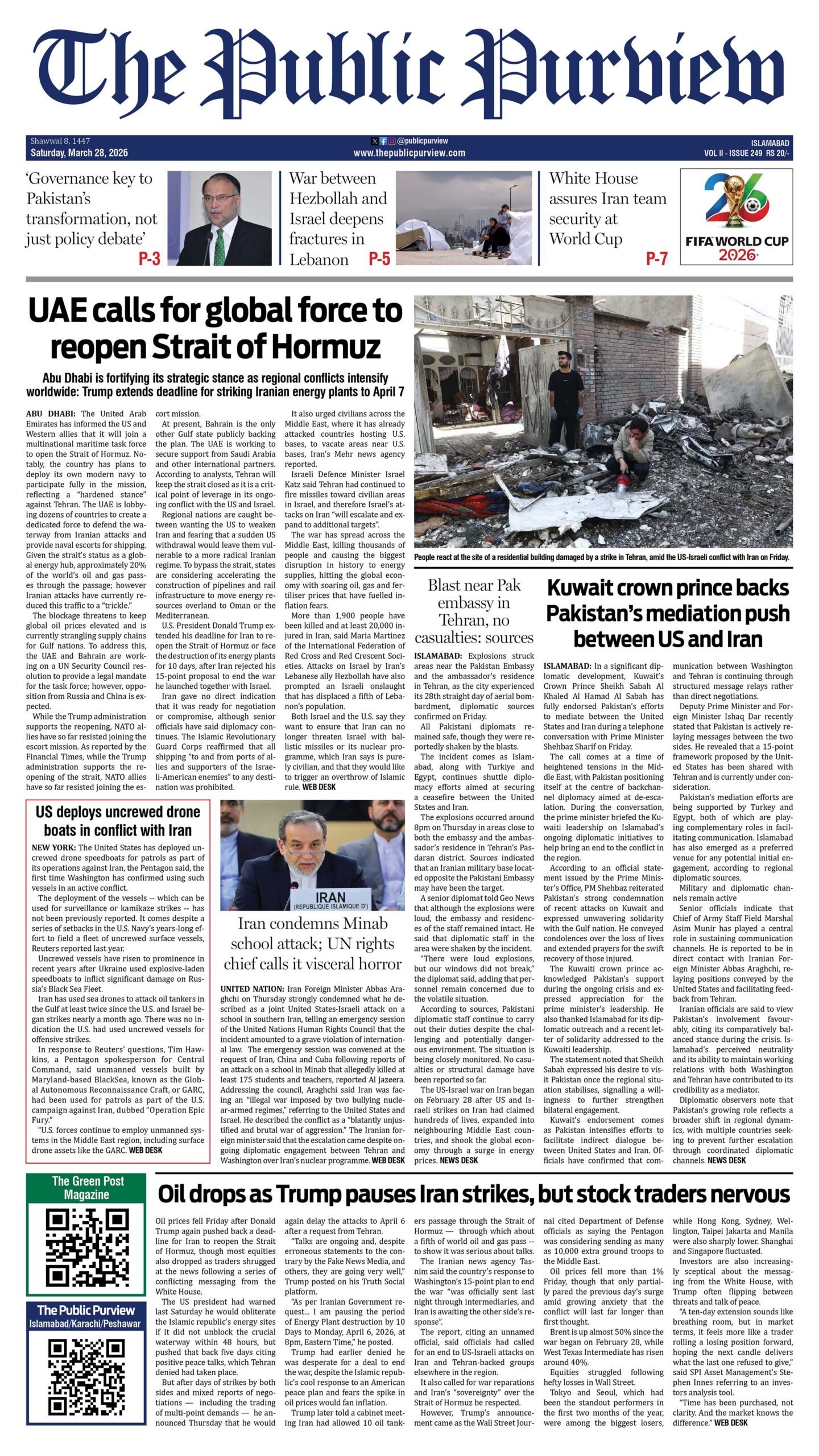 Today's E-Paper