
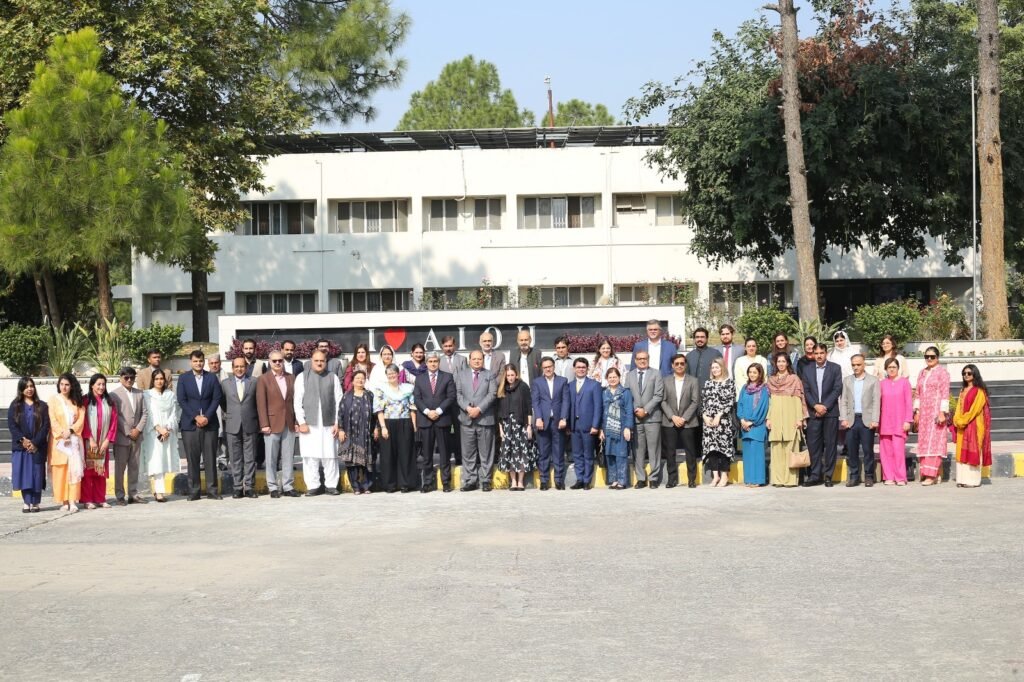
ISLAMABAD, November 3, 2026: Federal Secretary for Education Nadeem Mehbub has announced that foundational learning will be included as a key agenda item at the Inter-Provincial Education Ministers’ Conference (IPEMC), as Pakistan moves to strengthen coordination between federal and provincial governments to improve children’s learning outcomes.
The announcement came during the launch of the National Coalition for Foundational Learning (NCFL) Pakistan at Allama Iqbal Open University (AIOU), Islamabad, where government officials, education experts, civil society organisations and development partners gathered to develop a shared national agenda through 2030.
The roundtable, titled “Enhancing Coalitions for Foundational Learning: From a South-South Fellowship to a National Movement,” was jointly organised by Idara-e-Taleem-o-Aagahi (ITA) and the Pakistan Foundational Learning Hub of the Ministry of Federal Education and Professional Training (MoFEPT).
Addressing the gathering, Nadeem Mehbub formally launched the coalition and emphasised the need to place foundational learning at the centre of national education policy discussions.
He said bringing the issue to the IPEMC would help strengthen federal-provincial coordination, encourage collective action and improve accountability for children’s learning outcomes.
The event highlighted Pakistan’s continuing education challenges, including an estimated 25.37 million children aged five to 16 who remain out of school.
According to figures presented at the roundtable, Punjab accounts for 9.60 million out-of-school children, followed by Sindh with 7.82 million, Khyber Pakhtunkhwa with 4.92 million and Balochistan with 2.94 million.
Participants stressed that improving foundational learning requires sustained cooperation among governments, educational institutions, civil society and development partners.
The opening session featured remarks by AIOU Dean of Social Sciences and Humanities Prof. Dr. Muhammad Amir Shah and ITA Chief Executive Officer Baela Raza Jamil.
Other speakers included Qaisar Alam, Special Secretary Development and Managing Director of the Elementary and Secondary Education Foundation, Khyber Pakhtunkhwa; Dr. Faisal Bari of IDEAS-LUMS; Dr. Ehtisham Anwar of DARE-RC; Dr. Adriana Conconi of Brazil’s Centro Lemann; Deborah Kimathi of the Learning Generation Initiative; and Dr. Javed Malik, Lead of the Pakistan Foundational Learning Hub.
A session chaired by MoFEPT Senior Joint Secretary Syed Junaid Ikhlaque reviewed foundational learning initiatives across Punjab, Sindh, Khyber Pakhtunkhwa and Balochistan.
Participants also discussed the evaluation of the South-South Fellowship Programme, with contributions from ASPIRE, the Pakistan Institute of Education (PIE) and the Federal Directorate of Education (FDE).
International experts shared experiences from Brazil and other countries on developing education coalitions and sustaining reforms.
The roundtable secured commitments from development partners, technical organisations and civil society representatives to support the coalition through consensus-based governance, innovative financing and measures aimed at improving educational equity.
Working groups were established to develop priorities in governance, financing, curriculum, evidence and data, knowledge sharing, and policy advocacy and communication.
These groups will help shape the coalition’s priorities and implementation plans for 2027–2030.
Participants also identified gender equality, inclusion and technology as priorities that should be integrated across foundational learning initiatives.
The closing session brought together Qaisar Alam, provincial representatives and ITA officials to discuss the coalition’s future direction and longer-term priorities.
The newly launched NCFL Pakistan aims to provide a national platform for coordinating existing education initiatives, sharing research and practical knowledge, mobilising resources and strengthening cooperation between federal and provincial governments.
The coalition will focus on improving foundational learning outcomes and helping children across Pakistan acquire essential skills for continued education and lifelong learning.