

By Abdul Basit Alvi
A balanced foreign policy focused on autonomy and diversification allows states outside the superpower tier to protect sovereignty and long-term stability in a multipolar environment. By maintaining constructive ties with multiple major powers and avoiding dependence on any single partner, countries can reduce exposure to coercion, economic volatility, and security shocks. Such an approach strengthens economic resilience, limits involvement in proxy conflicts, preserves political and ideological independence, and enhances diplomatic credibility and influence, though it requires consistent leadership and strong institutional coordination.
Pakistan is shown advancing this approach through calibrated engagement with both China and the United States under the leadership of Field Marshal Syed Asim Munir. High-level diplomacy reinforced security cooperation, revitalized economic initiatives, and reset strained relationships without undermining balance, while projecting Pakistan as a confident and autonomous actor. The U.S. visit broadened cooperation beyond security to include trade, investment, and people-to-people ties, culminating in a landmark trade agreement that improved Pakistan’s market access. Together with strengthened ties to China, these outcomes highlighted how military credibility combined with strategic diplomacy translated into tangible economic and political gains, elevating Pakistan’s international standing and strategic leverage.
What truly sets Field Marshal Asim Munir apart is his masterful command of equilibrium, a principle he has elevated to a strategic art form. While strengthening Pakistan’s relationship with the U.S. and securing a preferential trade deal, he simultaneously preserved and advanced strategic ties with China, demonstrating an ability to conduct high-level diplomacy on a dual track. This sophisticated dual-track approach has allowed Pakistan to extract economic, military, and diplomatic benefits from both relationships, thereby enhancing its global leverage without becoming a pawn in great-power rivalries. Field Marshal’s approach is a strategic doctrine of engagement, wherein Pakistan acts as a responsible regional power and a crucial bridge between competing interests, rather than a subordinate ally. The U.S. trade deal, therefore, is not a standalone achievement but the outcome of a broader trust-building effort rooted in Pakistan’s consistent messaging and responsible behavior on the world stage.
The preference shown to Pakistan by the United States in this new trade architecture has already begun to alter dynamics across South Asia, creating a palpable sense of unease in New Delhi. Indian officials have expressed concern and frustration, suggesting that Washington’s shift is a clear warning against strategic drift and an indication of Pakistan’s rising influence. Meanwhile, Pakistani economic leaders have welcomed the development as a long-overdue recognition of Pakistan’s global relevance and a testament to its economic potential. Analysts worldwide are now taking notice of how a military victory, when channeled through smart diplomacy and strategic outreach, can translate into tangible economic outcomes. Field Marshal Asim Munir has been at the very center of this transformation, proving that modern military leadership extends far beyond the battlefield into the corridors of diplomacy, trade, and global influence. His legacy will likely be defined not only by his battlefield triumphs but also by his rare ability to balance the competing gravitational pulls of the United States and China, charting a sovereign, stable, and strategically respected course for Pakistan on the world stage.
The British magazine Financial Times also acknowledged the impressive personality of Chief of Defence Forces Field Marshal Asim Munir, calling him an effective strategic leader in a changing global system. The British magazine Financial Times called Field Marshal Asim Munir an expert in multilateral foreign policy. According to the Financial Times, changing global politics has opened a new but difficult era for the middle powers. This development is proving to be particularly complicated for the middle powers. According to the report, Field Marshal Asim Munir is among the most successful multi-aligners of the middle powers. The honor of being the best aligned with Trump goes to Pakistan’s military chief Field Marshal Asim Munir. The British journal described Field Marshal Asim Munir as a successful example of middle powers diplomacy and wrote that Pakistan’s leadership remained active in simultaneous contacts between Washington, Beijing, Riyadh and Tehran. Field Marshal Asim Munir effectively advanced Pakistan’s diplomacy in a changing global environment. The journal says that timely pleasantries and soft diplomatic behavior with Trump proved effective. Pakistan’s diplomatic success disappointed India. The middle power game proved to be more difficult for India than expected. India could not adapt to the changing global situation and Trump’s style. Due to this diplomatic failure, India is facing difficulties in its middle power strategy.
According to an article in the Washington Times, 2025 marked a revolutionary turning point in Pakistan–US relations, ending Washington’s long-standing “India First” approach and elevating Pakistan to a central position in President Trump’s South Asia strategy. The shift was driven mainly by the May Pakistan–India war, during which Pakistan’s military performance reportedly exceeded US expectations and surprised Trump. The Washington Times noted that Pakistan moved from being viewed as an unwanted state to a key partner, while India’s political challenges, restrictions on personal freedoms, uneven military performance, and diplomatic rigidity weakened its image as a reliable regional stabilizer. Early signs of improvement included secret counterterrorism cooperation and Trump’s unexpected public praise for Pakistan in March, which Islamabad quickly leveraged to deepen engagement. The Washington Times also highlighted the growing prominence of Field Marshal Syed Asim Munir, portraying him as a pivotal figure in the policy shift and in reshaping Pakistan’s strategic image in Washington. Pakistan’s military modernization, command restructuring, and activation of the Chief of Defense Forces post are described as gaining new global significance, with Field Marshal’s leadership receiving strong recognition. His interactions with President Trump and senior US military leaders, including meetings at the White House and CENTCOM, are depicted as unprecedented and symbolic of Pakistan’s renewed importance. While Pakistan is presented as an emerging anchor of US strategy heading into 2026, the article concluded that the durability of this realignment will depend on the future conduct of both Pakistan and India, with 2025 seen as a year that reshaped US policy and the balance of power in South Asia.
The nation is indeed blessed to have such a military leader who has played such a key role in its current strong global standing, giving it a significant and unprecedented edge over its enemy, India, a truly satisfactory outcome.


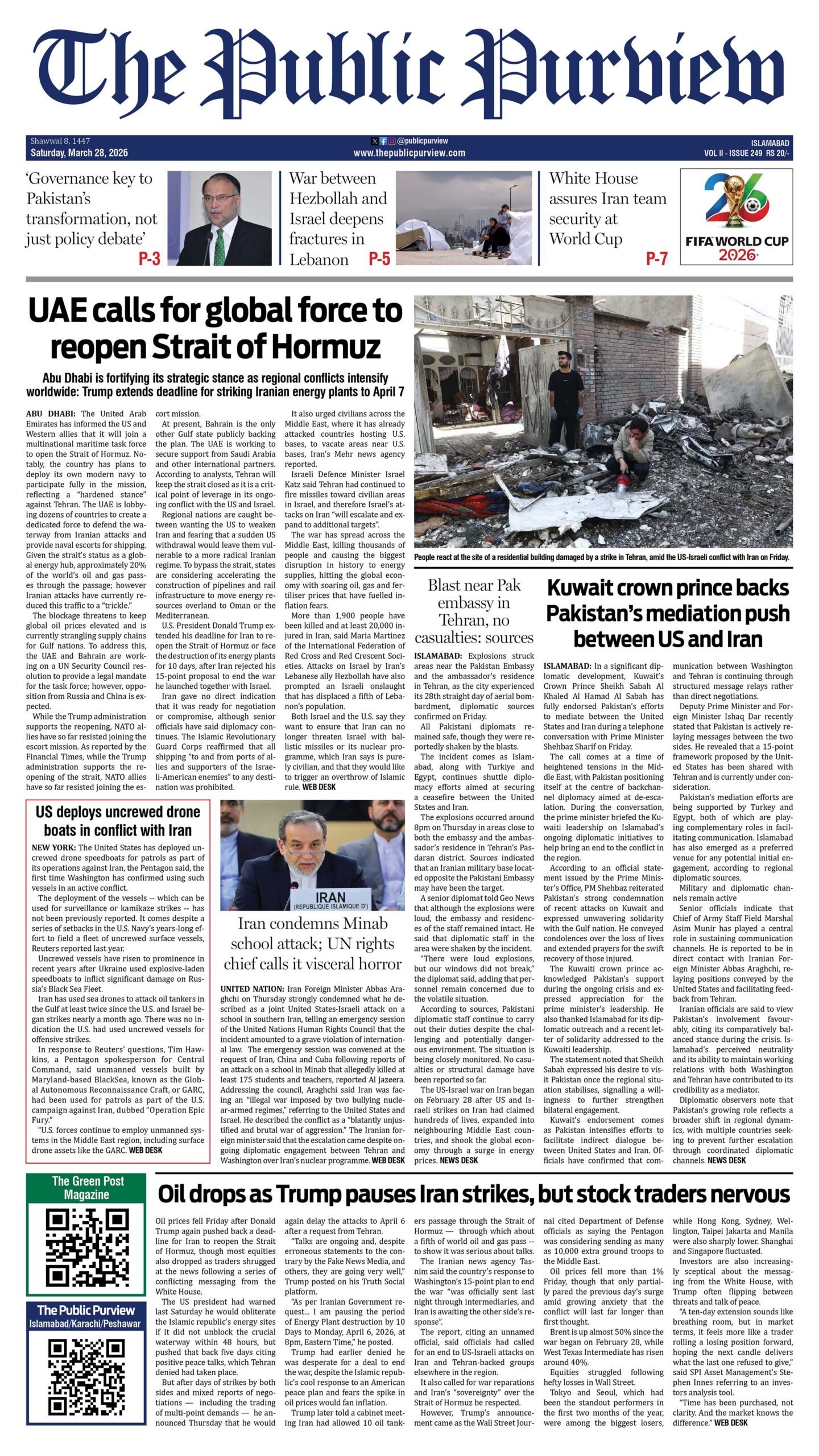 Today's E-Paper