
Turkish President Recep Tayyip Erdogan has reaffirmed Türkiye’s commitment to reducing tensions between the United States and Iran, emphasizing that diplomacy remains active and that dialogue between the two rivals is still possible. His remarks highlight Ankara’s growing role as a regional mediator at a time when the Middle East faces renewed uncertainty and the threat of military confrontation.
Speaking to journalists aboard his return flight to Türkiye following official visits to Saudi Arabia and Egypt, President Erdogan said that Ankara is working tirelessly to prevent the region from sliding further into conflict and instability. He stressed that Türkiye is determined to block any developments that could plunge the Middle East into deeper chaos.
“We are making every possible effort to reduce tensions between Iran and the United States without pushing the region into further confrontation and disorder,” Erdogan said. “Our goal is to keep diplomatic channels open and to ensure that dialogue remains possible.”
Erdogan highlighted Türkiye’s recent diplomatic engagement with both Washington and Tehran, underscoring Ankara’s role as an active facilitator. According to the Turkish leader, he held direct talks with U.S. President Donald Trump and, shortly afterward, engaged in discussions with Iranian President Masoud Pezeshkian.
These high-level contacts were followed by a trilateral meeting in Istanbul, involving Türkiye’s foreign minister and Iran’s Foreign Minister Abbas Araghchi. The meeting, Erdogan said, reflected Ankara’s determination to create platforms where sensitive issues could be addressed through diplomacy rather than confrontation.
By engaging simultaneously with both sides, Türkiye has positioned itself as a trusted intermediary capable of bridging communication gaps between long standing rivals. This approach reflects Ankara’s broader foreign policy strategy of maintaining balanced relations with regional and global powers.
A central theme of Erdogan’s remarks was Türkiye’s clear opposition to military action against Iran. He said that Ankara has consistently conveyed this position directly to its counterparts, emphasizing that armed intervention would only deepen regional instability.
“Our rejection of military intervention in Iran has been clearly stated,” Erdogan said. “We have shared this position openly with our partners.”
He argued that military solutions have repeatedly failed to resolve Middle Eastern conflicts and have instead produced long-lasting humanitarian, economic and political crises. From Syria to Yemen, decades of warfare have left deep scars, reinforcing the need for alternative approaches.
Erdogan stressed that problems cannot be solved through war but through dialogue, compromise and mutual understanding. “Diplomacy must remain active and uninterrupted,” he said. “The path for negotiation and dialogue is still open.”
The Turkish president also emphasized the importance of building momentum at lower diplomatic levels to prepare the ground for leadership level negotiations. He noted that technical talks, confidence-building measures and informal consultations could help reduce mistrust and pave the way for broader agreements.
“In times of rising military tension, it is crucial to establish a negotiation table,” Erdogan explained. “Progress at lower levels can open doors for meaningful discussions between leaders.”
This approach reflects Türkiye’s belief in gradual diplomacy, where sustained engagement and incremental progress help prevent crises from escalating into open conflict. By encouraging continuous communication, Ankara hopes to keep misunderstandings and miscalculations in check.
Erdogan also pointed to strong regional backing for diplomatic solutions, particularly from Gulf countries. In response to questions about regional dynamics, he said that Saudi Arabia and other Gulf states do not want another war and are actively supporting diplomatic initiatives.
“Everyone understands that full peace and stability in our region will benefit us all,” Erdogan said. “Conflicts only bring harm.”
He warned that viewing regional challenges solely through a military lens would lead to disaster. The Middle East, he said, has already witnessed enough bloodshed and suffering. Instead of repeating past mistakes, regional leaders should focus on peace, cooperation, and economic development.
This regional consensus reflects growing fatigue with prolonged conflicts that have drained resources, disrupted trade, and displaced millions. Countries across the Middle East are increasingly prioritizing stability as a foundation for growth and modernization.
Erdogan’s statements come at a particularly sensitive time, as Iran and the United States prepare for talks in Oman. These negotiations aim to explore potential diplomatic progress on Iran’s nuclear program and other contentious issues, including regional security and sanctions.
While Washington has expressed interest in diplomacy, it has not ruled out the possibility of military action. This dual approach combining negotiations with pressure has long characterized U.S. policy toward Iran and remains a source of uncertainty.
The upcoming talks, confirmed by both sides after days of speculation, will mark the first such meeting between the two adversaries in this format. The location, timing, and structure of the negotiations were only finalized after prolonged discussions, reflecting the deep mistrust that continues to shape relations.
Nevertheless, their very occurrence signals a willingness to explore alternatives to confrontation. Observers view the talks as a rare opportunity to de-escalate tensions that have been building for months.
Türkiye’s involvement in easing U.S., Iran tensions reflect its broader ambition to act as a stabilizing force in the region. By maintaining dialogue with both Western allies and regional powers, Ankara seeks to enhance its diplomatic influence and protect its national interests.
Stability in the Middle East is vital for Türkiye’s economic and security priorities. Escalation between Iran and the United States could disrupt energy supplies, harm trade routes, and fuel refugee flows developments that would directly affect Türkiye.
Moreover, Ankara’s mediation efforts also strengthen its international standing. Successful facilitation could reinforce Türkiye’s image as a responsible regional actor capable of managing complex diplomatic challenges.
Despite Erdogan’s optimism, significant obstacles remain. Deep-rooted mistrust, domestic political pressures and competing strategic interests continue to complicate U.S. Iran relations. Any agreement will require difficult compromises and sustained political will on both sides.
Hardliners in both countries remain skeptical of diplomacy, arguing that concessions could weaken national security. Meanwhile, regional rivalries and proxy conflicts further undermine confidence-building efforts.
In this environment mediators like Türkiye face the delicate task of balancing expectations while keeping negotiations alive. Even minor setbacks could derail progress.
President Erdogan’s renewed push for diplomacy underscores Türkiye’s commitment to preventing another major crisis in the Middle East. By engaging both Washington and Tehran, opposing military intervention, and promoting regional cooperation, Ankara is working to keep dialogue alive at a time of heightened uncertainty.
As Iran and the United States prepare for critical talks in Oman, Türkiye’s efforts highlight the enduring value of mediation and negotiation. While the road to lasting peace remains long and uncertain, Erdogan’s message is clear: wars deepen wounds but diplomacy offers a path toward stability.
In a region that has endured decades of conflict such a message resonates strongly. Whether it will translate into lasting progress now depends on the willingness of all parties to choose dialogue over confrontation.



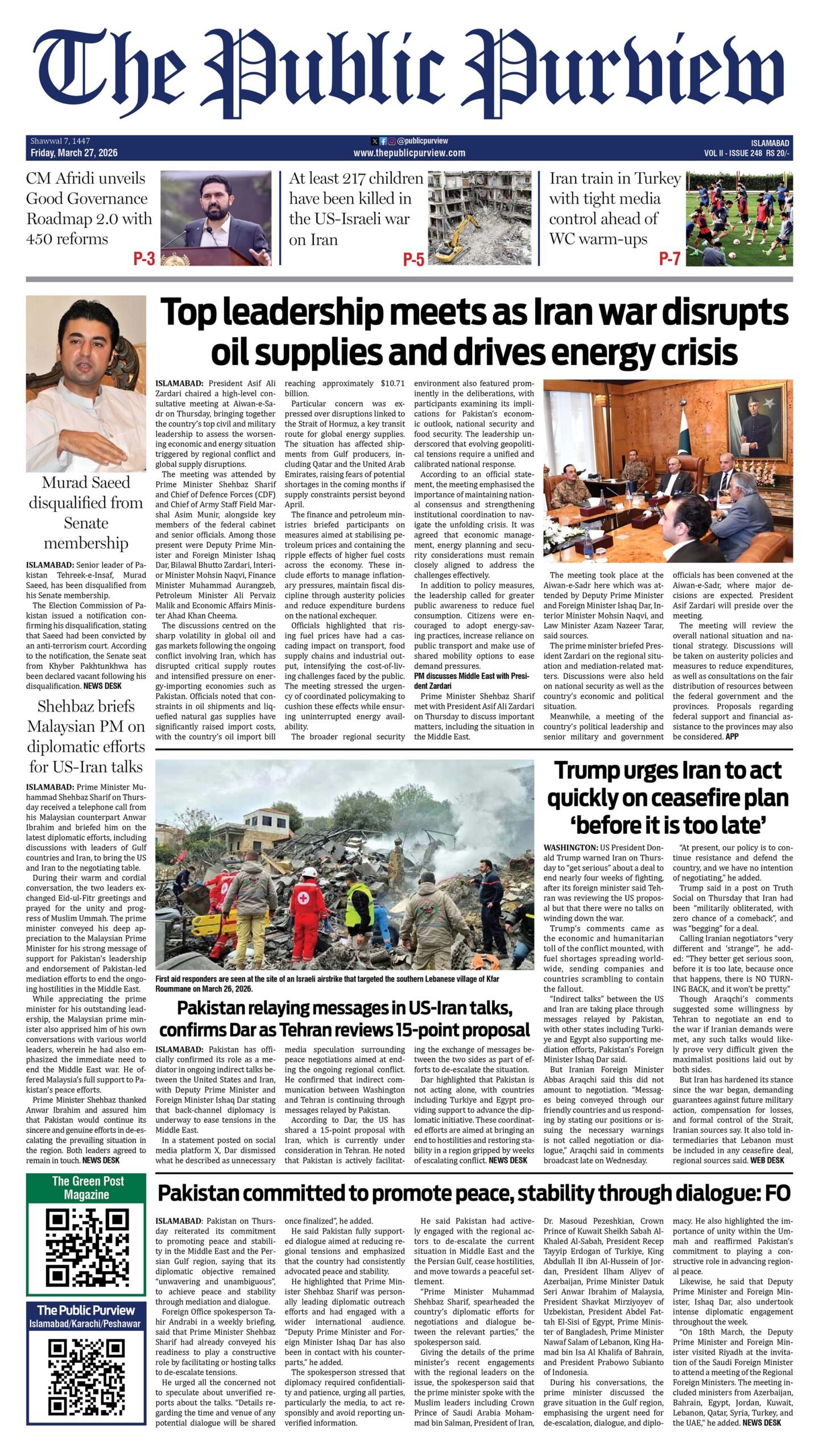 Today's E-Paper