

Pakistan’s grief over developments in Iran, particularly the reported martyrdom of Seyyed Ali Hosseini Khamenei, is portrayed as both an emotional moment and a strategic warning, reinforced by Iran’s pressures, Venezuela’s prolonged crisis, and the missile scare in the United Arab Emirates, all underscoring that natural wealth and economic prosperity alone cannot ensure sovereignty without strong governance and credible defense. In this volatile regional environment, Pakistan’s proven and formidable military capability—especially its nuclear deterrent—is presented as the ultimate guarantor of ideological and territorial integrity, providing citizens with security and stability through decades of sacrifice and investment. This strength, validated in real confrontations with India and symbolized by the widely resonant “Marka Huq,” underpins national morale, reinforces foreign policy credibility, and enables Pakistan to advocate peace, dialogue, and justice from a position of confidence and demonstrated capability rather than fear, with its armed forces serving as vigilant guardians against the vulnerabilities seen in resource-rich but defense-poor states.
Therefore, the complex and deeply saddening situation unfolding in Iran, viewed through the clarifying lens of strategic analysis, should serve as the ultimate, the most powerful, and the most urgent eye-opener for the entire nation. It must function as a stark, flashing warning bell, a final wake-up call for those voices, both within Pakistan and in the broader discourse, who persist in advocating for a false, dangerous, and ultimately suicidal choice. There is a persistent, often naive, and sometimes deliberately misleading narrative that posits a fundamental, zero-sum trade-off between building a strong economy and maintaining a strong defense. This narrative, often heard in drawing-rooms, on talk shows, and in certain academic circles, argues, with a veneer of pseudo-sophistication, that the vast resources allocated to the military and national defense are resources effectively stolen from the people, resources that could have been spent on schools, hospitals, roads, and social welfare programs. This is not merely a flawed or incomplete argument; it is a perilous, insidious, and deeply dangerous fallacy, a line of thinking that the recent, dramatic, and tragic regional events have not just challenged but have utterly and conclusively debunked with the force of a thunderbolt. The argument, so glibly repeated, that “we need a strong economy at the price of our strong defense” is not just strategically unwise; it is a clear, unambiguous, and horrifyingly effective blueprint for eventual national suicide, for the slow or rapid dismantling of everything that generations have fought and sacrificed to build. The living, breathing examples of nations that prioritized the glittering facade of economic prosperity over the hardened steel of defensive capability are now written indelibly in the anxious, terrified alerts of the UAE’s population fleeing their skyscrapers and in the tragic, humiliating political turmoil and compromised sovereignty of Venezuela. Their immense, resource-based wealth could not purchase them even a moment of genuine security when the moment of ultimate strategic truth arrived, when the missiles were in the air or the foreign operatives were on the ground. They were forced to learn the hardest and most bitter lesson of all: that a massive bank account, a thriving stock market, and a portfolio of global investments are rendered completely and utterly meaningless if the nation itself is not alive, not sovereign, and not in control of its own destiny to spend, enjoy, or leverage that wealth. In the current era, an era characterized by the proliferation of missile technology, the complexities of hybrid warfare involving state and non-state actors, and the ever-present reality of cyber and information warfare, a strong economy is not a fortress; it is a hostage, a prize waiting to be claimed, if it is not protected by a strong, credible, and modern defense apparatus. The economy provides the essential resources for the well-being and prosperity of the people, but it is the national defense that provides the fundamental, non-negotiable precondition for the very existence of the people, and the nation itself, to be in a position to enjoy those resources in peace and freedom.
This, in its clearest and most urgent formulation, is the monumental, history-altering lesson for Pakistan, a lesson that demands not a reduction in defense preparedness in a naive pursuit of short-term economic gains, but an even greater, more focused, and more sustained national effort to strengthen and modernize it. The rapidly evolving, increasingly volatile, and unpredictable situation in the region, with its dizzying shifts in alliances, its intensifying great power rivalries playing out in our neighborhood, its persistent and evolving threats from both state and non-state actors, and its rapid technological advancements in weaponry, necessitates that Pakistan’s defense and deterrence posture is not merely maintained at its current level, which is a significant achievement in itself, but is continuously, relentlessly, and strategically reviewed, upgraded, upgraded further, and reinforced to meet the challenges of tomorrow, not just the challenges of yesterday. Complacency, in the realm of national security, is not just an attitude; it is the most dangerous and unforgivable enemy of long-term survival. The peace, the relative stability, and the secure environment that the people of Pakistan are privileged to enjoy today are not a gift of geography or a historical accident; they are the direct, earned, and continually maintained product of the vigilance, the sacrifices, and the credible strength of yesterday and today. To ensure, with any degree of confidence, the peace, the security, and the sovereignty of Pakistan for the generations yet to come, the national investment in defense, in all its dimensions, must be viewed not as a burdensome expenditure that competes with development, but as the single most critical, most essential, and most non-negotiable insurance premium that the nation can possibly pay. It is the ultimate and indispensable safeguard for every citizen’s personal dreams and aspirations, for every farmer’s hope for a good harvest in a secure land, for every industrialist’s investment in the nation’s future, and for every child’s right to grow up in a free, independent, and respected country. The national narrative, the public discourse, and the strategic thinking of the elite must fundamentally and permanently shift from questioning the utility and the cost of the armed forces to celebrating, supporting, and strengthening them as the very reason, the foundational pillar, upon which the entire edifice of Pakistan’s existence as a free, independent, proud, and respected nation on the world map is built. The tears of solidarity and sorrow that are shed for the martyrs and the suffering of brotherly nations like Iran must not be allowed to remain as mere expressions of transient grief. They must be transformed, through conscious national effort, into a hardened, unshakeable, and permanent national resolve, a sacred commitment to never allow Pakistan, through neglect, naivety, or false economic priorities, to ever find itself in a position of similar vulnerability, where its wealth becomes a curse and its people are left exposed. We must learn, with deep humility and unflinching honesty, from their sorrows, internalize every painful lesson their experiences offer, and dedicate ourselves, our resources, and our collective will, to the perpetual, unwavering, and sacred task of strengthening the shield, the mighty defense, that guarantees our survival, our cherished sovereignty, and our ability to sleep peacefully, securely, and proudly under the starry skies of our beloved homeland.




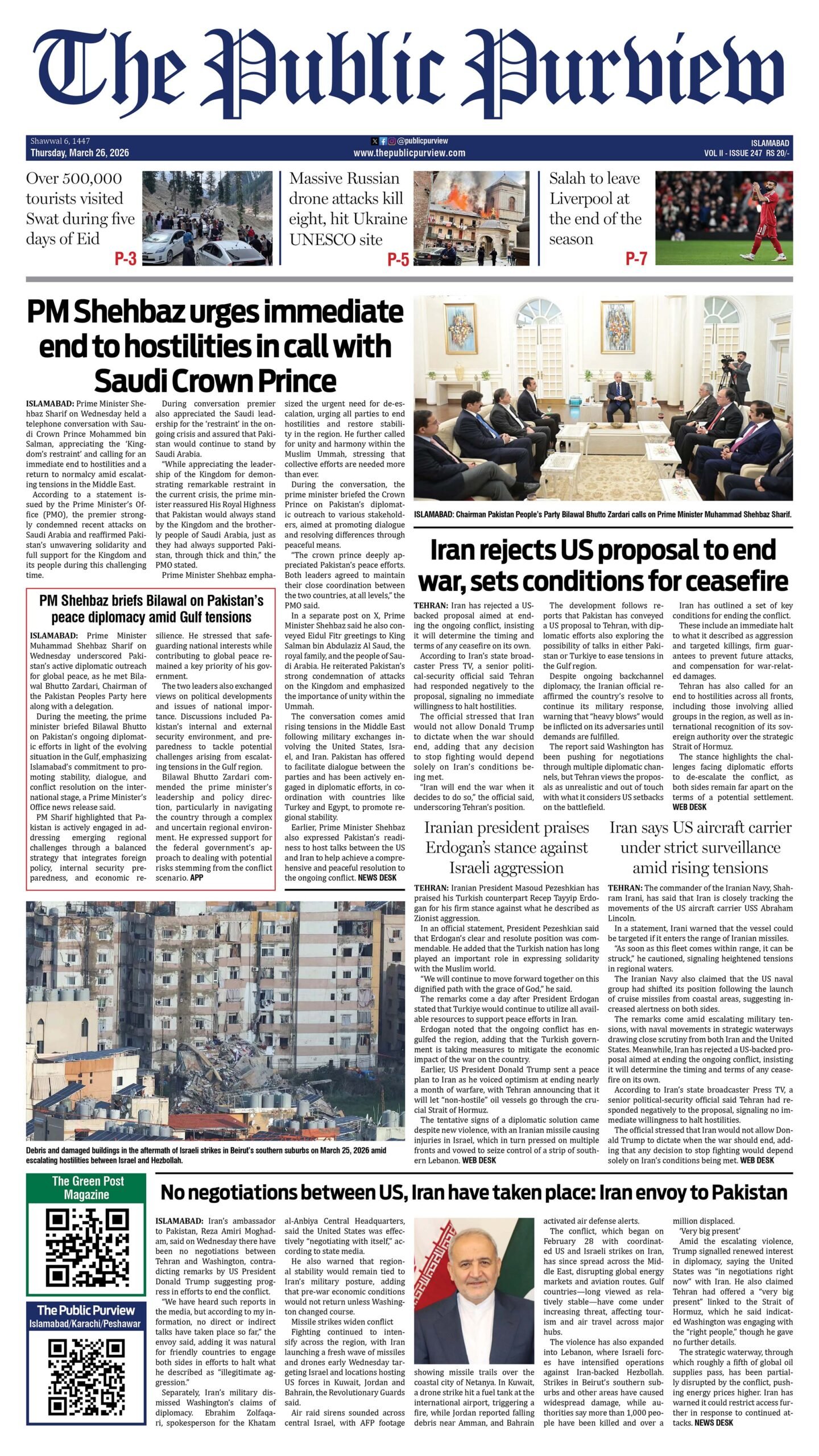 Today's E-Paper