
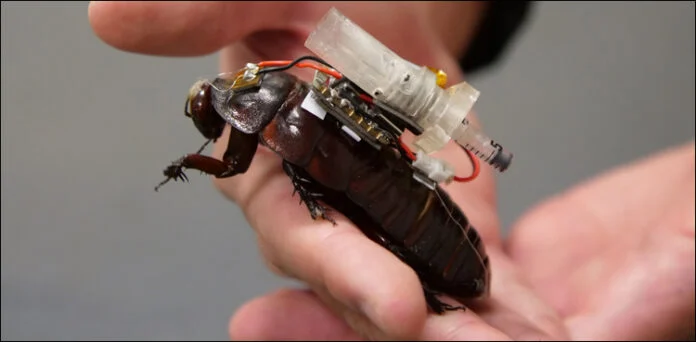
SYDNEY: Australian researchers have developed remotely controlled cyborg cockroaches equipped with miniature cameras and drug-delivery devices, with the technology being explored for use in search-and-rescue operations after disasters.
The insects, known as “paraborgs,” were developed by researchers from the University of Queensland and the University of New South Wales. The team believes they could eventually be used to navigate narrow, difficult-to-reach spaces in collapsed buildings and deliver basic medical assistance to trapped survivors before conventional rescue teams arrive.
How the Cyborg Cockroaches Work
The researchers fitted giant burrowing cockroaches from northern Queensland with small backpacks containing cameras and syringe-based drug-delivery systems.
Electrodes implanted in the insects’ nervous systems allow operators to remotely stimulate their movement and guide them in a desired direction.
Researchers said real cockroaches were chosen because of their agility, durability and relatively low energy requirements, which can be difficult to replicate with small robots.
Before the electrodes are implanted, the cockroaches are anesthetized and immobilized, according to the research team.
Cameras and Drug Delivery
The researchers tested different roles for the insects. One cockroach was equipped with a camera to help operators locate targets, while another carried medication that could be remotely activated for delivery.
The experiments recorded a 100% success rate in reaching designated checkpoints, while the overall medication-delivery success rate was 72%. When delivery was attempted within 15 centimetres of a target, the success rate increased to 95%.
The findings were published in the journal Advanced Science.
Potential Use in Disaster Rescue
Researchers said the technology could eventually help stabilize injured people in situations where every minute matters, including collapsed buildings and other hard-to-access environments. Potential applications could include delivering emergency medication for snake bites or severe allergic reactions.
The team envisions deploying multiple cyborg cockroaches as a network capable of searching large areas inside collapsed structures and helping rescuers locate survivors more quickly.
However, the technology remains experimental. Tests were conducted under controlled laboratory conditions using silicone targets and pig skin. Researchers said further work is needed to address challenges such as complex terrain, loss of communication signals inside collapsed structures and the safety of remotely triggered injections.
The study also noted that ethical guidelines for research involving insects are not yet standardized. The researchers said the cockroaches were kept in suitable conditions and provided with food during the experiments.