
Beijing, Feb 8, 2026 — Chinese researchers say they have identified a core brain network involved in Parkinson’s disease, a discovery that could improve treatment for both the movement-related and non-motor symptoms of the condition.
The findings come from a research team led by Professor Liu Hesheng at Changping Laboratory and were published this week in the journal Nature. Scientists involved in the study said targeted medical intervention based on the newly identified network has already shown positive results in clinical settings.
Parkinson’s disease affects more than 5 million people in China, accounting for about two-fifths of the global patient population, according to the China Parkinson’s Disease Report 2025. The disease is the world’s second most common neurodegenerative disorder after Alzheimer’s and presents a growing public health challenge.
Beyond movement symptoms
Parkinson’s has long been understood primarily as a movement disorder, marked by tremors, slowed motion, and walking difficulties. However, many patients also experience non-motor symptoms such as low blood pressure, sleep disruption, and digestive problems, which have been harder to explain and treat.
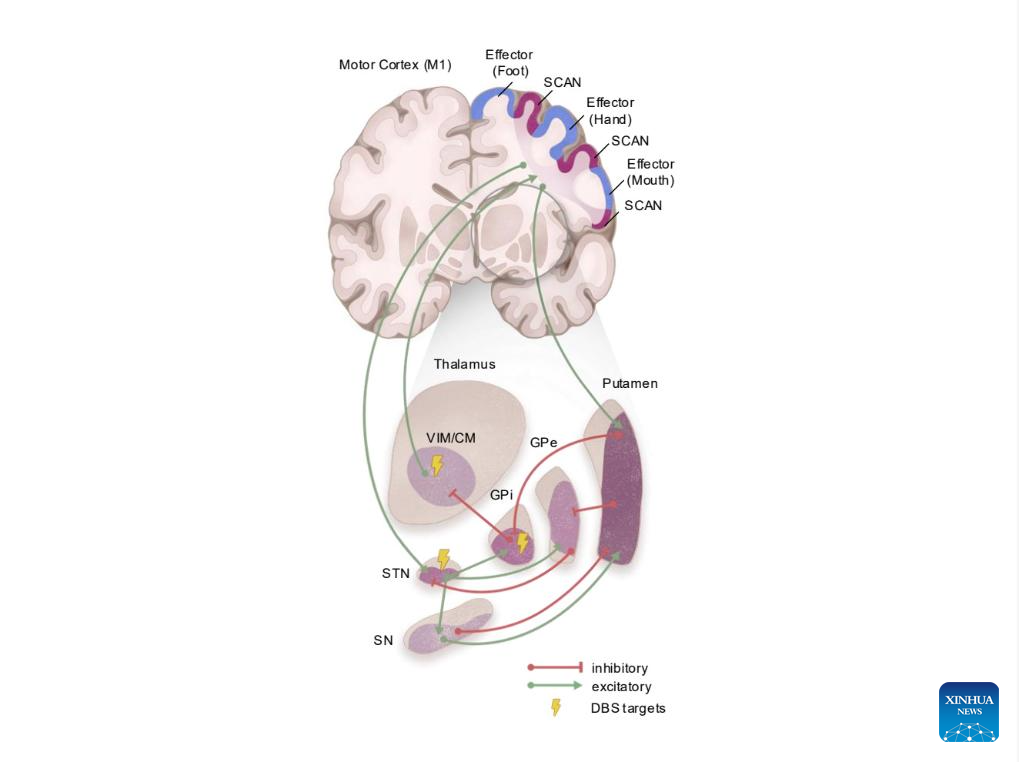
The new study, which analyzed data from more than 800 Parkinson’s patients, found that the disease consistently affects a brain system known as the somato-cognitive action network, or SCAN. This network, located in the brain’s cortex, connects regions involved in movement control, including the basal ganglia and thalamus.
Researchers found that the connections between SCAN and these regions are abnormally strengthened in patients with Parkinson’s disease. They said this abnormal connectivity helps explain why the condition affects both motor and non-motor functions.
Implications for treatment
Scientists involved in the research said identifying this core network provides a clearer target for treatment approaches that address the underlying mechanisms of the disease rather than isolated symptoms.
Building on this work, Liu’s team has supported the development of a precision brain circuit stimulator by Galaxy Brain Scientific Inc.. The device is designed to target affected brain regions with millimeter-level accuracy.
Earlier research by the team also led to the development of Personalized Brain Functional Sectors, a system that maps individual brain function in detail and guides highly targeted magnetic stimulation. Combined with real-time navigation, the approach allows doctors to locate treatment targets in seconds, compared with up to half an hour using traditional methods, according to company officials.
The stimulator uses transcranial magnetic stimulation, a non-invasive technique that applies magnetic fields to influence neural activity. Researchers said the refined targeting could improve treatment outcomes and reduce side effects.
The team noted that the findings may not only improve Parkinson’s care but also contribute to broader understanding of how brain networks drive complex neurological disorders.





 Today's E-Paper