
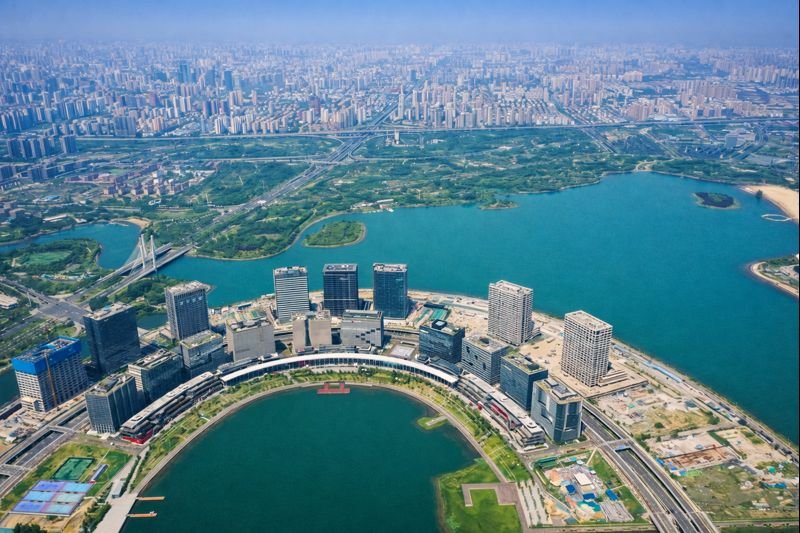
China’s urban renewal drive is reshaping disused factories and aging districts into cultural and leisure destinations, helping cities create new consumption spaces while preserving industrial heritage, according to officials and local data.
Across several provinces, local governments and businesses have repurposed former industrial sites into creative parks, teahouses, and cultural venues, attracting visitors and boosting spending. The projects reflect a broader policy shift toward high-quality urban development that emphasizes heritage protection, service consumption, and livability.
In Zhengzhou, central China’s Henan Province, an abandoned washing products factory founded in 1952 has been transformed into the “Zhengzhou Memory 1952” creative park. The Soviet-style complex ceased production in 2006 and underwent a three-year renovation starting in 2019. Today, the site hosts cultural venues, restaurants, performance spaces, and market stalls, with old production lines and storage facilities repurposed for exhibitions and live events.
Local managers say the park now houses more than 230 shops and around 100 market stalls spanning catering, cultural creativity, entertainment, and immersive experiences. During the 2026 New Year holiday, it received more than 250,000 visitors and generated over 11 million yuan ($1.57 million) in revenue, according to park operators.
From factories to cultural venues
Similar transformations are underway in other cities. In Chengdu, a former lacquerware factory in Qingyang District has been renovated into Daqi Teahouse, a venue that combines tea culture, performances, and exhibitions of intangible cultural heritage. The project preserved the original structure while adapting it for new uses, local officials said.
District authorities said the approach avoids large-scale demolition and instead treats old buildings and traditional crafts as assets for developing new consumption scenarios. Managers at Daqi Teahouse said the venue regularly hosts tea art performances, Sichuan opera shows, and craft workshops.
Policy backing and investment
Urban renewal has been identified as a priority in national planning. Guidance from the Central Urban Work Conference held in July 2025 highlighted renewal as a tool to optimize urban structure, improve quality of life, advance green development, and protect cultural heritage.
According to the Ministry of Housing and Urban-Rural Development, China invested 133.2 billion yuan last year to renovate 27,100 old urban residential communities, benefiting nearly 5 million households. Authorities have also expanded pocket parks, recreational spaces, and urban greenways to improve city environments.
With further urban renewal planned through 2026 and the 15th Five-Year Plan period (2026–2030), local governments expect more city-specific upgrades of industrial zones, historic districts, and older neighborhoods to generate new forms of consumption and economic activity.



 Today's E-Paper