
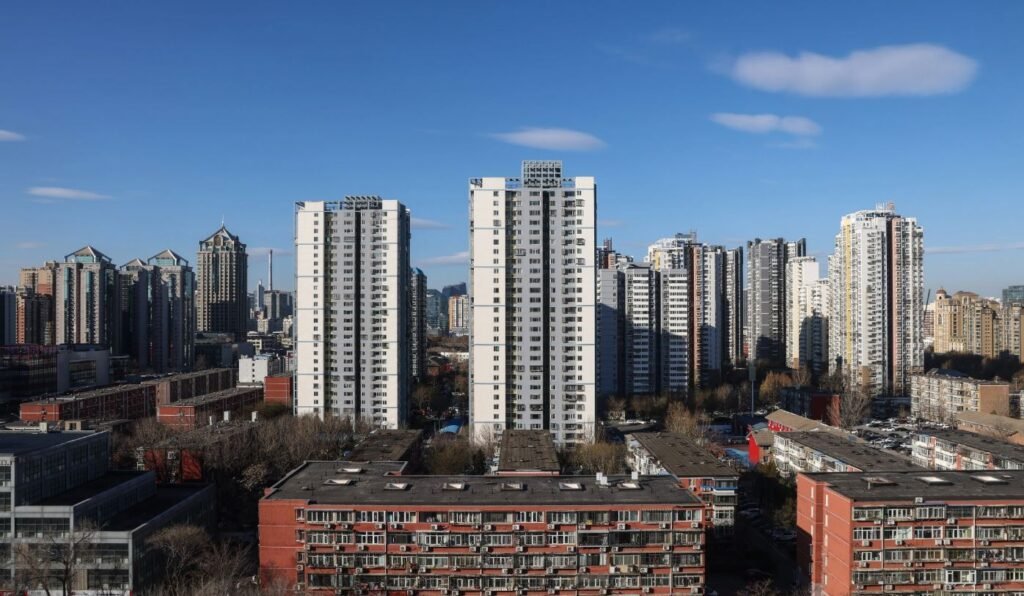
HANGZHOU: China’s shift towards resident-led urban renewal is transforming aging residential communities into safer, modern neighborhoods, with homeowners increasingly financing reconstruction projects instead of relying entirely on government funding or property developers.
A pioneering project in Hangzhou, capital of east China’s Zhejiang Province, has demonstrated how residents can take the lead in rebuilding deteriorating housing while sharing costs with local authorities.
At Zhegong Xincun, a residential compound in Hangzhou’s Gongshu District, 548 homeowner households contributed 499 million yuan (approximately $74.32 million), covering more than 80 percent of the reconstruction cost. The government financed the remaining amount.
The project replaced 13 aging six-story residential buildings with seven modern mid-rise buildings featuring green spaces and shared facilities. The reconstructed compound was completed in February 2025.
Unlike conventional redevelopment schemes, which often involve government-funded relocation, compensation and large-scale demolition, the Hangzhou initiative allowed homeowners to collectively finance improvements to their existing community.
The approach is gaining attention as China moves away from extensive urban expansion towards improving existing buildings, infrastructure and public spaces.
Similar initiatives are being tested in cities including Harbin in northeast China’s Heilongjiang Province and Shenzhen in southern Guangdong Province.
Urban planning experts say resident-led redevelopment could help overcome financial and administrative challenges that have historically delayed the renovation of older residential areas.
Wu Songtao, a professor at the School of Architecture and Design at Harbin Institute of Technology, said small and scattered redevelopment sites often generate limited returns for commercial developers, while disagreements over compensation can stall projects.
China’s State Council acknowledged this changing development landscape during an executive meeting in May, highlighting the country’s transition from large-scale urban expansion towards improving the quality and efficiency of existing urban areas.
Zheng Degao, vice president of the China Academy of Urban Planning and Design, said the new approach prioritises revitalising existing buildings, factories, neighborhoods and public spaces rather than relying on widespread demolition.
He emphasised that governments, businesses and property owners should share both the costs and benefits of urban renewal.
The experience of Zhegong Xincun illustrates how this model can work in practice.
Originally built during the 1980s and 1990s to accommodate faculty members of Zhejiang University of Technology, the compound occupies a valuable location in central Hangzhou, close to shopping centres, metro stations and a major hospital.
Despite its location, the buildings had deteriorated significantly over the decades.
Residents reported structural settlement, cracked walls, damaged doors and windows, and other safety concerns.
A resident surnamed Yu recalled that plaster would crumble easily and that the condition of the buildings had become a constant source of anxiety.
Earlier attempts to reinforce the structures provided only temporary relief because settlement and cracking continued.
Previous redevelopment proposals also failed to secure sufficient support from homeowners.
Residents said plans considered in 2014 and 2018 did not proceed, partly because of disagreements over compensation and the financial burden on public authorities.
The breakthrough came when local officials began exploring a model that would give homeowners greater responsibility for financing and directing the redevelopment.
Preparatory work began in mid-2022, while community consultations in April 2023 helped establish a resident-led approach supported by local urban renewal policies.
Gongshu District formed a dedicated task force to coordinate government departments, examine regulatory requirements and explain the proposed arrangement to residents.
Li Yin, a district official, said the greatest challenge was building consensus among homeowners.
According to Li, the project required changing residents’ attitudes from viewing redevelopment as a government responsibility to recognising their own role in improving living conditions.
A voluntary committee comprising 13 resident representatives was established to coordinate discussions and submit a formal redevelopment application.
By late August 2023, 547 of the compound’s 548 homeowner households had signed agreements, achieving a participation rate of 99.82 percent.
The final homeowner signed in May 2024, allowing the project to proceed with unanimous agreement.
Li said the last resident eventually accepted the proposal after becoming convinced that the process was fair.
Under the financing arrangement, residents contributed according to their housing requirements, including additional living space and parking facilities.
Yu said she paid nearly 980,000 yuan for the reconstruction of her original 76-square-metre apartment, an additional 19 square metres of living space and a parking space.
Having originally purchased the apartment for 1.51 million yuan, she said the combined expenditure remained below the prevailing market value of comparable housing.
The project also addressed the needs of elderly residents, who formed a substantial proportion of the community.
At the time redevelopment began, 208 residents were aged 80 or above, including 36 aged at least 90.
Some elderly homeowners were concerned that prolonged construction could prevent them from returning, while others faced difficulties arranging temporary accommodation.
To ease the transition, the project team arranged assistance with relocation, including ambulance transportation for several residents over 90.
Temporary accommodation was also secured for elderly residents, with accessibility improvements such as shower seats and bathroom grab bars.
Following the completion and handover of the reconstructed compound in 2025, approximately 70 percent of households had moved into their new homes, while residents continued interior renovation work.
Experts noted, however, that Zhegong Xincun benefited from the relatively strong financial position of many homeowners, most of whom were university faculty members or their families.
This helped make the substantial household contributions possible, suggesting that similar projects elsewhere may require financing arrangements suited to residents’ economic circumstances.
The Hangzhou initiative forms part of China’s broader strategy to modernise existing urban communities while reducing dependence on large-scale land acquisition and developer-led construction.
Under the country’s urban renewal plans for the 15th Five-Year Plan period (2026–2030), China aims to renovate 500,000 units of dilapidated urban housing and 115,000 older residential communities.
The programme supports homeowner participation, on-site demolition and reconstruction, and sustainable financing arrangements for neighborhood redevelopment.
Xu Lin, a professor at Zhejiang University, said the resident-led model had created a new pathway for urban renewal as China entered a different stage of urbanisation.
Rather than concentrating on expanding cities through extensive construction, authorities are increasingly focusing on improving the safety, quality and functionality of existing residential areas.
The Zhegong Xincun experience demonstrates how cooperation between homeowners and local governments can help overcome redevelopment obstacles while improving living conditions in established urban communities.