
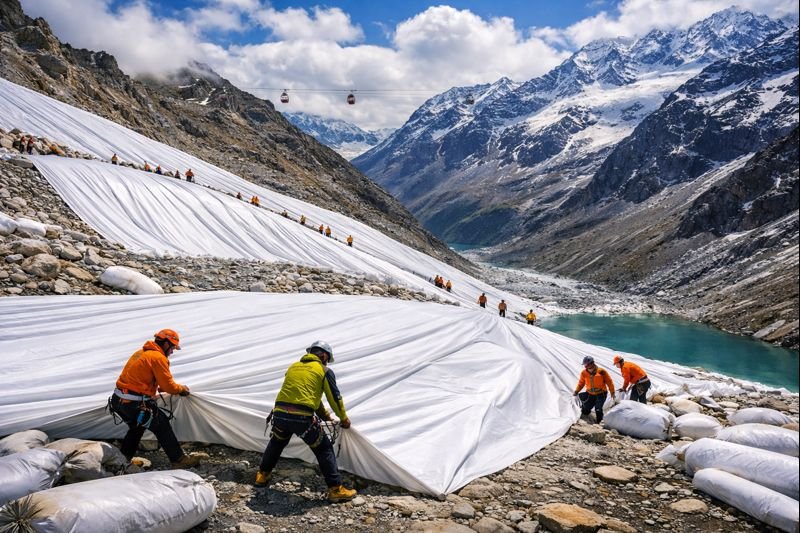
China has begun testing the use of white geotextile blankets to slow glacier melting in limited areas, an approach that has shown measurable results at small scales but remains constrained by cost and logistics, according to research conducted by Chinese scientists.
The trials, carried out on sections of the Dagu Glacier in southwest China’s Sichuan province, demonstrate that covering ice with reflective material during warmer months can significantly reduce local melting. However, researchers stress that the technique does not address the underlying cause of glacier retreat: rising global temperatures driven by climate change.
How the glacier blanket experiment works
In 2019, researchers from the Chinese Academy of Sciences covered approximately 500 square metres of the Dagu Glacier with white geotextile material during the summer melt season. The blankets were designed to reflect sunlight and limit heat absorption, increasing the glacier’s albedo — its ability to reflect solar radiation.
After about two and a half months, the coverings were removed. Measurements showed that the protected ice was up to one metre thicker than nearby uncovered areas, indicating a substantial reduction in melting at the test site.
Measured reductions in ice loss
Follow-up monitoring found that melting in the covered area fell by around 34% between August 2020 and October 2021. Similar trials in other locations and studies have reported summer melt reductions ranging from 59% to 70% in protected sections.
Scientists note, however, that the benefit is strictly local. Ice outside the covered zones continues to melt at normal rates, limiting the overall impact on glacier systems.
Limits to scaling the approach
Researchers say the technique cannot be applied on a large scale. Covering the world’s glaciers — estimated to span more than 250,000 square kilometres — would require extensive resources, continuous maintenance, and seasonal replacement of materials. Even with significant reductions in local melting, the costs would be prohibitive.
Also Read: Lanzhou uses acoustic technology to monitor, protect birdlife
The blankets also degrade over time and must be carefully managed to avoid leaving debris or residue on sensitive ice surfaces.
China’s glacier loss and rising risks
China has already lost about 26% of its total glacier area since 1960, with roughly 7,000 smaller glaciers disappearing entirely during that period. In regions such as the Qilian Mountains and the Tibetan Plateau, shrinking glaciers are increasing pressure on freshwater supplies that support millions of people.
Accelerated melting also raises the risk of landslides, flash floods, and the collapse of natural dams formed by ice and debris.
A temporary measure, not a climate solution
Scientists say geotextile blankets may help protect specific sites, such as tourist attractions, vulnerable slopes, or strategically important water sources where short-term intervention is needed. The method is being discussed alongside other cryosphere-focused efforts under international initiatives, including the International Year of Glaciers’ Preservation 2025 and the Decade of Action for Cryospheric Sciences (2025–2034).
Researchers emphasize that while the blankets can buy time in select locations, they do not replace the need for broader reductions in greenhouse gas emissions, which remain the primary driver of global glacier retreat.





 Today's E-Paper