
BEIJING: China’s newly adopted 15th Five-Year Plan (2026–2030) places technology-driven industrial development at the center of its economic strategy, outlining measures to accelerate the adoption of advanced technologies across the country’s manufacturing sector.
The plan, approved this week, highlights the integration of scientific innovation with industrial production, aiming to move emerging technologies from research laboratories to factory floors. Officials say the approach is designed to strengthen productivity, expand high-tech industries and support long-term economic growth.
Under the plan, sectors such as next-generation information technology, new energy, advanced materials, intelligent connected vehicles, robotics, biomedicine, high-end equipment manufacturing and aerospace have been identified as strategic emerging industries.
Policymakers also highlighted several future technologies for development, including quantum technology, hydrogen and nuclear fusion energy, brain–computer interfaces, embodied artificial intelligence and 6G communications.
Analysts say these sectors are expected to drive new industrial opportunities and expand China’s high-tech economy over the coming decade. Government projections indicate that emerging pillar industries could exceed 10 trillion yuan in output by 2030.
Role of technology companies
Chinese technology companies are already moving to commercialize innovations developed through research and development programs.
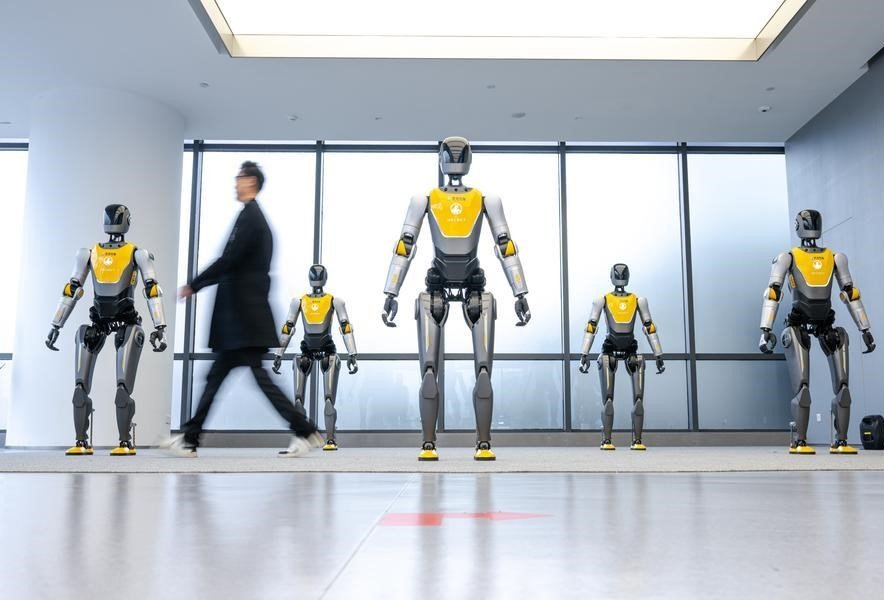
Recent demonstrations of humanoid robots during national celebrations attracted widespread attention, and developers are now deploying similar systems in practical settings such as manufacturing facilities and logistics operations.
Companies such as Shenzhen-based robotics developer UBTECH have begun supplying humanoid robots for use in industrial production environments, including cooperation agreements with international manufacturers.
The plan encourages companies to take a larger role in innovation, calling for stronger participation by enterprises in research projects, investment decisions and technology commercialization.
Authorities also encourage major technology firms to form collaborative research partnerships known as “innovation consortia,” aimed at accelerating the development and testing of key technologies.
Government support for technology transfer
Government-backed pilot platforms will play a role in helping new technologies move from research to commercial application.
The plan highlights initiatives such as artificial intelligence application pilot bases designed to test and scale new technologies before large-scale deployment in industry.
Officials describe the innovation process as a three-stage model: research institutions achieve early scientific breakthroughs, pilot platforms test practical applications, and companies scale the technology for industrial use.
To support digital transformation in manufacturing, China has also introduced a national smart factory certification system. The program offers incentives such as financing support, tax benefits and policy preferences to qualified facilities.
As of 2025, China had built more than 35,000 basic-level smart factories, over 8,200 advanced-level facilities, more than 500 excellence-level factories and 15 flagship smart factories nationwide.
Opportunities for international cooperation
The plan also aims to attract foreign investment in advanced manufacturing, modern services, green energy and high-technology sectors.
International companies have already expanded research and development activities in China. Pharmaceutical company AstraZeneca recently opened a global R&D center in Beijing, while Bayer has expressed plans to continue investing in the Chinese market.
Policy advisers say the strategy reflects China’s broader shift from rapid economic expansion toward high-quality development driven by innovation.
Experts note that technological innovation is expected to play a central role in shaping the next phase of China’s economic growth and industrial transformation.


 Today's E-Paper