
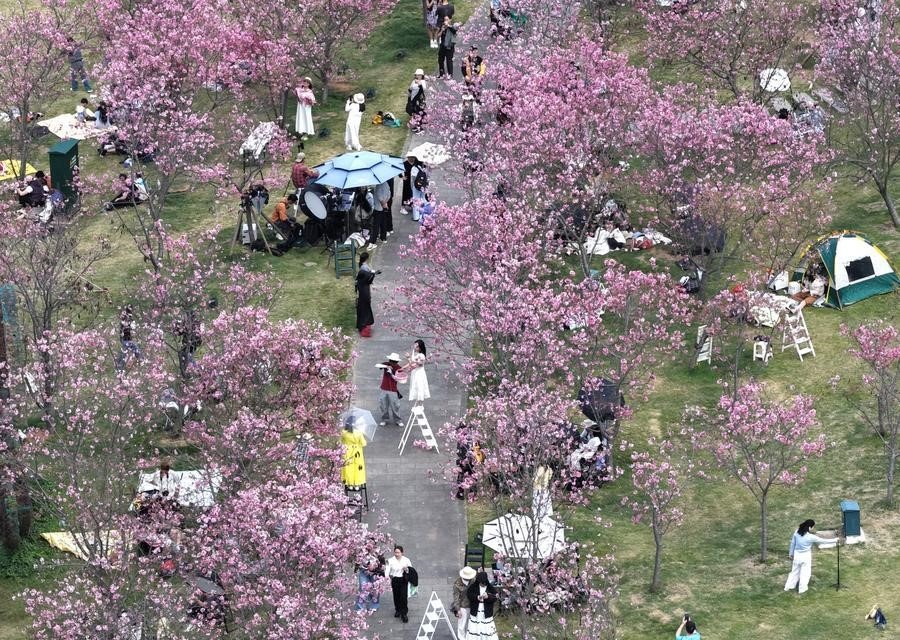
China is exploring changes to its national holiday and paid leave system as policymakers seek to improve work-life balance while encouraging domestic consumption in the world’s second-largest economy.
The discussion gained attention during the recent annual sessions of China’s national legislature and the country’s top political advisory body, where officials and policy advisers proposed reforms aimed at giving citizens more flexibility in scheduling vacations and using paid leave.
The government’s latest work report suggested introducing spring and autumn breaks for primary and secondary school students in regions where conditions permit. It also proposed implementing a system of staggered paid leave, designed to distribute travel and leisure activities more evenly throughout the year.
Shift toward flexible holiday policies
The proposals signal a gradual shift in China’s policy thinking about holidays and leisure time. Previous government work reports focused on implementing paid leave, but the latest discussions emphasize a more flexible system that spreads travel demand across multiple periods instead of concentrating it during national holidays.
Officials say staggered leave could reduce pressure during peak travel periods such as the October “Golden Week” holiday, while encouraging steadier consumption patterns throughout the year.
Gordon Lam, a deputy to the National People’s Congress and chief supply chain officer of Sinopec in Hong Kong, said spreading vacation time across different periods could improve travel experiences and reduce congestion at popular tourist sites and public facilities.
School breaks could encourage family travel
The proposal to introduce spring and autumn breaks for school students has also drawn attention as a potential way to encourage family travel outside traditional peak seasons.
A pilot program conducted in Sichuan Province in 2025 offered an early example of the potential economic impact. During a five-day autumn break in November, ticket bookings for tourist attractions in the province rose more than fourfold compared with the same period in 2024. Flight bookings departing Chengdu also increased by about 22 percent during the same period, according to local media reports.
However, lawmakers say the system would need to be coordinated with workplace leave policies to allow families to travel together.
Coordination between schools and workplaces
Zhao Wanping, a deputy to the National People’s Congress and vice head of the Anhui Academy of Agricultural Sciences, suggested linking school holiday schedules with paid leave arrangements for parents.
Lu Ming, a member of the Chinese People’s Political Consultative Conference National Committee and a professor at Shanghai Jiao Tong University, said employers could provide more flexibility during school breaks so parents can adjust work schedules or take leave.
Where parents cannot take time off, schools and community organizations could organize educational activities, study trips or recreational programs with government support.
Balancing reforms with business needs
Policy advisers note that implementing new holiday arrangements will require balancing workers’ needs with operational considerations for businesses.
Some experts have proposed linking companies’ compliance with leave policies to incentives such as tax benefits or credit evaluations to encourage better implementation of labor regulations.
Tian Xuan, a National People’s Congress deputy and professor at Peking University, also suggested reviewing the current practice of rearranging workdays around holidays, which often requires employees to work additional days before or after extended breaks.
Analysts say a well-designed holiday system could support economic activity by stimulating sectors such as tourism, transportation, catering and entertainment.
Yu Miaojie, a National People’s Congress deputy and president of Liaoning University, said stronger legal protections may also be needed to ensure employees can take leave without concerns about negative performance evaluations or career consequences.

 Today's E-Paper