
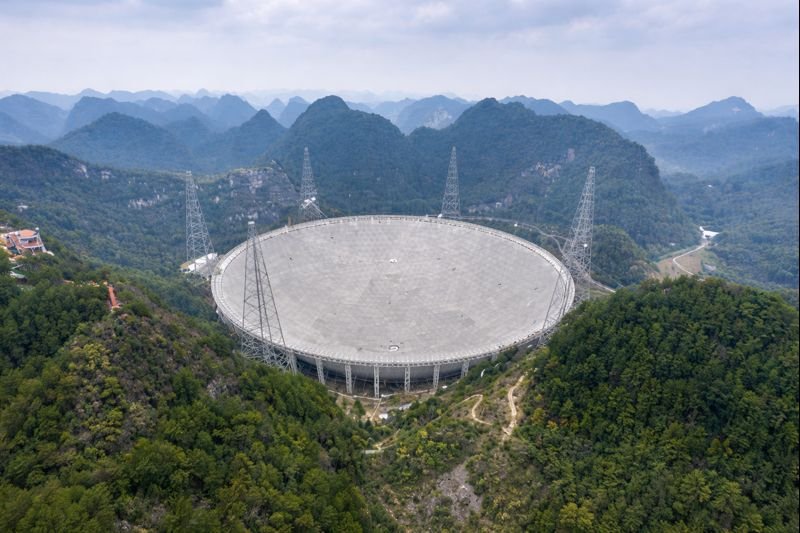
Chinese astronomers have identified the birth environment of a mysterious cosmic signal after years of observation, concluding that a repeating fast radio burst originates from a young supernova remnant. The finding follows long-term monitoring with China’s Five-hundred-meter Aperture Spherical radio Telescope and offers new evidence about where some of the universe’s most powerful radio flashes are formed.
The discovery matters for astronomy because the origin of fast radio bursts has remained one of the field’s most persistent questions since the signals were first detected in 2007. By tracking changes in a single source over multiple years, researchers were able to link the bursts to the aftermath of a stellar explosion, providing rare insight into their physical environment.
The results were published in Science Bulletin by a research team from Central China Normal University, Tsinghua University, Yunnan University, and the National Astronomical Observatories of the Chinese Academy of Sciences.
Years-long monitoring reveals changing environment
Using the Five-hundred-meter Aperture Spherical radio Telescope (FAST), the team followed a repeating source known as FRB 20190520B, first identified in 2019. The burst is unusual because it has remained active continuously, allowing scientists to observe its behavior over time.
Analysis of more than 400 bursts showed a steady decline in a key signal property known as dispersion measure, which reflects how much material the radio waves pass through. Researchers said the gradual decrease indicates that the surrounding environment is expanding and becoming less dense.
Evidence points to young magnetar after supernova
The data suggest the bursts are powered by a young magnetar — a highly magnetized neutron star — embedded within a supernova remnant. As the debris from the explosion expands, the density of plasma drops, explaining the observed changes in the signal.
Models based on the observations indicate the remnant is only about 10 to 100 years old, making it extremely young on cosmic timescales. Scientists said this provides direct observational support for a long-standing theory linking some repeating radio bursts to the deaths of massive stars.
FAST’s role in future discoveries
Researchers noted that similar long-term changes may be common among young, active repeating bursts and said FAST’s sensitivity makes it especially suited for detecting faint, persistent signals. Continued monitoring could help identify additional sources and clarify how different types of fast radio bursts are produced.
FAST, located in a karst depression in southwest China’s Guizhou Province, is the world’s largest single-dish radio telescope and began formal operations in 2020. It was opened to international scientists in 2021.





 Today's E-Paper