
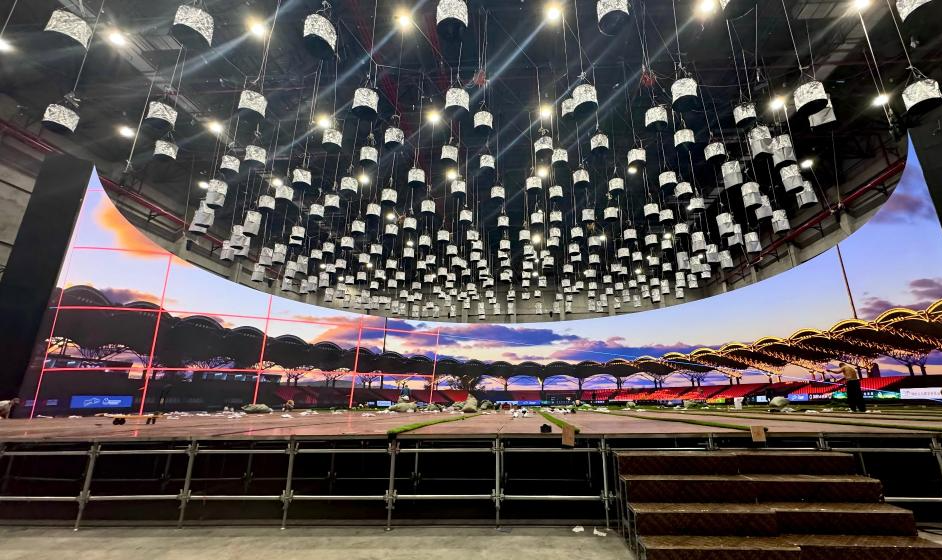
HANGZHOU: China’s film industry is rapidly adopting artificial intelligence (AI) and virtual production technologies, reshaping how movies are made and boosting efficiency. At an AI virtual film base in Deqing, Zhejiang Province, filmmakers recently recreated Hong Kong’s Kai Tak Sports Park inside a studio using the world’s largest single-structure LED screen. The 50-meter curved display rendered a stadium packed with cheering digital spectators, offering an immersive experience without the need for costly on-location shoots.
Versatile Media, the Hangzhou-based company behind the facility, said the technology allows crews to blend virtual and physical elements seamlessly. “Shooting on location is difficult and expensive, especially for long periods. The virtual studio fulfills creative needs by bringing a whole stadium indoors,” explained project coordinator Niu Cong.
Since opening in July 2025, the Deqing base has hosted more than 30 film projects and signed nearly 10 companies in 2026. It is also expanding into AI-generated short dramas, with 89 projects planned this year.
Other studios across China are also embracing digital innovation. In Yangzhou, Jiangsu Province, a constant-temperature water scene studio uses digital intelligence to simulate over 200 wave types, enabling realistic underwater filming without heavy reliance on post-production effects. In Chongqing, a digital set workshop allows crews to swap scenes instantly, cutting set costs by 90 percent and improving shooting efficiency by more than 50 percent.
Industry experts say these advances mark a fundamental shift in filmmaking. “The application of AI technology is not just an innovation at the tool level. It brings a revolution to the filmmaking workflow,” said Wang Shu of the China Science Writers Association. He added that AI-powered film and television creation will drive greater efficiency and intelligence across the sector.




 Today's E-Paper