
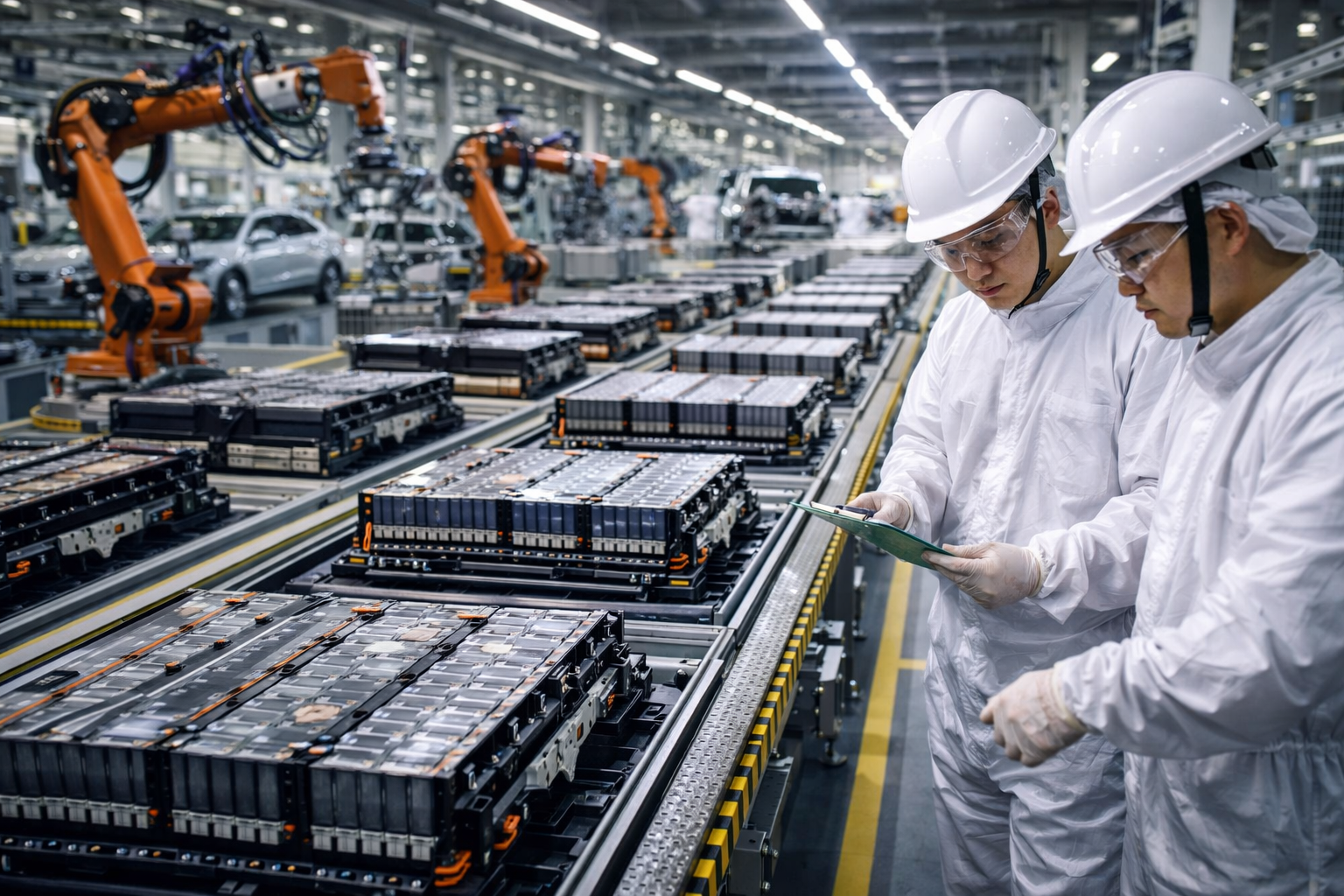
Chinese battery manufacturers CATL and BYD strengthened their positions in the global EV battery market in January, reflecting the growing international reach of China’s electric vehicle supply chain and the rising demand for battery-powered transport.
Global electric vehicle battery installations outside China reached 32.7 gigawatt-hours (GWh) in January, marking a 13.7 percent increase compared with the same month last year, according to data from market analysis firm SNE Research. Industry analysts say the expansion highlights the competitiveness of China’s new energy vehicle (NEV) industrial chain, which combines cost efficiency with safety-focused battery technologies.
CATL maintains top position outside China
CATL, the world’s largest EV battery supplier, retained the leading position in markets outside China with battery installations totaling 11.2 GWh in January, representing a 26.5 percent increase year-on-year.
The company has broadened its global presence by supplying batteries to international automakers including Volkswagen and Audi. Growth has been particularly strong in Europe and several emerging markets, supported by increasing battery capacity in electric vehicles produced by Chinese manufacturers.
While lithium-ion batteries remain the core of CATL’s product portfolio, the company is also advancing sodium-ion battery technology as part of its strategy to strengthen competitiveness in next-generation energy storage solutions.
BYD expands international footprint
BYD ranked third globally with battery installations of 3.7 GWh, recording an 86 percent year-on-year increase.
Analysts attribute the company’s growth partly to its vertically integrated business model, which combines electric vehicle manufacturing with in-house battery production. The company has also expanded its global presence through increased international investment and exports.
The report noted that BYD is investing in sodium-ion battery production and aims to establish an annual production capacity of around 30 GWh to support future demand.
Korean battery makers lose market share
The three leading South Korean battery manufacturers — LG Energy Solution, SK On and Samsung SDI — saw their combined global market share fall to 25.5 percent in January, down 10.4 percentage points compared with the same period last year.
LG Energy Solution’s battery installations declined 16.2 percent to 4.4 GWh. SK On recorded a 21.3 percent drop to 2.3 GWh, while Samsung SDI saw installations decrease 24.4 percent to 1.6 GWh.
The slowdown has been linked to weakening electric vehicle sales in the United States, a key market for Korean battery suppliers.
Competition intensifies across EV battery industry
Several other Asian manufacturers also ranked among the world’s leading EV battery suppliers. Japan’s Panasonic placed fourth globally with battery installations of 3.1 GWh and a 9.5 percent market share, while Chinese companies Gotion High-tech and CALB ranked seventh and ninth respectively.
Also Read: China controls over 70% of global EV batteries, led by CATL and BYD
Industry observers say the competition among global battery makers increasingly reflects broader factors such as supply-chain resilience, technological innovation and the ability to respond to shifting geopolitical pressures.
Sun Xiaohong, secretary-general of the automotive branch of the China Chamber of Commerce for Import and Export of Machinery and Electronic Products, said Chinese manufacturers have gained recognition among global automakers by focusing on cost-efficient and safe battery technologies, particularly lithium-iron-phosphate batteries.
Analysts expect Chinese companies to continue expanding their presence in the global EV battery market as automakers diversify supply chains and price competition intensifies across the electric vehicle industry.




 Today's E-Paper