
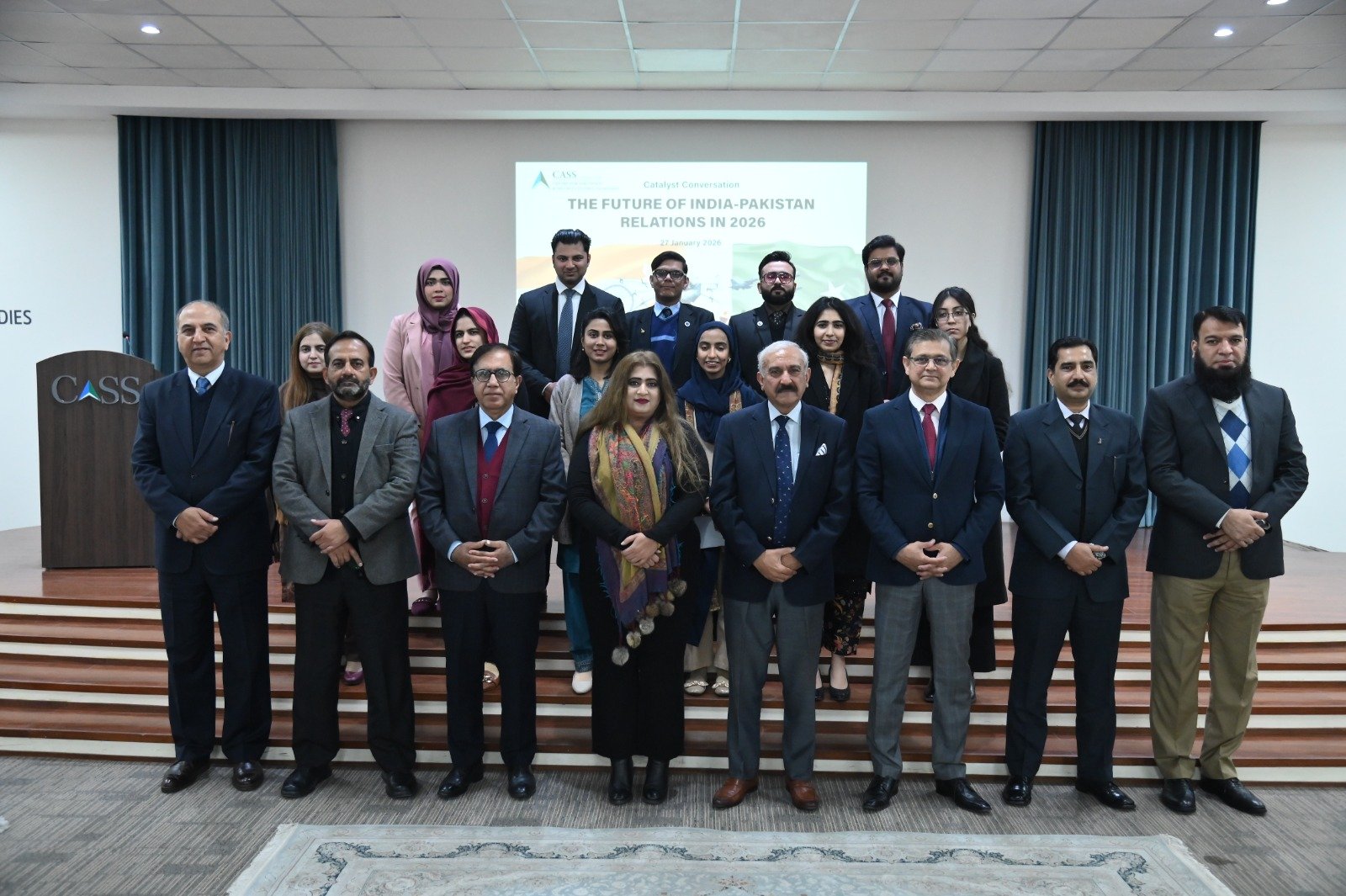
Islamabad — The Centre for Aerospace & Security Studies (CASS) on Monday hosted a guest lecture examining the post-2025 strategic environment in South Asia and the prospects for stability between India and Pakistan following last year’s conflict. The session, titled “The Future of India-Pakistan Relations in 2026,” brought together academics and security experts in Islamabad to assess how recent developments are reshaping regional security dynamics.
The discussion focused on the implications of the May 2025 war between the two nuclear-armed neighbours, with speakers highlighting how changes in warfare, technology, and geopolitics could affect crisis stability and escalation control in the coming years.
Shifting nature of conflict
Moderating the session, Zahid Mehmood, Air Marshal (Retd), said the 2025 conflict had significantly altered South Asia’s strategic landscape. He noted that future confrontations are likely to involve multiple domains, including air, cyber, space, and maritime operations, increasing the complexity of managing escalation. He added that evolving geopolitical alignments and emerging regional flashpoints could continue to fuel instability, underscoring the need for adaptive security policies.
Lessons from the 2025 war
In her address, Maria Sultan, President of the South Asian Strategic Stability Institute (SASSI), said the May 2025 war marked a structural shift in the pattern of India-Pakistan confrontation. She explained that future conflicts are expected to rely less on large-scale land operations and more on air power, supported by cyber, space, maritime, and intelligence capabilities.
Dr Sultan observed that while earlier assumptions placed the focus of major fighting in the southern theatre, the recent crisis indicated that the northern theatre could become the primary arena for high-intensity operations, with supporting actions elsewhere. She also pointed to the increased use of precision strikes extending deeper into mainland territories, reflecting changes in deterrence and response frameworks.
CASS Lahore hosts talk on shift in US National Security Strategy
Despite the intensity of the four-day conflict, she said the absence of large-scale land mobilisation suggested a preference for limited, fast-paced operations rather than prolonged conventional campaigns. Dr Sultan cautioned that future crises may increasingly target economic and strategic infrastructure, even as efforts continue to geographically contain escalation. She also noted that developments in previously marginal regions could gain strategic relevance in future scenarios.
Looking ahead, she said there were no clear indications of sustained de-escalation, warning that 2026 could see managed hostility, recurring crises, and persistent mistrust. As potential risk-reduction measures, she highlighted the importance of strengthening military communication channels, reviving back-channel diplomacy, restoring water data-sharing mechanisms, and pursuing limited confidence-building initiatives through economic, diplomatic, and multilateral platforms, including the Shanghai Cooperation Organisation and Track-II processes.
Air power and regional balance
Concluding the session, Javaid Ahmed, Air Marshal (Retd) and President of CASS, said India faces challenges in effectively integrating advanced technologies into its military structure. He noted that modern weapons systems are increasing the complexity of naval operations and said aircraft losses during the 2025 crisis led to strategic constraints for the Indian Air Force.
He added that future conflicts are likely to involve greater reliance on air assets, including unmanned systems and missile engagements, and said current capabilities in the air domain would remain a key factor shaping the regional balance of power.




 Today's E-Paper