
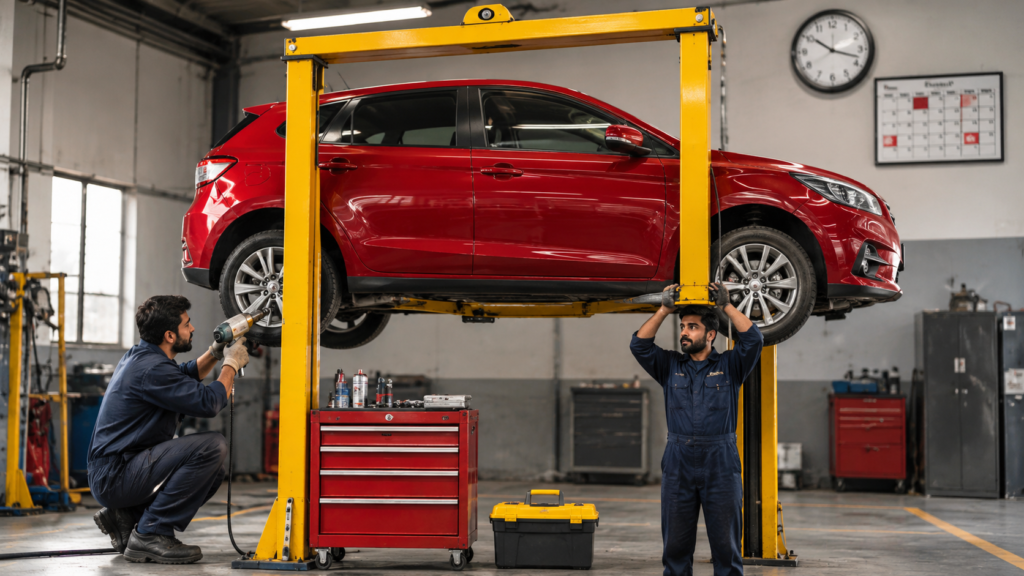
Islamabad: Car owners may be spending money on unnecessary maintenance because routine oil changes, engine tuning and major servicing are often treated as the same procedure, despite manufacturers recommending different intervals for each.
Vehicle maintenance schedules vary according to engine design, oil specifications, filtration systems and driving conditions. While some vehicles require servicing after 5,000 kilometres, others may have recommended intervals of 6,000, 10,000 or even 15,000 kilometres.
According to an automotive maintenance guide published by PakWheels, motorists should follow the service schedules provided in their vehicles’ official owner’s manuals rather than automatically agreeing to every procedure recommended by a workshop.
The guide forms part of a new series examining manufacturer-recommended maintenance intervals for individual vehicle models.
It explains that routine maintenance generally falls into three categories: periodic oil changes, engine tuning and major servicing.
Routine oil changes and filters
Regular periodic servicing primarily involves engine oil, the oil filter and inspection or replacement of the engine air filter.
Engine oil lubricates moving components, reduces friction and helps regulate engine temperature. However, prolonged exposure to heat and contamination gradually reduces its effectiveness.
Manufacturers recommend different oil grades and replacement intervals depending on the engine’s requirements.
Common engine oil grades include 0W-20, 5W-30 and 10W-40. Motorists are advised to use the viscosity grade specified in their owner’s manual rather than selecting oil solely on the basis of thickness or price.
Oil filters are commonly replaced alongside engine oil, while air filters may require inspection, cleaning or replacement depending on their condition and the manufacturer’s recommendations.
When does an engine need tuning?
Engine tuning involves inspecting and, where necessary, servicing components responsible for ignition, fuel delivery, airflow and valve operation.
Common procedures include checking spark plugs, inspecting valve clearances, cleaning the throttle body and examining fuel injectors.
However, these procedures are not necessarily required during every oil change.
For example, fuel injector cleaning is generally performed when deposits or performance problems indicate a need for servicing.
Similarly, throttle body cleaning may be necessary when carbon deposits affect airflow and cause unstable engine idling.
Spark plugs and valve clearances should also be inspected or adjusted according to the vehicle manufacturer’s maintenance schedule.
Major servicing involves additional systems
Unlike routine oil changes, major servicing covers several mechanical systems, including the transmission, brakes, cooling system and suspension.
Depending on the vehicle, maintenance may involve replacing engine coolant, transmission oil and brake fluid.
Other checks can include brake pads, tyres, drive belts, battery terminals, cooling system hoses and wheel alignment.
The required maintenance varies between vehicles, particularly those equipped with manual, automatic, continuously variable or dual-clutch transmissions.
Driving conditions can change service intervals
Driving conditions also influence how frequently a vehicle requires maintenance.
Frequent short journeys, prolonged idling, heavy traffic, dusty roads and extreme temperatures may fall under severe driving conditions specified by manufacturers.
Vehicles operating under these conditions may require more frequent maintenance than those driven under normal conditions.
Manufacturers may also specify both mileage and time limits, such as 5,000 kilometres or six months, whichever comes first.
This means a vehicle could require scheduled maintenance even if it has not covered the recommended distance.
The guide emphasises that motorists should distinguish between essential scheduled maintenance and additional workshop recommendations.
Following the manufacturer’s instructions can help vehicle owners avoid unnecessary servicing expenses while ensuring that important mechanical components receive attention when required.