

When Sir Syed Ahmed Khan, with his visionary eloquence, likened Gujrat to a ‘Hellenic region’, it was neither a mere geographical compliment nor a fictitious metaphor, but rather the prophecy of an unbroken civilizational continuum where sparks of light continue to spring even from barren earth. This very tradition assumed a luminous new chapter on the luminous Monday of August thirty-first, when a representative and intellectually vibrant delegation of book-loving circles from this township of literary luminaries—led by Rai Fasihullah Jarral, a dynamic young researcher, author of fifteen books, and the founder of the Sherani Centre for Research, Publication, and Rare Manuscripts—walked into the Central Quaid-e-Azam Library at the University of Gujrat. This arrival was not merely a mechanical meeting of two institutions or a handful of individuals, but rather an exquisite equilibrium between the private soul of the city and the institutional framework of the university, where history and the present stood eye to eye in profound dialogue.
The intellectual stature of this caravan of knowledge can be gauged by the vast horizons of the personalities it encompassed, each standing as a walking, breathing academy in their own right. This delegation included Ehsan Faisal Kunjahi—the moving spirit behind Bazm-e-Ghaneemat Kunjahi, patron-in-chief of the Sharif Kunjahi Memorial Library Kunjahi, poet, fiction writer, journalist, and the author and compiler of more than twenty-five books—whose entire life has been consecrated to the sanctity of the pen and the ignition of scholarly lamps upon the soil of Kunjahi.
Alongside him stood Sikandar Riaz Chauhan, an overseas Pakistani intellectual rooted in the Hellenic spirit, linguist, researcher, and translator, coupled with the eminent researcher, author, and senior educator Mr. Siddique Mujahid, who holds six authoritative volumes on local history to his credit. When these arbiters of intellect crossed the threshold of the Quaid-e-Azam Library, they were received with extraordinary warmth and intellectual synergy by the Chief Librarian A.R. Sheikh, Professor Mubashir Hussain of the Department of Information Technology, and Librarian Liaquat Ali, thereby emphatically demonstrating that modern universities have finally learned to step beyond their towering architectural ramparts to entwine themselves with the living, pulsating intellectual currents of the city.
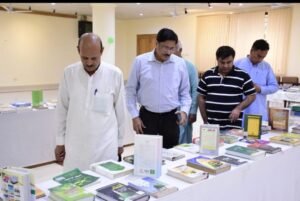
This contemporary and evolving role of universities is termed in modern academic parlance as ‘community outreach’, yet upon this soil of Gujrat, it is no passing modern fad but an innate inheritance woven into the very bloodstream. When the exhibition comprising rare and precious folios of Seerat-un-Nabi was unfurled within the Quaid-e-Azam Library, it was not merely a decorative arrangement of display shelves, but a pragmatic declaration that the University of Gujrat seeks to pull its academic syllabi out of sequestered chambers and hold them up before the collective consciousness of society. Upon observing this exhibition, when these scholars articulated their impressions, their words transcended standard pleasantries or routine tropes of praise, elevating themselves to such a lofty plane of intellectual discourse that the reader feels transported away from a mere news report and straight into the heart of a mystic symposium and an elite scholarly seminar.
Laying the foundation of this intellectual dialogue, Rai Fasihullah Jarral invoked the sanctity of manuscripts, rare books, and historical trusts, touching upon a core truth that serves as the beating heart of this entire episode. With profound intellectual insight, this intrepid voyager of research and founder of the Sherani Centre asserted that unless universities dismantle their enclosing ramparts and absorb the private libraries and individual passions of the city within their own folds, genuine intellectual societies can never be born; indeed, this exhibition at the Quaid-e-Azam Library stands as an irrefutable testament to the fact that when institutional scale and an individual’s passionate love for the book coalesce, the intellectual sterility of society is shattered forever. His eloquent observation unmasks the bitter reality that knowledge is never cultivated solely through state grants or bureaucratic curricular mandates, requiring instead the tireless devotion of kindred spirits like Rai Fasihullah who spend decades cradling rare texts against their chests in the dark corners of their homes.
When the voice of Ehsan Faisal Kunjahi joins this intellectual caravan, the relationship between creation and reading assumes an entirely new philosophical dimension. Hailing from the historic soil of Kunjahi, this master of prose articulated the nature of this bond in his distinctive essayistic idiom, declaring that our connection with the book is not merely about reciting orthography or passing examinations, but rather a vital bond of breathing and living, and when prestigious seats of learning like the University of Gujrat bring this boundless ocean of the Prophet’s biography within the reach of ordinary students and researchers, they are essentially generating illumination and solace within the parched and scorching deserts of the soul. This intellectual insight from Ehsan Faisal serves as a brilliant reminder that the editing, dissemination, and study of the Seerah is not a mere historical subject, but rather the ultimate journey toward humanity’s moral ascension and the purification of heart and intellect.
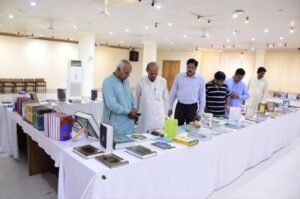
Advancing this intellectual inquiry through linguistic and investigative lenses, when Sikandar Riaz Chauhan examined this repository of biographical literature, his conceptual threads intertwined seamlessly with language, primary sources, and civilizational survival. Exercising deep linguistic comprehension, he observed that languages and histories remain vibrant and robust only when they remain anchored to their original and foundational sources, and the biographical texts housed in this exhibition have opened up fresh vistas of contemplation for the researchers of Gujrat, proving decisively that the university is no longer a detached academic island handing out degrees, but has transformed into the intellectual qibla of the city. His declaration highlights the absolute truth that as long as successive generations remain bound to foundational primary sources, the temperament of language and the identity of history can never be distorted.
And when the authoritative voice of local history, Siddique Mujahid, contemplated this exhibition against the backdrop of the alleys of Kunjahi—that town of Ghaneemat—ancient traditions, and the chronicles of the city, his philosophical commentary became the culminating harvest of this entire journey. With profound depth, he remarked that the scattered pages of history we once witnessed fluttering through the narrow lanes and unpaved pathways of Gujrat have found their true voice echoing today within the silence of this library, and through this exhibition, the University of Gujrat has bestowed upon the nexus of local history and faith a fresh and potent metaphor that will chart intellectual trajectories for times to come. Siddique Mujahid’s observation reflects the vital truth that local history remains confined to domestic niches unless it clasps hands with institutional guardians, yet once embraced by the university, it ascends into collective history.
The most luminous and civilizational intellectual facet of this entire landscape was that this delegation did not arrive merely to offer polite applause, but rather brought forth their own private capital of knowledge—treasures they had cultivated through a lifetime of tireless toil. When individuals who have dedicated their existence to amassing rare books in domestic corners, preserving manuscript folios from the ravages of termites, and stitching together the lost leaves of history step forward to present gifts of their personal libraries directly to the library of the University of Gujrat, this act transforms into the most exquisite and sacred synthesis of tradition and modernity. It stands as an open proclamation that sequestering knowledge within domestic four walls or claiming individual monopoly over it is merely another name for ignorance, and a genuine book lover forever yearns to see their accumulated capital reach capable hands where it is rightfully valued and transmuted into a beacon of light for future generations.
In this contemporary digital and materialistic age, where the cold blue glare of screens has made a predatory attempt to relegate the yellowed, traditional, and golden aroma of the book to the shadows, the gathering of these brilliant sons of Gujrat at the university and their rapturous surrender before an exhibition of biographical literature serves as an unyielding testament that the soul’s romance with the book can never be weakened by any artificial gadget or technological tempest. As long as visionary researchers like Rai Fasihullah Jarral, soulful creators like Ehsan Faisal, profound linguists like Sikandar Riaz, and discerning historians like Siddique Mujahid walk this earth, the Hellenic region of Gujrat can never succumb to intellectual sterility or decline.
The imperative of the hour is to transform this transient surge of enthusiasm into a permanent institution, an organized intellectual forum where the financial resources of academia and the private libraries of the populace unite in an incomparable confluence to serve as a lighthouse for generations yet unborn. This Seerah exhibition at the Quaid-e-Azam Library and the participation of the city’s intellectual vanguard constitutes an autographed guarantee of that radiant and illustrious future, which in coming epochs will script new chapters of knowledge and research whose brilliant illumination will once again cause this land of Gujrat to shine across the globe as an unmistakable beacon of intellect and civilization.