
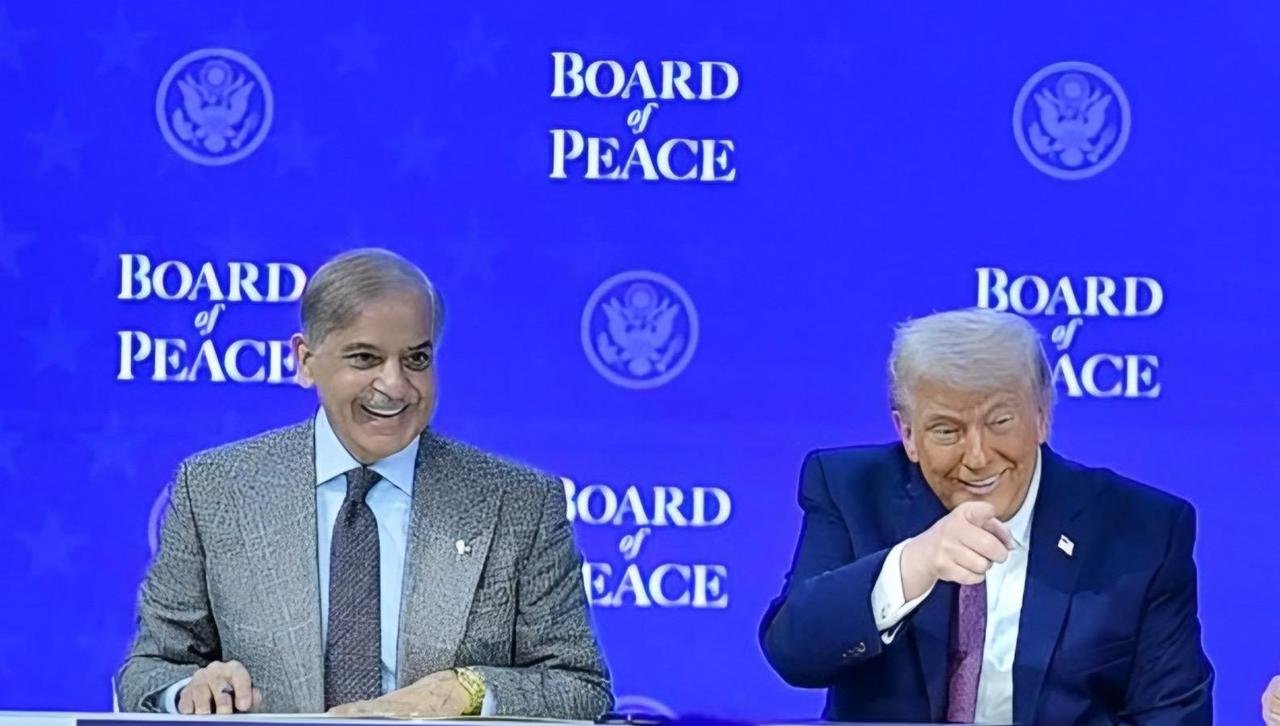
Recent debate surrounding Pakistan’s participation in the Board of Peace (BoP) has generated confusion, much of it driven by the deliberate conflation of diplomacy with military deployment. At the center of the controversy is a false equivalence: signing a multilateral political framework is being misrepresented as a commitment to deploy troops.
This claim does not withstand scrutiny.
BoP is not a military force
The Board of Peace is a political and diplomatic forum, not a military instrument. It exists to facilitate dialogue, coordination, and international consensus-building around post-conflict stabilization and humanitarian outcomes. Any International Security Force (ISF), if proposed in the future, would be an entirely separate construct requiring a distinct mandate, separate approvals, and explicit conditions.
To equate BoP participation with troop deployment reflects either a misunderstanding of multilateral processes or a conscious attempt to distort Pakistan’s position.
Read More: The first foreign minister to visit China in 2026 come from this country
Pakistan’s position on troop deployment is unambiguous
Pakistan’s stance is categorical: no Pakistani troops will be sent to Gaza under any ISF arrangement aimed at disarming Hamas. This position is not conditional, negotiable, or subject to reinterpretation. It reflects a consistent state policy rooted in sovereignty, constitutional process, and long-standing principles.
UN role remains central, not undermined
Claims that the BoP undermines the United Nations fail basic logic. Multilateral diplomacy has always functioned through multiple forums, while the UN remains the legal and institutional anchor of international order. Pakistan has neither advocated bypassing nor sidelining the UN. Its position remains clear: no replacement, no erosion, no parallel authority to the UN system.
Importantly, the Gaza Peace Plan and the Board of Peace framework carry formal international legal backing, having received approval in the United Nations Security Council with a 13–0 vote. This alone refutes claims that the initiative is ad hoc or unilateral.
Pakistan’s participation is principle-driven
Pakistan’s engagement in the BoP is guided by three non-negotiable priorities:
-
Unhindered humanitarian assistance to Palestinians, free from political coercion
-
Reconstruction guarantees that prevent renewed Israeli military aggression
-
Protection and safety of Palestinian civilians as a central pillar, not a secondary concern
These are substantive policy positions—not symbolic gestures or public relations exercises.
Continuity in Pakistan’s Palestine policy
Pakistan’s position on Palestine is neither new nor opportunistic. It is a consistent state policy: support for a contiguous, independent Palestinian state with Al-Quds Al-Sharif as its capital. This position has endured across governments and political cycles.
Arguments suggesting Pakistan should disengage simply because Israel is present in the same forum are strategically flawed. Israel is also present within the UN system; disengagement does not weaken occupation it only cedes space to others to define outcomes.
Presence is leverage, not endorsement
Diplomatic absence does not translate into moral clarity. If Pakistan vacates the forum, others will shape the narrative, design the framework, and present it as consensus—while Palestinians bear the consequences. Participation is not endorsement; participation is leverage.
Pakistan’s inclusion in the BoP also places it within a broad cross-regional coalition spanning Asia, the Middle East, Africa, and Latin America, countering claims that the initiative reflects a narrow Western agenda.
Financial contribution does not imply military alignment
The much-discussed $1 billion contribution is voluntary and does not obligate Pakistan to any military, operational, or political alignment. Financial participation does not equate to troop deployment, nor does it dictate policy positions.
A sovereign, constitutional decision
Finally, Pakistan’s participation in the Board of Peace is not freelancing. It is a sovereign decision of the Government of Pakistan, formally validated through the Prime Minister’s signature and consistent with constitutional processes. That is the lawful chain of authority. Everything beyond that is speculation—and noise.

 Today's E-Paper