
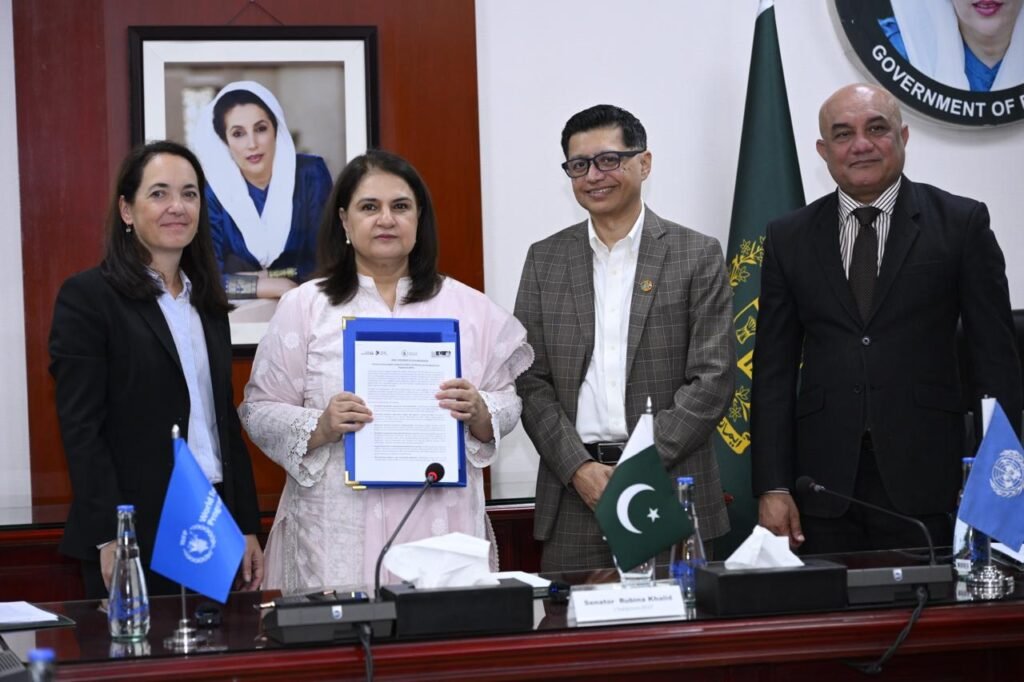
ISLAMABAD, October 19, 2026: The Benazir Income Support Programme (BISP), UN Women and the World Food Programme (WFP) have signed a joint agreement to strengthen women’s economic empowerment and improve social protection services for millions of beneficiaries across Pakistan.
The Joint Statement of Collaboration, signed on Monday, aims to expand the impact of BISP beyond financial assistance by connecting women with skills development, employment opportunities, entrepreneurship and financial inclusion.
The partnership will also focus on improving the safety, accessibility and quality of social protection services, particularly for women and vulnerable communities.
With more than 10 million women receiving quarterly financial assistance through the Benazir Kafaalat Programme, BISP provides an extensive platform for reaching women from low-income households.
The three organisations intend to use that network to help beneficiaries understand their rights, participate in household decisions and develop opportunities for long-term economic independence.
Rubina Khalid highlights women’s financial independence
BISP Chairperson Senator Rubina Khalid said the programme was committed to strengthening gender-responsive social protection and making its services more accessible to women and persons with disabilities.
“Our collaboration with UN Women and WFP will help ensure that social protection services are safe, accessible and responsive to the needs of women and vulnerable communities,” she said.
Rubina Khalid explained that the partnership would improve awareness of rights and entitlements, counselling services, maternal and child healthcare, and the quality of facilities at Benazir Nashonuma centres.
She said particular attention would be given to women’s skills development, entrepreneurship, livelihoods and access to financial and digital services.
The initiative would also address the safety of female frontline workers and encourage families to share responsibilities related to childcare and household wellbeing.
According to the BISP chairperson, stronger coordination among the three organisations would help expand economic opportunities and improve services for beneficiaries across Pakistan.
UN Women calls for social protection beyond cash assistance
UN Women Pakistan Country Representative Jamshed M. Kazi said social protection programmes could play a significant role in advancing gender equality when women’s needs and participation were incorporated into their design.
“Social protection is one of the most powerful tools a country has to advance gender equality, when it is designed with women and not only for them,” he said.
Kazi noted that Pakistan had established one of the world’s largest cash transfer programmes targeting women.
He said the collaboration aimed to build on that foundation by strengthening women’s participation in decision-making, improving their safety and expanding their economic choices.
The initiative would also engage men and families to encourage shared responsibilities and greater support for women’s empowerment.
WFP focuses on maternal health and nutrition services
WFP Representative and Country Director in Pakistan Anita Hirsch emphasised the relationship between women’s nutrition, health and their ability to make decisions for themselves and their families.
She said the Benazir Nashonuma Programme, jointly supported by WFP and BISP, already provided an important platform for assisting women and young children during critical stages of development.
The new partnership with UN Women would build on those efforts by improving services and addressing barriers that women face when seeking assistance.
Hirsch stressed that dignity, safety and accessibility should remain central to the delivery of maternal and child nutrition services.
Up to 12 Benazir Nashonuma centres to undergo assessment
Under the agreement, the three organisations will establish a Gender-Responsive Social Protection Working Group to coordinate planning, implementation and accountability.
A major component of the collaboration involves conducting gender assessments at up to 12 Benazir Nashonuma facilitation centres across Pakistan’s four provinces.
The assessments will examine privacy, safety, accessibility, dignity and service quality to identify areas requiring improvement.
A Gender-Responsive Centre Framework and Checklist will also be developed to guide improvements and support their possible expansion to other facilities.
The partnership will separately assess the working conditions of female Nashonuma frontline staff, focusing on workplace safety, protection from harassment, mobility challenges, workload and career development.
Partnership to connect BISP beneficiaries with skills and livelihoods
The agreement also seeks to create stronger links between social assistance and economic opportunities.
Women receiving BISP support will be connected with opportunities for vocational skills, livelihoods, entrepreneurship and financial and digital inclusion.
Awareness initiatives will help beneficiaries understand their entitlements and available public services, while family engagement activities will promote maternal nutrition and women’s participation in household decisions.
The organisations will also provide technical assistance to finalise BISP’s Gender Strategy, document the programme’s impact on women’s lives and explore resources for future empowerment initiatives.
The collaboration supports Pakistan’s commitments under the United Nations Sustainable Development Goals, particularly poverty reduction, zero hunger and gender equality.
It also aligns with the UN Sustainable Development Cooperation Framework for Pakistan.