

PESHAWAR: Benazir Income Support Programme Chairperson Senator Rubina Khalid has announced that BISP will introduce an interoperable digital payment system from its next payment cycle, allowing beneficiaries to withdraw their stipends from the nearest authorized banking agent or retailer anywhere in Pakistan.
The announcement came during her visit to the Benazir Nashonuma Facilitation Centre at Maulvi Ameer Shah Memorial Hospital in Peshawar, where she reviewed maternal and child health, nutrition and newborn care services.
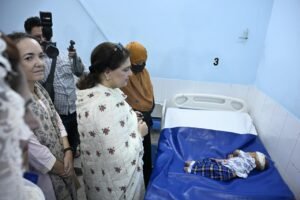
Senator Khalid was accompanied by World Food Programme Country Director Anita Hirsch. Officials briefed them on beneficiary registration, health monitoring, anthropometric assessments, compliance procedures, social and behavioural change communication and the distribution of specialized nutritious food supplements.
The BISP chairperson also met beneficiary women to hear their feedback and later visited the hospital’s Neonatal Stabilization Centre to assess facilities available for newborn infants.

Speaking to the media, Senator Khalid said the Benazir Nashonuma Programme is a key component of BISP and is designed to improve the health and nutritional status of pregnant women, breastfeeding mothers and children under the age of two.
She said BISP now serves more than 10 million deserving families across Pakistan and has developed into one of the country’s most trusted social protection institutions over the past 17 years.
Senator Khalid urged the media to verify complaints and negative reports with BISP before publication or broadcast, warning that unverified claims could damage the credibility of the institution and create confusion among beneficiaries.
She said the programme was moving towards a fully digital payment mechanism to reduce human intervention, improve transparency and ensure that women receive financial assistance securely and with dignity.
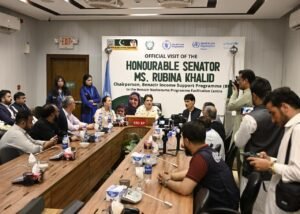
Under the new system, BISP beneficiaries will receive digital SIM cards free of cost through authorized BISP offices. The SIMs will be linked to Digital Social Protection Wallets, enabling beneficiaries to receive SMS alerts when quarterly stipends are credited and after withdrawals are made.
According to Senator Khalid, the system will allow women to independently monitor their balances and payment transactions, reducing the risk of unauthorized deductions and fraud.
She added that the planned interoperability feature would remove the restriction requiring beneficiaries to visit designated payment centres. Instead, women would be able to collect their stipends from authorized banking agents and retailers closer to their homes.
The BISP chairperson also warned against individuals using the programme’s name to defraud the public. She said complaint cells and monitoring mechanisms were already functioning and urged beneficiaries to report suspicious activity immediately.
Senator Khalid clarified that no individual or official has the authority to stop or restore a beneficiary’s financial assistance, as eligibility and payments are processed through a computerized system.
She advised beneficiaries not to trust unofficial claims, agents or individuals promising to influence BISP payments.
The new digital payment system is expected to improve access for women living in remote areas, reduce reliance on crowded payment centres and strengthen transparency in the distribution of government financial assistance.