
By Amna Ahsan
Artificial Intelligence (AI) is transforming every field of life. From healthcare to education, and now even defense. Today, militaries around the world are using Artificial Intelligence to improve decision-making, automate tasks, and strengthen national security.
However, just like any other technology, Artificial Intelligence in the military has both advantages and serious risks. In this paper, I will discuss the main benefits and risks of using AI in military systems, and share my own understanding of why careful control and ethical use are necessary.
To understand its impact better, let’s first look at the major benefits of using Artificial Intelligence in military applications.
Benefits of AI in military applications
1. Faster and Smarter Decision-Making
One of the biggest advantages of Artificial Intelligence in the military is speed. Systems based on Artificial Intelligence can process large amounts of data from satellites, drones, and radars much faster than humans.
This helps commanders make better decisions in less time. In other words, Artificial Intelligence allows militaries to respond in seconds rather than minutes, which can be the difference between success and failure in combat.
For example, the U.S. Department of Defense’s Project Maven uses Artificial Intelligence to analyze drone footage and identify objects such as vehicles or enemy movements automatically.
This reduces the burden on human analysts and helps in real-time decision-making. Similarly, AI-based early warning systems can instantly detect missile launches or unusual enemy movements, giving armies valuable reaction time.
2. Reducing Risk to Human Soldiers
Moreover, AI-powered robots and drones can be used for dangerous missions such as bomb disposal, battlefield surveillance, or supply delivery in war zones. This helps protect human lives by sending machines instead of soldiers into risky environments.
Countries like the U.S., Russia, and Israel are already testing autonomous vehicles for these types of operations.
3. Better Logistics and Maintenance
Military logistics is one of the most complex parts of defense operations. Artificial Intelligence also helps in managing military logistics.
For example, it can help in tracking supplies, predicting when a vehicle or aircraft will need maintenance, and avoiding breakdowns during missions. This predictive maintenance saves time, money, and increases the overall efficiency of military operations.
4. Stronger Cybersecurity and Intelligence
Artificial Intelligence tools can detect unusual network activities faster than traditional systems. This is extremely important for national security because cyberattacks are becoming more common.
Artificial Intelligence can also analyze intelligence reports, satellite images, and online activities to identify possible threats before they happen.
In 2023, several studies by NATO’s Cooperative Cyber Defence Centre of Excellence showed that Artificial Intelligence tools can reduce response time to cyber incidents by up to 70%.
This proves how powerful Artificial Intelligence can be in protecting military communication systems and sensitive data from hackers.
5. Training and Simulation
Apart from real-world combat, Artificial Intelligence can also improve military training through realistic simulations. Using virtual environments based on Artificial Intelligence, soldiers can practice real-world scenarios safely and repeatedly.
DARPA (Defense Advanced Research Projects Agency) in the U.S. has developed AI-driven simulation platforms that help pilots train against virtual enemy aircraft controlled by machine learning algorithms.
This allows military personnel to learn how to respond to unpredictable situations in combat, improving preparedness and performance without the risks of real warfare.
6. Coordination and Swarm Technology
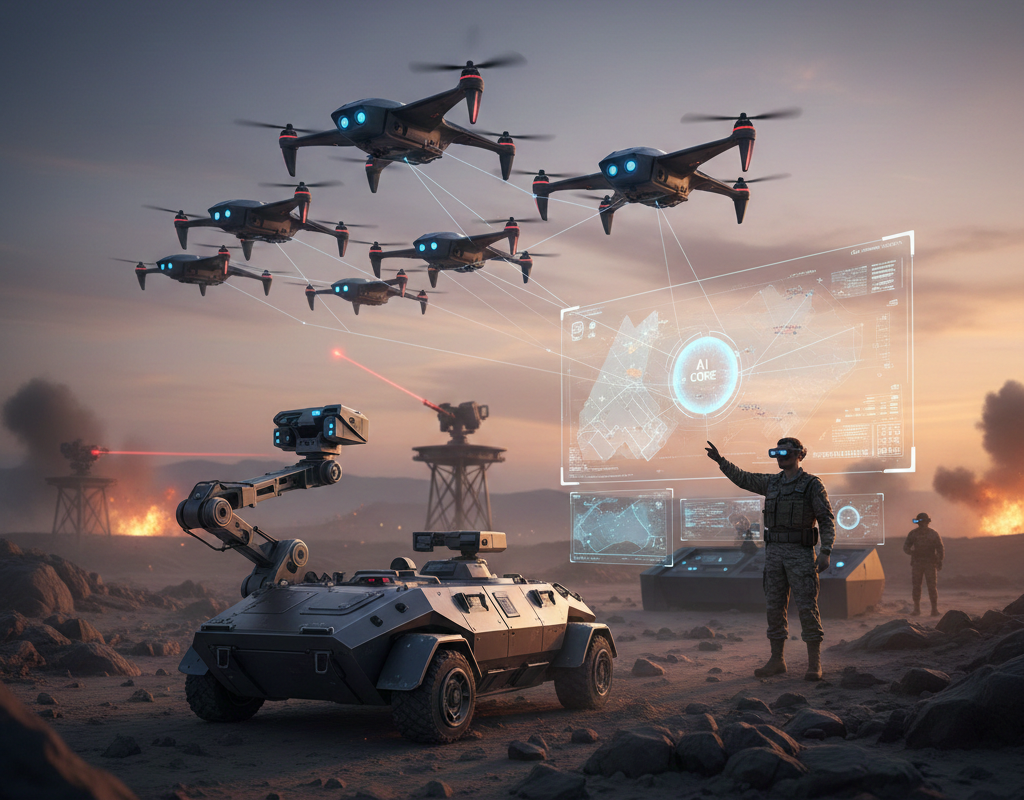
Finally, one of the most futuristic applications of Artificial Intelligence in the military is swarm technology. Artificial Intelligence can control swarms of drones that move and communicate like groups of birds or insects.
These drone swarms can perform surveillance, confuse enemy radars, or even attack targets in coordination.
Currently, China and the United States are both developing swarm drone technologies, which could change the entire nature of warfare by increasing speed, coordination, and adaptability during missions.
While these advantages are significant, it is important to consider the potential risks that come with military Artificial Intelligence.
References:
PEI- Genesis
Risks and challenges of Artificial Intelligence in military applications
1. Ethical and Legal Concerns
One of the biggest concerns with military Artificial Intelligence is ethics. Many experts fear that if machines are given full control to select and attack targets, it could lead to serious moral and legal issues.
Who will be responsible if a machine makes a wrong decision and kills innocent people? This question has made many countries call for international rules to limit the use of fully autonomous weapons.
2. Possibility of Accidents or Malfunctions
Artificial Intelligence systems are not perfect. They can make mistakes if the data used to train them is wrong or incomplete.
For example, a drone driven by Artificial Intelligence could misidentify a civilian vehicle as a target. A small technical error could lead to large-scale destruction.
Therefore, full human supervision is essential whenever Artificial Intelligence is used in defense operations.
In fact, studies show that during testing, these type of systems often misidentify targets due to lighting or environmental confusion.
Such mistakes can lead to accidental attacks and civilian casualties, which can damage a nation’s reputation and trigger political conflicts.
3. Risk of Cyber Manipulation
AI systems can be hacked or fooled by adversaries. If an enemy changes the data or tampers with the model, the entire defense system could behave incorrectly.
This could result in misinformation, false alarms, or even the self-destruction of military assets.
The Pentagon’s 2022 Cybersecurity Review warned that adversaries are increasingly trying to attack autonomous systems through hacking or misinformation.
4. Increasing Global Tension and Arms Race
Furthermore, as more countries develop weapons based on Artificial Intelligence technology, the global arms race is speeding up. Nations are competing to build smarter and faster weapons.
This competition could make wars more likely because powerful systems based on Aritficial Intelligence might make nations overconfident in their military strength.
5. Human Control and Accountability
Lastly, one of the most important concerns is maintaining human control and accountability.
Even if such systems perform well, removing human judgment completely from life-and-death decisions is dangerous.
Machines don’t have emotions or ethics, and they only follow patterns. This lack of empathy can lead to serious moral and humanitarian problems if not handled properly.
References:
HUMANATARIAN LAW AND POLICY
Recommendations
Considering both the benefits and risks, it is clear that AI’s use in military operations needs careful regulation.
In my opinion, Artificial Intelligence should be used in the military with strong human oversight and global ethical standards. It should support human officers, not replace them in critical decision-making.
Governments need to:
- Create strict policies for AI weapon testing and use.
- Ensure international cooperation to avoid arms race run by Artificial Intelligence.
- Maintain transparency and accountability in how AI systems make decisions.
- Train personnel to understand Artificial Intelligence’s strengths and limitations.
Countries should also invest in Artificial Intelligence safety research to make sure the systems are reliable and fair before deployment.
Final Words
In conclusion, Artificial Intelligence has the power to completely change modern warfare. Which makes it faster, smarter, and more efficient. It can save lives, reduce costs, and improve defense strategies.
However, if not used carefully, it can also create moral, legal, and security disasters. In my view, the goal should be to use Artificial Intelligence responsibly with strict human supervision, global cooperation, and strong ethical boundaries. Technology should make wars less likely, not more dangerous.
Read related news here: https://thepublicpurview.com/technews/
For more stories and insights, visit The Green Post





 Today's E-Paper