
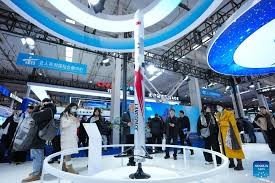
BEIJING: A commercial space exhibition held in Beijing has highlighted the rapid growth and rising global interest in China’s commercial space industry, as companies fielded strong demand for satellite products, launch services, and emerging space technologies.
The three-day expo brought together more than 300 commercial aerospace firms from across China, showcasing the full industrial chain—from launch vehicles and satellite manufacturing to space applications, supporting services, and investment. Industry representatives said discussions at the event focused largely on pricing, partnerships, and international cooperation, reflecting the sector’s increasing commercial maturity.
Representatives from GalaxySpace, a supplier involved in China’s satellite internet projects, said they received inquiries from companies and delegations from Kazakhstan, Thailand, Brazil, Pakistan, and Romania. Interest centered on cost-efficient satellite production methods and flexible solar wing technologies, according to company officials.
China’s commercial space sector has gained momentum following recent test flights of reusable rockets and the country’s application to the International Telecommunication Union for frequency and orbital resources for a large satellite constellation. These developments have fueled investment and intensified competition across the industry.
Well-known private rocket companies such as LandSpace and Galactic Energy drew large crowds, while smaller suppliers specializing in components such as bearings, hydraulics, and electronics also reported strong interest from potential clients. For many firms, cost efficiency and scalability were central themes of discussion.
At the expo, representatives from iSpace discussed different commercial strategies behind reusable and non-reusable rocket development, noting that companies balance payload capacity against long-term cost reductions. iSpace said it aims to conduct the first flight of its reusable Hyperbola-3 rocket later this year.
The exhibition also coincided with the launch of the “Rocket Street” industrial cluster in Beijing’s Yizhuang district, where several new service platforms were unveiled. These include shared testing facilities, measurement and control services, and space situational awareness capabilities intended to support commercial aerospace companies.
China’s space authorities have signaled continued support for the sector. Last year, the China National Space Administration announced plans to expand commercial access to national space infrastructure and encourage international cooperation over the next two years.
Other exhibitors highlighted advances beyond launch and satellites. CAS Space showcased a model of its suborbital vehicle, Lihong, which recently completed its maiden flight and carried out experiments including metal 3D printing in near-space conditions. Company officials said such platforms could accelerate research in areas such as space manufacturing and biomedicine.
Interest extended to future applications as well. Commercial spacecraft developer InterstellOr announced its first group of planned space tourists following recent system tests, reflecting growing attention to space tourism and human spaceflight services.
Organizers said the strong turnout and international interest at the expo reflected how China’s commercial space industry is moving from experimental stages toward broader market-driven development.





 Today's E-Paper