
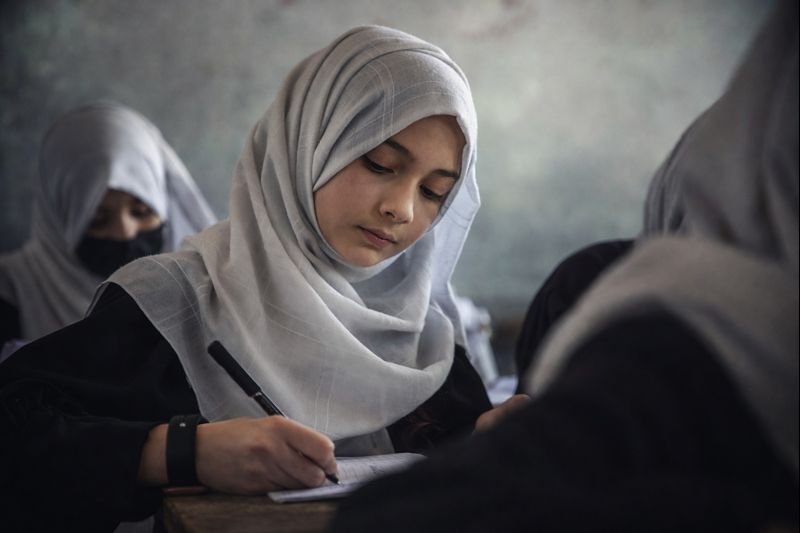
Kabul — A now-viral video of an Afghan girl crying over her inability to continue schooling has reignited international attention on the Taliban’s longstanding ban on girls’ education, nearly four and a half years after it was first imposed. The footage reflects broader frustrations and despair among millions of girls denied access to secondary and higher education under Afghanistan’s de facto authorities.
The clip, first widely shared during earlier waves of protest against restrictions on female university attendance, shows a young student expressing deep anguish about being confined at home with no access to education beyond primary school. That personal plea mirrors the plight of an estimated 2.2 million adolescent girls currently barred from secondary classrooms, according to a recent United Nations report.
Ban on Secondary and University Education
Since the Taliban’s return to power in 2021, education policies have progressively restricted girls’ academic opportunities. Secondary schools for girls have remained closed for more than 1,566 days and university education for women has similarly been suspended for over 1,100 days, leaving millions without institutional learning opportunities.
International agencies including UNICEF and UNESCO have repeatedly highlighted the scale and duration of these bans, noting that Afghanistan is the only country where such comprehensive restrictions on girls’ secondary and higher education persist. They warn that the continued exclusion jeopardises both personal futures and national development.
Human Toll Beyond the Numbers
Beyond statistics, the restrictions have deep social and psychological effects. Interviews and reports from students indicate increasing feelings of isolation, anxiety and a sense that time has stopped. Many former students describe uncertainty about their futures and diminished hope as the ban continues without clear timelines or pathways to resume education.
University lecturers and education specialists say the bans are eroding human capital and widening gender disparities in skills and professional prospects. “When women are excluded from universities year after year, the country loses female doctors, teachers and professionals,” one lecturer told local media.
Taliban Position and International Response
The Taliban leadership has defended its education policies as aligned with its interpretation of Islamic law and cultural norms, but has not provided a concrete roadmap or timeline for reopening secondary schools and universities to girls. Human rights advocates and many foreign governments have condemned the policies as discriminatory and harmful.
International pressure has included formal statements from United Nations missions in Kabul expressing “deep disappointment” over the ongoing ban and urging its reversal, while broader diplomatic engagement continues to link education access to humanitarian and development cooperation.
Long-Term Implications
Experts say the combined impact of prolonged education bans and societal restrictions paints a troubling picture for Afghanistan’s long-term recovery and resilience. Decades of progress in gender parity and literacy, achieved between 2001 and 2021, are at risk of being reversed without a concerted effort to restore girls’ access to all levels of education.


 Today's E-Paper