


Pakistan’s foreign policy has been in a state of evolution since its inception, initially based on principles of sovereignty, peaceful coexistence, adherence to the UN Charter, and solidarity with oppressed nations. In the current global system where multipolar powers, geopolitical tensions, and the climate crisis are intensifying, there is a need to address the debate in Pakistan on how to make strategic autonomy, economic diplomacy, and balanced regional relations the centerpiece of its policy.
Managing Regional Tensions and Global Recognition
A responsible resolution of tensions with India, in partnership with China, the US, the Muslim world and Central Asia, and a role in stabilizing Afghanistan will be a manifestation of Pakistan’s realistic and active diplomacy. The recent Pak-India tension is a blazing bonfire between two global powers. However, Pakistan’s appointment to the UN Counter-Terrorism Committee is proof that the international community is recognizing Pakistan as a responsible and peaceful state. Like Pahalgam, once again India wants to link the alleged and self-inflicted attack in Delhi, which it has been calling a cylinder blast, with Pakistan by making it a terrorist incident.
The past is a witness that India has been continuously propagating against Pakistan that it promotes terrorism, but a look into the mirror of facts has proven that India’s propaganda has failed and it has been proven that Pakistan is a peaceful country and wants peace in the region. In these circumstances, only a coherent, realistic and democratic foreign policy can lead Pakistan towards internal stability and global prestige.
Historical Roots of Pakistan’s Foreign Policy
The right to self-determination and solidarity with oppressed peoples, regardless of their religion, were central to the foreign policy of the founder of Pakistan. His continued support for Palestine, as well as his support for movements in countries such as Indonesia, Syria, Morocco, Burma and Ceylon, reflected his broader humanitarian spirit. He was also keen to establish brotherly ties with Islamic countries.
Pakistan’s first diplomatic delegation, led by Feroz Khan Noon, visited only Muslim countries such as Turkey, Syria, Lebanon and Jordan. (During the Cold War, Pakistan’s relations with Afghanistan and Iran were influenced by the regional situation and ideological differences. Pakistan supported the Afghan Mujahideen against the Soviet occupation, while its relations with Iran were based on partnership in the Western bloc and regional security cooperation. Despite ideological differences after the Iranian Revolution of 1979, Pakistan maintained relations with both countries to ensure strategic interests and peace and stability in the region.)
He wisely managed relations with neighboring countries through diplomacy, Another important pillar of your policy was peaceful coexistence with all neighboring countries, be it India, China or Burma, despite tensions with them, handled through mutual respect and cultural exchange. The leader’s neutrality, independence and commitment to ideological freedom during the bipolar era of the Cold War were evidence of his determination.
Contemporary Challenges Facing Pakistan’s Foreign Policy
Pakistan’s foreign policy today faces a number of complex challenges, due to the US-China rivalry, regional instability, and changing global alliances. On the other hand, the return of the Taliban in Afghanistan, border tensions with Iran, including cross-border smuggling, human movement, and illegal activities, and the complications arising from US support for the Palestinian issue, are making Pakistan’s diplomatic situation more difficult.
Given the current economic leverage and security threats, Pakistan’s foreign policy involves maintaining a balance with both China and the US, raising its voice for regional peace, defending national interests, and supporting oppressed nations like Palestine and Kashmir. At the same time, Pakistan has to promote strategic autonomy and multilateral diplomacy.
Global Implications of Pakistan’s Foreign Policy Decisions
Foreign policy affects global politics and the world economy – it is not only influenced by global conditions but also influences them, especially through institutions such as the United Nations, the Organization of Islamic Cooperation (OIC), NATO, and the EU – its economic implications are profound, foreign policy decisions can alter global markets, disrupt supply chains, and alter trade dynamics, as we saw during the Ukraine war and the COVID-19 pandemic.
Pakistan’s Foreign Policy Balancing Powers in a Multipolar World
In a rapidly changing (multipolar) world (when there is more than one powerful country), Pakistan’s foreign policy faces complex challenges such as balancing its relations with major global powers such as China, the United States and Russia, while also maintaining strategic ties with Islamic countries and regional tensions with India.
Historical alignments are changing and new geopolitical situations are emerging, in view of which Pakistan’s foreign policy has to manage issues such as the China-Pakistan Economic Corridor (CPEC), US interests in India, growing relations with Russia and sectarian conflicts in the Muslim world. Dependence on foreign aid and access to international institutions also complicates decisions. National interests and stability require a balanced, independent and realistic foreign policy that is based on neutrality, economic strength and regional cooperation.
Economic Diplomacy and the US-China Trade War
The ongoing trade war between the US and China has put Pakistan in a delicate economic, legal and diplomatic situation. China’s $65 billion investment under CPEC and its long-standing trade relations with the US have put Pakistan in a delicate balance where supporting one side could lead to costly legal consequences or sanctions.
Read more expert opinions here: https://thepublicpurview.com/category/blog/
For climate-related stories, visit: The Green Post



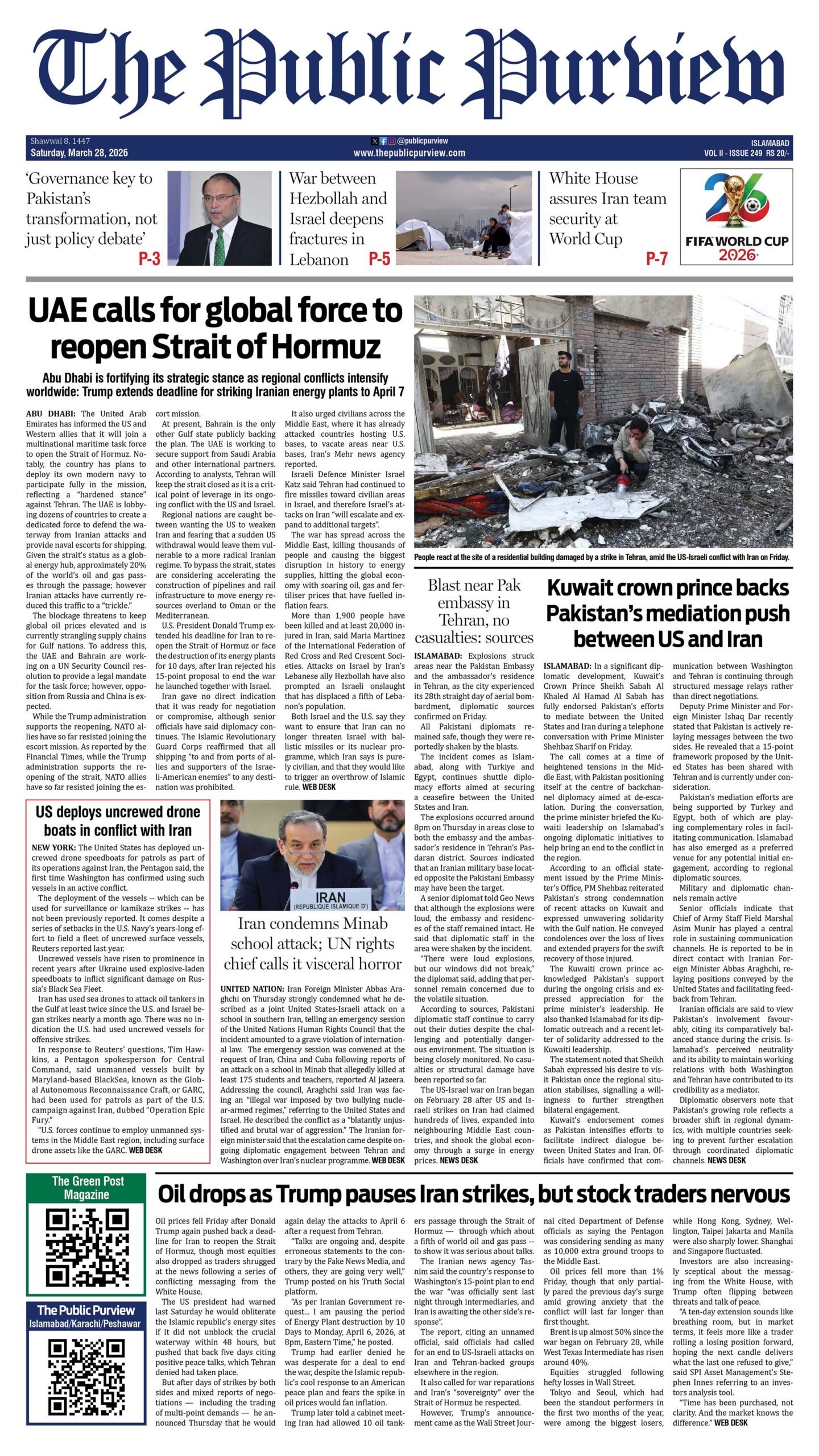 Today's E-Paper