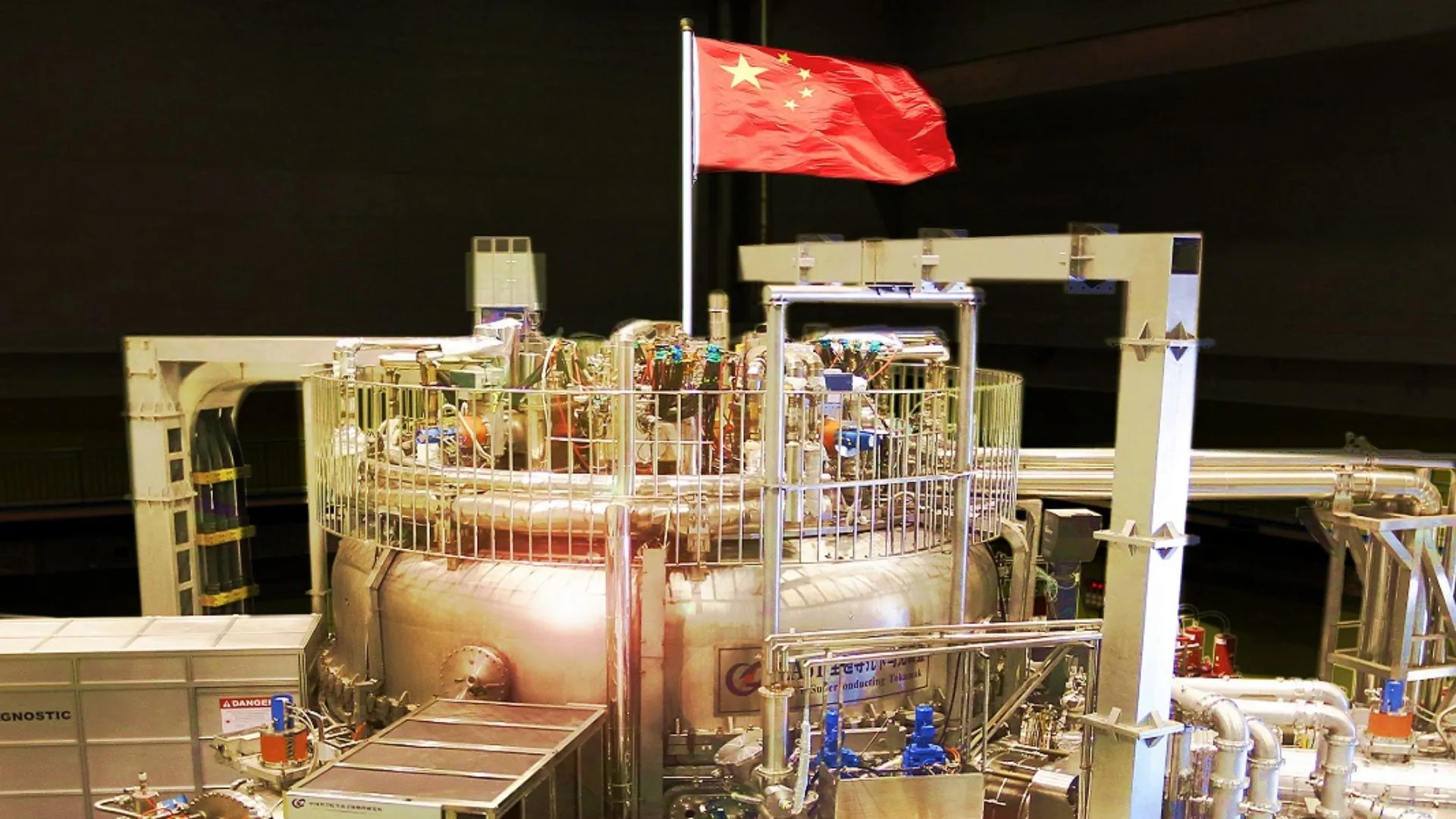
In a major advancement for nuclear fusion research, China’s Experimental Advanced Superconducting Tokamak (EAST), widely known as the “artificial sun,” achieved a new milestone in January 2025 by sustaining plasma for 1,066 seconds—nearly 18 minutes. This breakthrough marks a significant leap in the global pursuit of clean, sustainable energy and positions China at the forefront of fusion technology development.
Artificial sun pushes fusion boundaries
The EAST reactor, located in Hefei, is designed to replicate the energy-producing processes of the sun by fusing hydrogen atoms into helium at extremely high temperatures. In this latest experiment, the reactor maintained plasma at over 100 million degrees Celsius, a feat that scientists say is essential for future commercial fusion power plants.
Fusion energy differs from traditional nuclear power in that it merges atomic nuclei rather than splitting them. This process emits no greenhouse gases and produces minimal radioactive waste, making it a highly attractive alternative to fossil fuels and conventional nuclear energy. The EAST reactor uses a donut-shaped device called a tokamak, where powerful magnetic fields contain and circulate plasma in a ring formation.
From experimental success to energy revolution
While fusion energy remains in the experimental phase, the sustained reaction achieved by EAST (artificial sun) is a critical step toward commercial viability. The challenge lies in maintaining stable plasma loops for extended periods, which is necessary for continuous power generation. China’s success in this area offers a promising path forward for the international fusion community.
The EAST project is separate from ITER, the International Thermonuclear Experimental Reactor based in France, which is a collaborative initiative involving 35 countries. China is one of the seven core members of ITER, but its independent progress with EAST demonstrates its growing leadership in fusion innovation.
Fusion energy’s global implications
Since its launch in 2006, EAST (artificial sun) has undergone more than 150,000 tests, contributing to the development of other fusion research facilities across China. Scientists believe that fusion energy could eventually provide an unlimited supply of clean electricity, helping to address the global energy crisis and reduce dependence on fossil fuels.
Despite ideological debates surrounding nuclear technology, fusion’s safety profile and environmental benefits continue to attract support. Unlike fission-based reactors, fusion does not produce harmful byproducts or carry the same risk of catastrophic failure. As research advances, the artificial sun may become a cornerstone of future energy infrastructure.
Additional input from StarsInsider
Read related news here: https://thepublicpurview.com/category/world-news/china-insights/
For more stories and insights, visit The Green Post